

Toyota Camry Oil Capacity: Complete Guide by Engine and Model Year

Contents in this publication
- Quick Toyota Camry Oil Capacity Chart
- Why Toyota Camry Oil Capacity Varies
- 2018–2024 Toyota Camry Oil Capacity
- 2025 and Newer Toyota Camry Oil Capacity
- 2012–2017 Toyota Camry Oil Capacity
- 2007–2011 Toyota Camry Oil Capacity
- Older Toyota Camry Oil Capacities
- Oil Capacity With Filter vs Without Filter
- How to Find Your Exact Camry Engine
- How to Check Toyota Camry Oil Level Correctly
- Can You Add the Entire Listed Capacity at Once?
- What Happens if a Camry Is Overfilled With Oil?
- What Happens if the Engine Is Underfilled?
- Toyota Camry Oil Capacity and Oil Consumption
- How Often Should We Check Camry Oil?
- How Much Oil Should We Buy?
- Does Oil Brand Change the Capacity?
- Does Synthetic Oil Change the Required Amount?
- DIY Toyota Camry Oil Change Checklist
- Common Oil-Capacity Mistakes to Avoid
- Final Thoughts on Toyota Camry Oil Capacity
- Frequently Asked Questions
Knowing the correct Toyota Camry oil capacity sounds simple—until we discover that not every Camry takes the same amount.
A four-cylinder Camry does not necessarily hold the same quantity as a V6. A hybrid may use a slightly different refill amount from a conventional gasoline model, even when both vehicles have a 2.5-liter engine. The model year, engine code, oil-filter replacement, and draining method can all influence how much oil we actually need.
That is why pouring in a random five-quart container and calling the job finished is not the best approach.
For many modern Toyota Camry models, engine oil capacity falls between approximately 4.5 and 6.1 US quarts with a new filter. However, that range is only a starting point. The correct quantity must match the specific engine installed in the vehicle.
In this guide, we will examine common Camry oil capacities, explain why published figures sometimes differ, and walk through the safest way to refill the engine without underfilling or overfilling it.
Quick Toyota Camry Oil Capacity Chart
The following table covers the most common capacities found in recent North American Camry models. Figures represent an oil change that includes replacing the engine oil filter.
| Camry engine | Common model years | Approximate capacity with filter |
|---|---|---|
| 2.5L four-cylinder gasoline | 2018–2024 | 4.6 US quarts / 4.4 liters |
| 2.5L four-cylinder hybrid | 2018–2024 | 4.5 US quarts / 4.3 liters |
| 3.5L V6 gasoline | 2018–2024 | 6.1 US quarts / 5.8 liters |
| 2.5L hybrid | 2025 and newer | Around 4.5 US quarts; verify manual |
| 2.5L four-cylinder gasoline | 2012–2017 | Around 4.6 US quarts |
| 3.5L V6 gasoline | 2012–2017 | Around 6.4 US quarts |
| 2.4L four-cylinder gasoline | Selected older models | Roughly 4.0–4.5 US quarts |
Toyota dealership guidance commonly lists approximately 4.6 quarts for the 2018–2024 2.5-liter gasoline engine, 4.5 quarts for the hybrid, and 6.1 quarts for the 3.5-liter V6. Because specifications can vary by market and production configuration, the owner’s manual remains the final authority.
These numbers should not be treated like an invitation to dump the entire stated amount into the engine in one dramatic pour. Think of the listed capacity as a destination, not a launch button. We should add most of the oil, inspect the dipstick, run the engine briefly, and then make small corrections.
Why Toyota Camry Oil Capacity Varies
Several Camry generations may look similar from the outside while hiding very different engines beneath the hood.
The oil pan, filter housing, internal oil passages, cylinder count, and engine architecture determine the total capacity. A 3.5-liter V6 has more internal components to lubricate than a smaller four-cylinder engine, so it naturally requires more oil.
Capacity may also change because of:
- Engine redesigns
- Hybrid versus non-hybrid configurations
- Oil-pan dimensions
- Filter size
- Front-wheel-drive or all-wheel-drive packaging
- Regional specifications
- Whether the oil filter is changed
- How completely the old oil drains
Even two published sources can show slightly different figures for what appears to be the same car. One may provide the dry-fill capacity, while another gives the routine drain-and-refill quantity. One may round to the nearest tenth of a quart, while another converts from liters.
Engine Size Is Only Part of the Story
It is tempting to assume that every 2.5-liter Toyota engine has the same oil capacity. Unfortunately, engine displacement alone does not tell the whole story.
Toyota has used several 2.5-liter engine families in the Camry. These engines may differ in their oil pans, pumps, lubrication passages, compression cycles, and hybrid-system integration.
This is why we should identify the model year and engine—not merely the “2.5L” badge.
Hybrid Models May Have Their Own Specification
A Camry Hybrid still has a gasoline engine that needs engine oil. The hybrid battery and electric motor do not replace the lubrication system.
However, the hybrid engine may use a different operating cycle and a slightly different oil quantity than the regular gasoline version. For many 2018–2024 models, the difference is small: approximately 4.5 quarts for the hybrid compared with around 4.6 quarts for the conventional 2.5-liter engine.
Small difference, big consequence? Potentially. Precision matters because modern engines are designed with tighter tolerances than the relaxed mechanical giants of decades past.
2018–2024 Toyota Camry Oil Capacity
The eighth-generation Camry introduced a popular range of 2.5-liter four-cylinder, 2.5-liter hybrid, and 3.5-liter V6 powertrains.
These are among the most frequently searched Camry oil-capacity figures, partly because many owners now perform maintenance at home.
2.5L Four-Cylinder Gasoline Engine
Most 2018–2024 Camry models with the standard 2.5-liter four-cylinder engine require approximately:
- With filter: 4.6 US quarts
- Metric equivalent: Approximately 4.4 liters
- Common viscosity: 0W-16, depending on year and market
The 4.6-quart figure is not a command to add exactly 4.6 quarts without checking. A small amount of old oil may remain trapped in the engine, especially if the car is not level or the oil has not been allowed sufficient time to drain.
A sensible refill method is to begin with approximately 4.2 quarts, run the engine, wait, inspect the dipstick, and add the remaining oil gradually.
2.5L Camry Hybrid
Most 2018–2024 Camry Hybrid models require approximately:
- With filter: 4.5 US quarts
- Metric equivalent: Approximately 4.3 liters
- Common viscosity: 0W-16, subject to manual specification
The hybrid engine may operate less continuously than the engine in a regular gasoline Camry, but that does not mean oil maintenance matters less. Frequent engine starts, short operating cycles, temperature changes, and fuel dilution can still affect the lubricant.
3.5L V6 Engine
The 3.5-liter V6 found in models such as the Camry XSE V6 and XLE V6 generally requires approximately:
- With filter: 6.1 US quarts
- Metric equivalent: Approximately 5.8 liters
- Common viscosity: 0W-20, depending on the manual
The V6 holds considerably more oil than the four-cylinder engine. This is one reason we should never buy supplies based only on the word “Camry.”
A five-quart jug may be enough for a four-cylinder model, but it leaves a V6 noticeably short. For a V6 oil change, we normally need a larger combined supply, such as one five-quart container plus additional individual quarts.
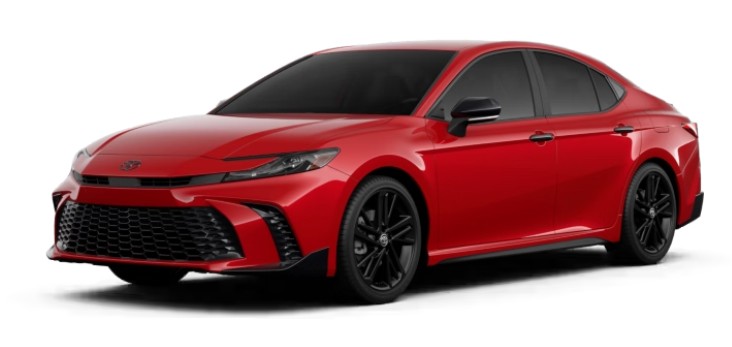
2025 and Newer Toyota Camry Oil Capacity
The 2025 Camry represents a significant change because the North American lineup became hybrid-focused. The familiar gasoline-only V6 and conventional four-cylinder choices were removed from that market’s new-model range.
The 2025 Camry uses a 2.5-liter hybrid powertrain, and owners should expect a refill amount in the neighborhood of 4.5 quarts, although the precise figure should be confirmed through the digital or printed owner’s manual for the specific vehicle.
Toyota’s official 2025 documentation directs owners to the manual for maintenance data and emphasizes routine oil-level inspection and scheduled oil-and-filter replacement.
What Oil Does a 2025 Camry Use?
Many 2025 US-market Camry models specify SAE 0W-8 oil. Toyota documentation and owner information may permit 0W-16 temporarily when 0W-8 is unavailable, with a return to the recommended viscosity at the next service.
This illustrates an important distinction:
- Oil capacity tells us how much oil the engine needs.
- Oil viscosity tells us how the oil flows at different temperatures.
- Oil specification tells us which performance standards the product must meet.
A correct quantity of the wrong oil is still the wrong oil.
2012–2017 Toyota Camry Oil Capacity
The 2012–2017 generation commonly came with a 2.5-liter four-cylinder engine, a 2.5-liter hybrid powertrain, or a 3.5-liter V6.
Typical drain-and-refill amounts include:
2.5L Four-Cylinder
The standard four-cylinder generally takes around:
- 4.6 US quarts with a filter
- Approximately 4.4 liters
Many models from this period specify SAE 0W-20. Toyota maintenance information for vehicles certified for 0W-20 has historically allowed longer normal-service intervals when the correct oil is used, while temporary substitute viscosities may require earlier replacement.
2.5L Hybrid
The hybrid version generally takes a quantity close to the regular 2.5-liter engine, often around:
- 4.5 to 4.6 US quarts with a filter
Because production specifications can differ slightly, we should verify the capacity using the manual associated with the exact model year.
3.5L V6
Many 2012–2017 V6 models require approximately:
- 6.4 US quarts with a filter
- Approximately 6.1 liters
The older V6 figure can differ from the approximately 6.1-quart capacity commonly quoted for the 2018–2024 V6. That difference is a perfect example of why selecting a capacity only by engine displacement can lead us astray.
2007–2011 Toyota Camry Oil Capacity
The 2007–2011 Camry generation is slightly more complicated because Toyota used different four-cylinder engines during the production run.
Depending on the year and market, we may encounter:
- A 2.4-liter four-cylinder
- A later 2.5-liter four-cylinder
- A 3.5-liter V6
- A hybrid powertrain
2.4L Four-Cylinder Models
Many 2.4-liter Camry models from this period hold around 4.5 quarts with a replacement filter, although certain references may show a figure closer to 4.3 quarts.
Engine repairs, replacement oil pans, aftermarket filters, and draining conditions can influence the final amount seen on the dipstick.
2.5L Four-Cylinder Models
Later models equipped with the 2.5-liter engine commonly require around 4.6 quarts with a filter.
3.5L V6 Models
The V6 typically requires a little over six quarts, often approximately 6.4 quarts with a filter.
With older vehicles, checking the dipstick is particularly important. Oil consumption, leaks, sludge history, and previous repairs may affect what we observe between services.
Older Toyota Camry Oil Capacities
Camry models built before 2007 used several engine families, including 2.2-liter four-cylinder, 2.4-liter four-cylinder, 3.0-liter V6, and 3.3-liter V6 configurations.
Their oil capacities commonly fall between roughly four and five quarts, but broad generation charts become less reliable as we move backward through the years.
Why? Older Camrys may have:
- Replacement engines
- Different engines across international markets
- Aftermarket oil pans
- Non-original filters
- Missing or replaced dipsticks
- Manual discrepancies caused by production changes
For an older Camry, we should search the manual using the exact year, market, trim, and engine code. The label under the hood or vehicle identification information can help confirm which engine is present.
Oil Capacity With Filter vs Without Filter
One of the most common sources of confusion is the phrase “with filter.”
The engine oil filter holds a small quantity of oil. When we replace it, that space must be filled after the engine starts and circulates fresh lubricant.
As a result, an oil change with a new filter normally requires slightly more oil than a drain-and-refill that leaves the old filter installed.
How Much Oil Does the Filter Hold?
The exact amount depends on filter design, but the difference is commonly around 0.2 to 0.4 quart.
We should normally replace the filter whenever we change the oil. Leaving a used filter in place is like pouring clean water into a dirty glass: technically possible, but hardly the clean start we intended.
Why the Dipstick Level Drops After Starting
After adding fresh oil, the dipstick may initially show a level close to full. Once we start the engine, oil moves through the filter and internal passages.
When the engine stops, the dipstick may then show a slightly lower reading. This is normal and is precisely why the final level should be checked after circulating the oil.
How to Find Your Exact Camry Engine
Before buying oil, confirm the engine installed in the car.
We can use several methods:
- Check the owner’s manual.
- Look at the emissions label beneath the hood.
- Review the vehicle identification label.
- Search the VIN through a Toyota dealer or trusted parts catalog.
- Inspect the engine-cover markings.
- Check the original sales documentation.
Do not rely entirely on the trim badge. Although certain trims were commonly paired with particular engines, options changed between years and markets.
Common Camry Engine Codes
Modern Camry owners may encounter engine codes such as:
- A25A-FKS: 2.5-liter gasoline four-cylinder
- A25A-FXS: 2.5-liter hybrid four-cylinder
- 2GR-FKS: 3.5-liter V6
- 2AR-FE: Older 2.5-liter gasoline four-cylinder
- 2AR-FXE: Older 2.5-liter hybrid engine
- 2AZ-FE: 2.4-liter four-cylinder
- 2GR-FE: Earlier 3.5-liter V6
The engine code is more useful than a vague description such as “Camry four-cylinder” because it identifies the actual engine family.
How to Check Toyota Camry Oil Level Correctly
Even the correct published capacity cannot replace a proper dipstick inspection.
For an accurate reading:
- Park the Camry on level ground.
- Bring the engine to operating temperature.
- Switch the engine off.
- Wait approximately five minutes for the oil to drain into the pan.
- Remove the dipstick.
- Wipe it clean with a lint-free cloth.
- Reinsert it fully.
- Remove it again and inspect both sides.
- Confirm that the level sits between the low and full marks.
If the oil is difficult to see, hold the dipstick under bright light and rotate it slowly. Fresh synthetic oil can be so transparent that it appears almost invisible.
Do Not Trust the First Dipstick Reading
Oil can smear along the dipstick tube, creating a false high reading. Check it at least twice.
The clearest, most consistent reading is the one we should trust.
Can You Add the Entire Listed Capacity at Once?
It is safer not to.
Suppose the manual lists 4.6 quarts. We might begin by adding approximately 4.1 or 4.2 quarts. Then:
- Reinstall the oil cap.
- Start the engine.
- Let it idle briefly.
- Check underneath for leaks.
- Shut it off.
- Wait several minutes.
- Inspect the dipstick.
- Add oil in small increments.
This controlled approach prevents accidental overfilling.
A bottle can always give us more oil. It cannot politely take the excess back.
What Happens if a Camry Is Overfilled With Oil?
A small amount above the full mark may not immediately destroy the engine, but significant overfilling should be corrected.
Too much oil can allow the crankshaft to whip through the lubricant, creating foam. Foamy oil contains air bubbles and may not maintain a stable protective film.
Possible consequences include:
- Increased crankcase pressure
- Oil leaks
- Seal damage
- Oil entering the intake system
- Catalytic-converter contamination
- Blue or gray exhaust smoke
- Rough running
- Reduced lubrication efficiency
If the level is clearly above the dipstick’s full mark, remove the excess through the drain plug or use an appropriate extraction pump.
Is Half a Quart Too Much?
Half a quart above the specified capacity is enough to justify checking carefully. The actual risk depends on the oil-pan design and where the level appears on the dipstick.
The dipstick matters more than the empty-container calculation.
What Happens if the Engine Is Underfilled?
Running below the minimum mark can be more immediately dangerous than a slight overfill.
Low oil reduces the engine’s lubrication reserve. During cornering, braking, acceleration, or steep climbs, the oil pickup may struggle to maintain consistent pressure.
Symptoms can include:
- Oil-pressure warning light
- Ticking or knocking noises
- Higher engine temperature
- Rough operation
- Accelerated timing-component wear
- Bearing damage
- Complete engine failure
Never assume that an oil warning light is simply a reminder. A red oil-pressure warning can indicate a serious lubrication problem. Stop the engine safely and investigate.
Toyota Camry Oil Capacity and Oil Consumption
Oil capacity is the total amount needed after service. Oil consumption is the amount the engine uses between services.
These are different concepts.
An engine may leave the shop filled correctly and still require a top-up months later. Some oil consumption is possible in any internal-combustion engine, especially at high mileage or under demanding conditions.
Consumption can increase because of:
- Worn piston rings
- Valve-seal wear
- External leaks
- Positive crankcase ventilation problems
- Long high-speed journeys
- High engine temperatures
- Incorrect viscosity
- Extended oil-change intervals
Toyota’s maintenance guidance encourages owners to inspect engine oil routinely rather than assuming the level will remain unchanged until the next service. The 2025 maintenance guide specifically recommends checking the level regularly, including approximately once per month.
How Often Should We Check Camry Oil?
A useful routine is to check:
- At least once per month
- Before a long road trip
- After an oil change
- After detecting a leak
- When the oil-pressure light appears
- After unusually hard driving
- More often on a high-mileage engine
Checking takes only a few minutes. Replacing an engine does not.
How Much Oil Should We Buy?
The amount purchased should slightly exceed the engine’s expected refill capacity.
For a 2.5L Four-Cylinder Camry
Buy:
- One five-quart container
This normally provides enough oil for the service and leaves a small quantity for future top-ups.
For a Camry Hybrid
Buy:
- One five-quart container
Again, this should cover the common 4.5-quart refill amount while providing a modest reserve.
For a 3.5L V6 Camry
Buy:
- One five-quart container
- Two additional one-quart bottles
This provides seven quarts in total. We will not normally use all seven, but the extra oil can be stored for later top-ups.
Keep remaining oil in its original sealed container, label it clearly, and protect it from dirt and moisture.
Does Oil Brand Change the Capacity?
No. The engine capacity does not change because we select a different brand.
What matters is whether the oil meets the viscosity and performance specification listed by Toyota.
Brand loyalty is optional. Correct specification is not.
A premium oil does not give us permission to overfill the engine, extend intervals indefinitely, or ignore a falling oil level.
Does Synthetic Oil Change the Required Amount?
Synthetic oil does not alter the engine’s physical capacity.
If the engine requires 4.6 quarts, it still needs roughly 4.6 quarts whether the product is conventional, synthetic blend, or full synthetic—assuming each product is approved for the application.
Modern Camrys generally call for low-viscosity synthetic oils such as 0W-16, 0W-20, or, in newer applications, 0W-8.
The owner’s manual and oil-filler cap should guide the selection.
DIY Toyota Camry Oil Change Checklist
Before beginning, gather:
- Correct engine oil
- Replacement oil filter or filter element
- New drain-plug washer
- Drain pan
- Correct socket and ratchet
- Filter wrench or housing tool
- Funnel
- Torque wrench
- Gloves
- Safety glasses
- Wheel ramps or jack stands if required
- Shop towels
Never work beneath a vehicle supported only by a jack. Use stable ramps or properly positioned jack stands on firm, level ground.
Basic Refill Procedure
After draining the old oil and replacing the filter:
- Install a new drain-plug gasket.
- Tighten the plug to the correct specification.
- Install the filter correctly.
- Add slightly less than the listed capacity.
- Refit the oil cap.
- Start the engine.
- Watch for warning lights.
- Inspect the drain plug and filter for leaks.
- Shut the engine off.
- Wait several minutes.
- Check the dipstick.
- Add small amounts until the level is correct.
- Reset the maintenance reminder if appropriate.
The final dipstick reading is the quiet referee that settles the match.
Common Oil-Capacity Mistakes to Avoid
Using a Generic Internet Figure
A capacity that fits a 2022 four-cylinder may not fit a 2016 V6.
Confusing Quarts and Liters
One US quart equals approximately 0.946 liter. Four liters is not the same as four US quarts.
Reading Imperial Quarts as US Quarts
Some international manuals show imperial quarts. An imperial quart is larger than a US quart.
Ignoring the Filter Difference
A refill without filter replacement may require slightly less oil.
Checking on a Slope
A tilted vehicle produces a misleading dipstick reading.
Overtightening the Filter Housing
Some Camry engines use a cartridge-style filter housing. Excessive force can damage the housing, cap, or threads.
Forgetting the Drain-Plug Washer
Reusing a flattened washer can create a slow leak that resembles an engine-oil-consumption problem.
Final Thoughts on Toyota Camry Oil Capacity
The correct Toyota Camry oil capacity depends on the model year, engine, market, and whether the filter is replaced.
For a practical summary:
- Most 2018–2024 2.5L gasoline Camrys take about 4.6 quarts with a filter.
- Most 2018–2024 Camry Hybrids take about 4.5 quarts with a filter.
- Most 2018–2024 V6 Camrys take about 6.1 quarts with a filter.
- Many 2012–2017 V6 models take closer to 6.4 quarts.
- Newer hybrid-only Camrys generally remain near the 4.5-quart range, but their viscosity requirements may differ.
The smartest method is beautifully simple: identify the engine, consult the correct manual, add slightly less than the published quantity, circulate the oil, and finish according to the dipstick.
Oil capacity is not merely a number printed in a manual. It is the engine’s working supply of protection—the thin, flowing shield standing between thousands of moving parts and a very expensive repair bill.
Frequently Asked Questions
1. How many quarts of oil does a Toyota Camry take?
Most Toyota Camrys take between approximately 4.5 and 6.4 US quarts with a new filter. Modern 2.5-liter four-cylinder models commonly take around 4.6 quarts, hybrids around 4.5 quarts, and V6 models approximately 6.1 quarts.
2. Does a five-quart container hold enough oil for a Camry?
A five-quart container is normally enough for a four-cylinder or hybrid Camry. It is usually not enough for a V6 Camry, which may require more than six quarts.
3. Should I check Camry oil when the engine is hot or cold?
Toyota commonly recommends checking after the engine has reached operating temperature and has been switched off for several minutes. The car must be parked on level ground. Following the procedure in the model-specific manual provides the most reliable result.
4. What happens if I put six quarts into a four-cylinder Camry?
Six quarts would significantly overfill most four-cylinder Camry engines. Do not start or continue driving the vehicle until the level is checked and the excess oil is removed.
5. Why does my Camry take less oil than the manual lists?
Some old oil may remain inside the engine, the car may not have been level, the filter may not have been replaced, or the oil may not have drained completely. Add oil gradually and use the dipstick rather than forcing the entire listed amount into the engine.
If you want to see other articles similar to Toyota Camry Oil Capacity: Complete Guide by Engine and Model Year you can visit the Compare category.
Ford Bronco Pros and Cons: Complete Buyer’s Guide
2026 Ford Bronco Towing: Capacity, Equipment, and Real-World Limits
Ford Bronco Gas Tank Size: 2026 U.S. Guide
2026 Ford Bronco Big Bend vs Outer Banks: Features and Differences Explained
2026 Ford Bronco Trim Levels in Order: Complete U.S. Guide
Ford Bronco Models Explained for U.S. Buyers
Leave a Reply
Related Topics