

Toyota Camry vs Lexus ES 350: Which Sedan Makes More Sense?

Contents in this publication
- Toyota Camry vs Lexus ES 350 at a Glance
- The Family Connection Between Camry and ES
- Exterior Design: Sensible Style or Premium Presence?
- Engine and Performance Comparison
- Fuel Economy: The Camry’s Knockout Punch
- Ride Comfort and Highway Refinement
- Interior Quality and Materials
- Passenger Space and Practicality
- Technology and Infotainment
- Safety and Driver-Assistance Features
- All-Wheel Drive and Winter Driving
- Reliability and Long-Term Durability
- Maintenance and Ownership Costs
- Pricing and Value
- New Camry or Used Lexus ES 350?
- Resale Value and Depreciation
- Which Car Is Better for Commuting?
- Which Car Is Better for Road Trips?
- Which Car Is More Fun to Drive?
- Toyota Camry vs Lexus ES 350: Advantages and Disadvantages
- Who Should Buy the Toyota Camry?
- Who Should Buy the Lexus ES 350?
- Toyota Camry vs Lexus ES 350: Which One Should We Buy?
- Final Verdict
- Frequently Asked Questions
The Toyota Camry vs Lexus ES 350 comparison looks simple at first. One is a practical midsize sedan known for efficiency and value. The other is a premium luxury sedan with more power, richer materials, and a prestigious badge.
Yet these cars are closer relatives than strangers.
Toyota owns Lexus, and both sedans have historically shared elements of the company’s GA-K vehicle architecture. They also follow a similar philosophy: comfortable road manners, dependable engineering, spacious cabins, and fewer ownership headaches than many European alternatives.
Still, choosing between them is not as easy as asking whether we want “regular” or “luxury.” The modern Camry has become more refined, stylish, and technologically advanced, while the ES 350 can cost substantially more without transforming into a dramatically sportier car.
There is also an important model-year detail. The traditional gasoline-powered Lexus ES 350 was discontinued for the redesigned 2026 ES lineup. Lexus now offers the ES as the hybrid ES 350h and electric ES 350e and ES 500e. Therefore, this comparison primarily examines the 2025 Lexus ES 350 V6 against the 2026 Toyota Camry Hybrid, the most relevant versions for shoppers comparing a new Camry with a recent or remaining-inventory ES 350.
So, does the Lexus justify its premium? Or has the latest Camry become so polished that paying extra begins to feel like buying an expensive frame for an already excellent picture?
Let’s find out.
Toyota Camry vs Lexus ES 350 at a Glance
Here is the central difference:
| Category | Toyota Camry | Lexus ES 350 |
|---|---|---|
| Main character | Efficient, practical midsize sedan | Comfortable entry-luxury sedan |
| Powertrain | 2.5-liter hybrid system | 3.5-liter naturally aspirated V6 |
| Horsepower | 225 hp FWD or 232 hp AWD | 302 hp |
| Drivetrain | Front-wheel drive or AWD | Front-wheel drive |
| Transmission | Electronically controlled CVT | Eight-speed automatic |
| Best fuel economy | Up to 51 mpg combined | About 25 mpg combined |
| Driving personality | Smooth, efficient, composed | Quiet, effortless, more powerful |
| Cabin quality | Modern and well equipped | Richer, quieter, more luxurious |
| Ownership costs | Lower | Higher |
| Best for | Value-conscious daily drivers | Comfort-focused luxury shoppers |
The 2026 Camry uses an all-hybrid lineup, producing 225 horsepower with front-wheel drive or up to 232 horsepower with available electronic all-wheel drive. Its most efficient configuration reaches an EPA-estimated 51 mpg combined.
The 2025 Lexus ES 350 uses a 3.5-liter V6 generating 302 horsepower and 267 pound-feet of torque. It sends power through an eight-speed automatic transmission and returns an EPA-estimated 22 mpg city, 32 mpg highway, and 25 mpg combined.
Those numbers immediately reveal the personality of each car. The Camry saves fuel like it is guarding a family secret. The ES 350 burns more gasoline but responds with the smooth strength of a larger engine.
The Family Connection Between Camry and ES
Are the Toyota Camry and Lexus ES 350 Basically the Same Car?
No, but we can understand why people ask.
The Camry and Lexus ES have both used variations of Toyota’s front-wheel-drive midsize architecture. They may share broad engineering philosophies, manufacturing expertise, and certain underlying technologies, but the Lexus is not merely a Camry wearing leather shoes.
The ES receives substantial changes in areas that affect refinement:
- More extensive sound insulation
- Higher-grade upholstery and trim
- Different suspension tuning
- More sophisticated seat designs
- A stronger emphasis on isolation
- Lexus-specific exterior and interior styling
- A premium dealership and ownership experience
Think of the relationship like two houses built by the same respected contractor. The foundation may follow familiar principles, but one house receives standard finishes while the other gets thicker windows, softer carpeting, upgraded lighting, and a quieter neighborhood.
That depends on what we expect from a luxury vehicle.
Some shoppers want a luxury car to feel exotic, rear-wheel-driven, and dramatically different from anything sold by a mainstream brand. For them, the ES 350 may appear too closely connected to Toyota’s sensible family sedans.
Other shoppers see shared engineering as an advantage. Toyota’s reputation for durability and conservative mechanical design gives the Lexus a reassuring foundation. Instead of paying for complexity, we are largely paying for comfort, materials, quietness, and service.
The ES has never tried to be a rebellious sports sedan. It is closer to a peaceful private lounge on wheels.
Toyota Camry Styling
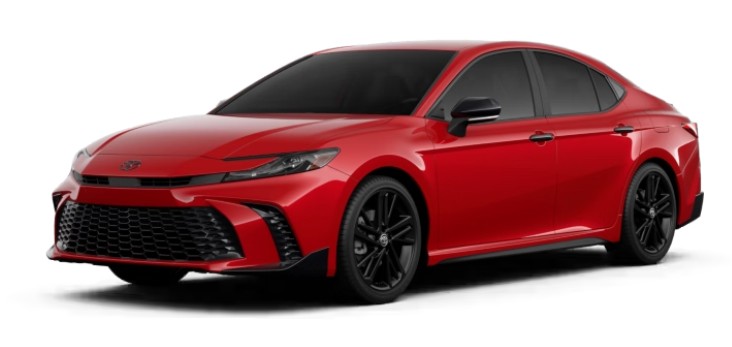
The latest Camry is far more expressive than older models. Toyota has moved away from the anonymous, appliance-like appearance that once defined the nameplate.
Its front end is lower and sharper. The body lines create more visual movement, while sport-oriented trims add larger wheels, contrasting details, and more aggressive lower-body styling.
The Camry now looks confident rather than merely responsible.
LE and XLE models lean toward elegance. SE, Nightshade, and XSE versions bring a more athletic character. Buyers can choose between a subtle business-casual appearance and something closer to weekend sportswear.
Lexus ES 350 Styling
The ES 350 has a longer, wider, and more formal visual presence. Its dramatic grille, slim lighting elements, flowing roofline, and carefully sculpted surfaces make it look more expensive.
It does not shout like some German performance sedans, but it carries itself with greater ceremony than the Camry.
Park both cars outside a hotel, and the Lexus is more likely to be mistaken for an executive vehicle. The Camry looks modern and attractive, while the ES looks deliberately upscale.
Which Sedan Looks Better?
Design is subjective, but the Lexus generally wins for premium road presence.
The Camry may appeal more to drivers who prefer a cleaner, sportier, or less formal design. It also attracts less attention, which can be useful for owners who want to blend into traffic.
The ES 350 is the better choice when we want the vehicle itself to communicate that we purchased something above the mainstream class.
Engine and Performance Comparison
Camry Hybrid Power
Every 2026 Camry combines a 2.5-liter four-cylinder gasoline engine with an electric motor system.
Front-wheel-drive models produce 225 combined horsepower, while all-wheel-drive models reach 232 horsepower. The electric motors provide immediate low-speed response, so the Camry rarely feels as slow as its numbers might suggest.
Acceleration is smooth rather than dramatic. Around town, the hybrid system feels alert and effortless. At highway speeds, it has enough strength for merging and passing, although hard acceleration can make the engine sound busy.
This is not a performance sedan. It is an efficiency-focused car with enough muscle to avoid feeling underpowered.
Lexus ES 350 V6 Power
The ES 350’s naturally aspirated 3.5-liter V6 produces 302 horsepower and 267 pound-feet of torque.
The engine changes the character of the car.
Press the accelerator, and the Lexus responds with a smooth, progressive surge. There is no turbocharger waiting to wake up and no hybrid system balancing gasoline and electric power. The V6 simply builds speed with quiet confidence.
It feels more relaxed during highway passing and more substantial when accelerating up a steep grade. The eight-speed automatic also gives the ES a more traditional driving sensation than the Camry’s continuously variable transmission.
Which Car Is Faster?
The Lexus ES 350 is clearly faster.
Its 77-horsepower advantage over the front-wheel-drive Camry becomes noticeable during full-throttle acceleration. The ES feels especially stronger above city speeds, where the V6 has room to stretch.
However, raw acceleration does not tell the entire story.
In urban driving, the Camry’s electric assistance provides responsive initial movement. It can slip away from traffic lights smoothly without revving the gasoline engine aggressively. For normal commuting, many drivers will find it perfectly adequate.
The Lexus wins the performance category, but the difference matters most to drivers who frequently use the extra power.
Fuel Economy: The Camry’s Knockout Punch
Fuel economy is one of the largest differences in the Toyota Camry vs Lexus ES 350 debate.
The 2026 Camry LE can achieve an EPA-estimated 53 mpg city, 50 mpg highway, and 51 mpg combined. Other trims may return lower figures because of larger wheels, performance-oriented tires, additional equipment, or all-wheel drive.
The 2025 ES 350 is rated at approximately:
- 22 mpg city
- 32 mpg highway
- 25 mpg combined
That means the most efficient Camry can travel roughly twice as far on a gallon of fuel in combined driving.
Real-World Fuel-Cost Difference
Suppose we drive 12,000 miles per year.
At 51 mpg, the Camry would use approximately 235 gallons.
At 25 mpg, the Lexus would use approximately 480 gallons.
The Lexus could consume around 245 additional gallons annually. Multiply that difference by local gasoline prices, and the Camry may save hundreds of dollars every year.
Over five years, the fuel savings become substantial.
Does the Lexus ES 350 Require Premium Gas?
Fuel recommendations can vary by model year and market, so owners should always follow the fuel-door label and manual for their specific vehicle. The ES 350’s operating costs remain higher regardless because its V6 uses considerably more fuel.
The Camry’s advantage is not subtle. It is the financial equivalent of turning off a dripping faucet that has been quietly wasting money every day.
Ride Comfort and Highway Refinement
How the Camry Rides
The Camry delivers a composed, controlled ride. Toyota has tuned it to feel more responsive than older generations without making it harsh.
LE and XLE trims generally provide the softest experience. Models with larger wheels and sportier suspension tuning can transmit more road texture into the cabin.
On ordinary streets, the Camry absorbs bumps well. On rough pavement, however, we may hear and feel more of the road than we would in the Lexus.
How the ES 350 Rides
Comfort is where the Lexus begins to justify its price.
The ES 350 isolates passengers from broken pavement, tire noise, wind, and mechanical vibration more effectively. Its suspension smooths out imperfections instead of announcing them.
The difference becomes clearer on long highway journeys. After several hours, reduced noise and vibration can leave passengers feeling less tired.
The Lexus is not floating like an old American luxury sedan. It still feels controlled and stable. Yet its movements are polished, as if the road has been ironed before the tires reach it.
Sporty Versions Change the Equation
The Camry XSE and Lexus ES 350 F Sport variants adopt sportier styling and firmer tuning.
Still, neither becomes a true sports sedan.
The Camry feels lighter and somewhat more eager to change direction. The ES 350 F Sport Handling adds adaptive suspension and stronger visual drama, but the vehicle’s basic personality remains comfort-first.
Drivers seeking sharp steering, rear-wheel-drive balance, and playful cornering may prefer something like a BMW 3 Series, Genesis G70, or Lexus IS.
Interior Quality and Materials
Inside the Toyota Camry
The latest Camry cabin is modern, clean, and thoughtfully arranged.
Depending on trim, available features include:
- Large central touchscreen
- Digital instrument display
- Heated and ventilated front seats
- Leather-trimmed upholstery
- Wireless phone connectivity
- Wireless charging
- Dual-zone automatic climate control
- Premium audio
- Panoramic glass roof
The controls are generally easy to understand, and storage spaces are practical.
Higher trims look expensive enough that passengers may question whether we really need to upgrade to a luxury brand. Still, some harder plastics remain, particularly in lower areas of the cabin.
Inside the Lexus ES 350
The ES 350 cabin feels more carefully finished.
Materials are softer, switchgear feels richer, the seats are more substantial, and decorative trim is used more convincingly. The Lexus also creates a stronger sense of separation from outside traffic.
Luxury and Ultra Luxury trims may include upgraded leather, power-adjustable seating, additional driver-assistance features, premium audio, a head-up display, a power rear sunshade, and other comfort-focused equipment.
The difference is not merely what we see. It is what we touch and hear.
A button clicks more softly. A door closes with greater weight. Seat padding supports the body differently. These small details gather like individual notes in a song, eventually producing a more polished experience.
Passenger Space and Practicality
Both sedans provide seating for five adults, although four passengers will be more comfortable on long trips.
Front-Seat Comfort
The Camry offers supportive front seats and a natural driving position. Visibility is good, and most drivers should find a comfortable arrangement.
The ES 350 goes further with broader cushioning, more refined seat materials, and available additional adjustments. Its seats are particularly appealing for long-distance drivers or anyone who values a softer seating surface.
Rear-Seat Experience
The Lexus provides the more luxurious rear compartment.
Rear passengers benefit from better isolation, softer materials, and an atmosphere that feels closer to chauffeured transportation. Depending on trim and equipment, the ES may also offer extra convenience features for rear occupants.
The Camry’s rear seat remains spacious enough for family use, airport trips, and daily commuting. It simply feels functional rather than indulgent.
Trunk Space
Both cars offer useful sedan trunks, but neither has the vertical cargo flexibility of an SUV or hatchback.
The Camry is well suited to groceries, luggage, and routine family needs. The ES provides a similarly usable cargo area, although individual model-year specifications and hybrid battery placement can influence exact capacity.
For bulky equipment, a crossover will remain more practical. For suitcases and shopping bags, either sedan works well.
Technology and Infotainment
Camry Technology
The 2026 Camry benefits from Toyota’s modern infotainment system, with available large-screen displays, wireless smartphone integration, cloud-based navigation services, and voice controls.
The interface is relatively straightforward. Menus are cleaner than older Toyota systems, and physical controls remain available for important functions.
That matters. A touchscreen should make driving easier, not turn changing the temperature into a puzzle game.
Lexus Technology
The 2025 ES uses the Lexus Interface system rather than the older touchpad-based setup found in earlier ES models.
It offers a large touchscreen, smartphone integration, voice assistance, connected services, and available premium Mark Levinson audio.
The Lexus system feels more upscale, but the basic user experience is not worlds apart from Toyota’s. This is another area where the Camry has narrowed the gap.
Which Infotainment System Is Better?
The Lexus offers a more premium presentation and available high-end audio. The Camry provides most of the everyday functionality at a lower cost.
For navigation, music, phone calls, and podcasts, both perform the essential tasks well.
Safety and Driver-Assistance Features
Toyota and Lexus equip these sedans with comprehensive safety technology.
Commonly available or standard functions include:
- Automatic emergency braking
- Pedestrian detection
- Adaptive cruise control
- Lane-departure alert
- Lane-centering assistance
- Automatic high beams
- Road-sign recognition
- Blind-spot monitoring
- Rear cross-traffic alert
Feature availability can depend on trim and model year, so buyers should inspect the equipment list of the exact vehicle under consideration.
Camry Safety Advantage
The newest Camry benefits from a recent generation of Toyota Safety Sense technology. Many assistance features come standard, making advanced safety accessible without moving far up the trim ladder.
Lexus Safety Advantage
The Lexus packages similar technology within a quieter and more refined driving environment. Higher trims may add parking assistance, panoramic-view cameras, or other convenience systems.
Neither car should be chosen solely because of the badge. The exact trim specification matters more.
All-Wheel Drive and Winter Driving
The 2026 Camry offers electronic on-demand all-wheel drive across its lineup. Toyota’s system uses an electric motor to provide assistance at the rear wheels when additional traction is needed.
The 2025 ES 350 is front-wheel drive only. Buyers wanting all-wheel drive in the previous ES generation had to consider the less powerful ES 250 AWD.
This gives the Camry a meaningful advantage for drivers living in snowy regions.
However, all-wheel drive is not magic. Quality winter tires usually make a greater difference in braking and cornering than drivetrain configuration alone.
Which Is Better in Snow?
With comparable winter tires, the Camry AWD provides better acceleration traction on slippery roads.
The ES 350 remains competent in moderate winter conditions because its engine sits over the driven front wheels, but it cannot send power to the rear axle.
Reliability and Long-Term Durability
Toyota and Lexus are both associated with strong long-term reliability, though no vehicle is immune to problems.
Camry Reliability Outlook
The Camry’s hybrid system builds on technology Toyota has refined over decades. Hybrid battery durability is generally strong, and regenerative braking can reduce wear on conventional brake components.
The vehicle also avoids several increasingly common complexity points:
- No turbocharger
- No dual-clutch transmission
- No traditional geared automatic transmission
- No high-output performance engine
That does not guarantee perfect ownership, but mechanical simplicity often supports predictable long-term costs.
ES 350 Reliability Outlook
The Lexus V6 and eight-speed automatic are mature technologies. The naturally aspirated engine avoids turbocharger-related heat and pressure, while the ES has historically emphasized proven engineering over experimental features.
The Lexus may remain reliable for many years, but luxury equipment can introduce additional repair costs as the car ages. Power accessories, premium lighting, larger wheels, advanced seat functions, and specialized trim pieces can be more expensive to replace.
Which Car Is Likely to Last Longer?
Both can deliver excellent longevity with proper maintenance.
The Camry may be cheaper to keep operating at high mileage. The Lexus may age more gracefully inside because of its upgraded materials, but restoring luxury components can cost more when something eventually fails.
Maintenance history matters more than the logo, especially when purchasing a used ES 350.
Maintenance and Ownership Costs
Toyota Camry Costs
The Camry usually costs less to maintain because:
- Toyota labor rates may be lower
- Parts are widely available
- Tires can be less expensive
- Fuel consumption is dramatically lower
- Insurance may cost less
- Routine service is generally straightforward
Even fully equipped trims retain the economic advantages of a mainstream sedan.
Lexus ES 350 Costs
The ES 350 is relatively sensible by luxury-car standards, but it is still a luxury vehicle.
Potential additional costs include:
- Higher dealership labor rates
- More expensive tires on larger wheels
- Higher insurance premiums
- Increased fuel use
- Costlier body and lighting components
- Premium interior parts
Lexus dealerships often provide a more attentive service experience, including upscale waiting areas, loaner vehicles, and personalized treatment. Whether that is worth the extra cost depends on how much we value convenience and hospitality.
Pricing and Value
The 2026 Toyota Camry LE starts at roughly $29,300 before destination charges and options.
The 2025 Lexus ES had a starting sticker price around $43,190, although actual transaction prices and remaining inventory vary.
That creates an initial gap of roughly $14,000 before we compare equipment.
A fully loaded Camry XLE or XSE can reduce that difference, while a Luxury, Ultra Luxury, or F Sport ES 350 can widen it again.
What Does the Extra Lexus Money Buy?
The premium primarily buys:
- A stronger V6
- Better sound isolation
- Softer and richer materials
- More luxurious seats
- Greater road presence
- A premium brand image
- A higher-end dealership experience
- More relaxed highway performance
It does not necessarily buy dramatically more practicality, superior fuel economy, or a radically more advanced infotainment system.
Is a Loaded Camry Better Value?
For most buyers, yes.
A well-equipped Camry can provide nearly every modern comfort feature we use regularly while consuming much less fuel. It may lack the Lexus’s final layer of refinement, but it delivers more value per dollar.
The Lexus becomes more compelling when refinement itself is the priority.
New Camry or Used Lexus ES 350?
This may be the most interesting version of the comparison.
A lightly used ES 350 can overlap in price with a new, high-trim Camry. That creates a real dilemma: new-car efficiency and warranty coverage versus used luxury and V6 power.
Reasons to Choose the New Camry
- Full new-car warranty
- Latest safety technology
- Better fuel economy
- Available AWD
- Lower running costs
- No uncertainty about the previous owner
- Newer infotainment system
- Higher potential resale timeline
Reasons to Choose the Used ES 350
- More power
- Quieter cabin
- Better seats and materials
- Stronger luxury presence
- Smoother highway acceleration
- Potentially attractive depreciation-adjusted pricing
What Should We Inspect on a Used ES?
Before buying, check:
- Complete maintenance records
- Accident and title history
- Tire condition and matching tire brands
- Wheel damage from potholes
- Operation of every power feature
- Suspension noises
- Brake condition
- Interior wear
- Warning lights and stored diagnostic codes
- Evidence of regular oil changes
A pre-purchase inspection is essential. A bargain luxury car can become expensive when neglected maintenance finally knocks on the door.
Resale Value and Depreciation
Toyota Camry models traditionally attract a broad used-car audience because buyers understand the nameplate and trust its practical reputation.
Lexus vehicles also hold value relatively well within the luxury market, but luxury sedans generally face stronger depreciation than mainstream models. Many secondhand buyers become cautious about premium repair costs, even when the vehicle itself is reliable.
The Camry will likely be easier to sell to a wider range of shoppers. The ES 350 may lose more dollars from its original price but can become an excellent used-car value for the second owner.
Which Car Is Better for Commuting?
The Camry wins for most commuters.
Its fuel economy, available AWD, lower ownership costs, and comfortable cabin make it almost perfectly designed for repetitive daily travel.
Stop-and-go traffic also favors the hybrid system. The Camry can use electric assistance at low speeds and recover energy through regenerative braking.
The ES 350 is the better commuter when silence, seat comfort, and stress reduction matter more than operating costs.
A long commute in the Lexus may feel calmer. A long commute in the Camry will cost less.
Which Car Is Better for Road Trips?
The answer is closer.
Choose the Camry when we want:
- Longer range per gallon
- Lower fuel expenses
- Modern driver-assistance features
- Easy ownership
- More economical cross-country travel
Choose the ES 350 when we want:
- Quieter cruising
- Stronger passing power
- More supportive luxury seats
- Better cabin isolation
- A more relaxed premium atmosphere
The Camry saves money at every fuel stop. The Lexus may leave us feeling fresher after eight hours behind the wheel.
Which Car Is More Fun to Drive?
Neither car is built primarily for entertainment.
The Camry feels lighter and more agile, particularly in sport-oriented trims. Its steering is predictable, and the low-mounted hybrid components help create stable road manners.
The Lexus has more straight-line speed and a richer engine note, but it also feels larger and more isolated. Its steering favors smoothness over detailed road feedback.
For quick urban movement, the Camry can feel more energetic. For effortless highway speed, the Lexus is more satisfying.
Toyota Camry vs Lexus ES 350: Advantages and Disadvantages
Toyota Camry Pros
- Excellent fuel economy
- Lower purchase price
- Lower operating costs
- Available all-wheel drive
- Modern standard safety equipment
- Spacious interior
- Strong resale appeal
- Proven hybrid technology
- Multiple trim personalities
Toyota Camry Cons
- Less powerful than the Lexus
- More road and engine noise
- Fewer premium materials
- CVT sound under hard acceleration
- Less prestigious badge
- Sport trims are not true performance cars
Lexus ES 350 Pros
- Smooth 302-horsepower V6
- Quiet and comfortable cabin
- High-quality materials
- Relaxed highway performance
- Strong luxury presence
- Excellent seat comfort
- Traditional automatic transmission
- Reputation for dependable luxury
Lexus ES 350 Cons
- Much lower fuel economy
- Higher purchase and running costs
- No AWD with the V6
- Less engaging than some luxury rivals
- Technology gap over Camry is relatively small
- Gasoline ES 350 discontinued after 2025
- Luxury features may cost more to repair
Who Should Buy the Toyota Camry?
The Camry is the better choice for drivers who want one car to handle nearly everything without creating financial drama.
It suits:
- Daily commuters
- Families
- High-mileage drivers
- Rideshare drivers
- Budget-conscious professionals
- Buyers planning long-term ownership
- Drivers in snowy areas who want AWD
- Anyone prioritizing fuel economy
The Camry is not the compromise it once was. In upper trims, it feels genuinely polished.
Who Should Buy the Lexus ES 350?
The ES 350 is for drivers who appreciate comfort every time they close the door.
It suits:
- Luxury buyers avoiding European maintenance costs
- Drivers who prefer naturally aspirated V6 power
- Frequent highway travelers
- Buyers who value quietness over sharp handling
- Shoppers considering a lightly used premium sedan
- Owners who enjoy high-quality seats and materials
- Drivers who want understated prestige
The Lexus does not make practical sense in the same way as the Camry. It makes emotional sense through refinement.
Toyota Camry vs Lexus ES 350: Which One Should We Buy?
For most shoppers, the Toyota Camry is the smarter purchase.
It costs less, uses dramatically less fuel, offers available all-wheel drive, includes modern safety technology, and remains comfortable enough for daily driving and long trips. It delivers roughly 80 to 90 percent of the practical luxury experience for considerably less money.
The Lexus ES 350 is the better car when comfort, power, and cabin refinement outrank efficiency.
Its V6 feels smoother and stronger. Its cabin filters out more noise. Its materials feel richer, and its seats make long journeys easier. We notice the extra quality in dozens of small moments rather than one spectacular feature.
So, is the Lexus worth it?
Yes—when we genuinely value what it does better.
No—when we are mainly chasing the badge.
The Camry behaves like an intelligent financial decision that has learned how to dress well. The ES 350 behaves like that same decision after moving into a quieter office, buying a tailored suit, and ordering lunch without checking the price.
Final Verdict
The Toyota Camry vs Lexus ES 350 contest does not produce one universal winner.
The Camry dominates fuel economy, affordability, winter versatility, and overall value. It is the logical choice and the one we would recommend to the greatest number of buyers.
The ES 350 wins in power, quietness, materials, seat comfort, and premium atmosphere. It is the more satisfying choice for drivers who spend many hours on the highway and view serenity as a feature worth purchasing.
Our recommendation is simple:
Choose the Toyota Camry when we want maximum value and minimum ownership stress.
Choose the Lexus ES 350 when we want a smoother, quieter, more luxurious experience and are comfortable paying for it at the dealership and fuel pump.
Neither choice is wrong. One protects the wallet. The other pampers the senses.
Frequently Asked Questions
1. Is the Lexus ES 350 just a luxury Toyota Camry?
No. The vehicles share Toyota engineering philosophies and have used related platform architecture, but the ES 350 receives different suspension tuning, additional sound insulation, higher-grade materials, Lexus-specific styling, premium seating, and more luxury equipment.
2. Is the Lexus ES 350 more reliable than the Toyota Camry?
Both have strong reliability potential. The Camry may cost less to maintain because of its simpler ownership profile, lower fuel use, and less expensive replacement components. The ES 350 uses proven mechanical technology but includes more luxury equipment that can cost more to repair.
3. Which is faster, the Toyota Camry or Lexus ES 350?
The Lexus ES 350 is faster. Its 3.5-liter V6 produces 302 horsepower, compared with 225 horsepower in the front-wheel-drive Camry Hybrid and 232 horsepower in the all-wheel-drive version.
4. Which gets better gas mileage, the Camry or ES 350?
The Camry gets substantially better fuel economy. The most efficient 2026 Camry reaches an EPA-estimated 51 mpg combined, while the 2025 ES 350 is rated at approximately 25 mpg combined.
5. Was the Lexus ES 350 discontinued?
Yes. The gasoline-powered ES 350 V6 was discontinued as Lexus introduced the redesigned 2026 ES range. The new lineup consists of the hybrid ES 350h and battery-electric ES 350e and ES 500e models.
If you want to see other articles similar to Toyota Camry vs Lexus ES 350: Which Sedan Makes More Sense? you can visit the Compare category.
Ford Bronco Pros and Cons: Complete Buyer’s Guide
2026 Ford Bronco Towing: Capacity, Equipment, and Real-World Limits
Ford Bronco Gas Tank Size: 2026 U.S. Guide
2026 Ford Bronco Big Bend vs Outer Banks: Features and Differences Explained
2026 Ford Bronco Trim Levels in Order: Complete U.S. Guide
Ford Bronco Models Explained for U.S. Buyers
Leave a Reply
Related Topics