

Which Toyota Camry Is the Fastest? Complete Performance Guide

Contents in this publication
- What Is the Fastest Toyota Camry Ever Made?
- Toyota Camry XSE V6: The Straight-Line Champion
- Toyota Camry TRD: The Sportiest Factory Camry
- Camry XSE V6 vs. Camry TRD Performance
- What Is the Fastest Current Toyota Camry?
- Fastest Toyota Camry Models Ranked
- Which Camry Has the Most Horsepower?
- What Is the Top Speed of the Fastest Camry?
- How the Fastest Camry Delivers Its Power
- Is the Fastest Camry a Real Sports Car?
- Fastest Camry by Generation
- Could a Modified Camry Be Faster?
- Which Fast Camry Should We Buy?
- What to Check Before Buying a Used V6 Camry
- Does the Fastest Camry Require Premium Gas?
- Is a Fast Camry Expensive to Insure?
- Why the Fastest Camry Matters
- Final Verdict: Which Toyota Camry Is the Fastest?
- Frequently Asked Questions
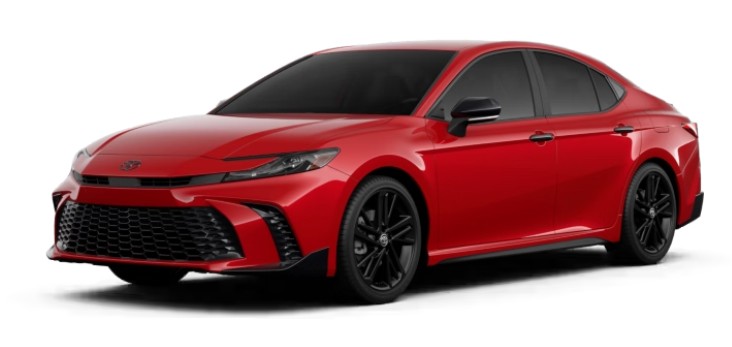
The 2024 Toyota Camry XSE V6 is generally the fastest factory-built Toyota Camry, although the closely related Camry TRD delivers nearly identical straight-line acceleration and sharper handling.
Both models use Toyota’s naturally aspirated 3.5-liter V6 engine, producing 301 horsepower and 267 lb-ft of torque through an eight-speed automatic transmission. Independent testing has placed V6 Camry models at roughly 5.8 seconds from 0 to 60 mph, depending on road conditions, tires, temperature, and testing methodology.
Here is the interesting twist: the dramatic-looking Camry TRD is not necessarily quicker than the XSE V6. The TRD looks like it escaped from a racetrack, while the XSE V6 dresses more like an executive sedan. Yet beneath their different outfits, they carry the same powerful heart.
So, which Camry earns the speed crown? Let’s dig into acceleration, horsepower, handling, top-speed limitations, model years, and real-world performance.
What Is the Fastest Toyota Camry Ever Made?
Among regular mass-production road cars, the fastest Toyota Camry is generally considered the eighth-generation Camry XSE V6, particularly models produced from 2018 through 2024.
The Camry TRD, offered from the 2020 through 2024 model years, is essentially tied with it. However, some instrumented tests have shown the XSE V6 covering the quarter mile slightly faster than the TRD.
That gives us two possible answers:
- Fastest in a straight line: Toyota Camry XSE V6
- Most performance-focused overall: Toyota Camry TRD
- Most powerful production Camrys: XSE V6, XLE V6, and TRD
- Quickest current-generation Camry: Camry AWD hybrid
- Fastest non-production Camry: Racing cars and modified concepts
The distinction matters because “fastest” can mean several things. Are we talking about horsepower, zero-to-60 acceleration, maximum speed, cornering ability, or lap times?
When we judge the whole package, the XSE V6 and TRD stand above every ordinary factory Camry that came before them.
Toyota Camry XSE V6: The Straight-Line Champion
The Camry XSE V6 is the quiet athlete of the family. It does not wear an enormous rear wing or shout about its performance from across a parking lot. Instead, it combines luxury features, aggressive styling, and serious acceleration.
Its specifications include:
- 3.5-liter naturally aspirated V6
- 301 horsepower at 6,600 rpm
- 267 lb-ft of torque at 4,700 rpm
- Eight-speed automatic transmission
- Front-wheel drive
- Sport-tuned suspension
- Paddle shifters
- Dual exhaust outlets
Toyota officially rated the 2024 V6 at 301 horsepower and 267 lb-ft of torque.
Those numbers may not sound outrageous in an age of 500-horsepower electric sedans, but context changes everything. The Camry is a practical family car with a large trunk, five seats, reasonable fuel economy, and Toyota’s reputation for everyday dependability.
Press the accelerator firmly, however, and the XSE V6 drops its polite commuter personality. The engine wakes up, the transmission grabs a lower gear, and the sedan charges forward with considerably more urgency than its sensible image suggests.
How Fast Is the Camry XSE V6 From 0 to 60 MPH?
A typical Toyota Camry XSE V6 can accelerate from 0 to 60 mph in approximately 5.8 seconds.
Some drivers and publications have achieved slightly quicker or slower results. Variations happen because acceleration depends on:
- Tire condition
- Road surface
- Fuel load
- Passenger weight
- Temperature
- Elevation
- Launch technique
- Testing equipment
Nevertheless, a sub-six-second run is a realistic expectation for a healthy XSE V6.
That makes it quick enough to surprise drivers who still associate the Camry exclusively with quiet commutes and grocery runs. It may not be a dedicated sports sedan, but it certainly does not move like an appliance.
Why Can the XSE V6 Be Faster Than the TRD?
At first glance, the TRD should win easily. It has a large rear spoiler, aerodynamic bodywork, a performance exhaust, bigger brakes, additional chassis bracing, and a suspension tuned by Toyota Racing Development.
Yet the TRD does not receive extra engine power.
Both cars produce the same 301 horsepower. The TRD’s upgrades improve handling, braking, sound, and body control rather than raw acceleration.
MotorTrend recorded a 5.8-second 0-to-60-mph run for the Camry TRD. Its quarter-mile time was 14.4 seconds, one tenth slower than a previously tested XSE V6, although testing conditions can influence such a narrow difference.
The XSE may also benefit from small differences in weight, tires, aerodynamics, or launch behavior. In practice, the two cars are close enough that the result of a short race could depend more on the driver and pavement than the badge on the trunk.
Toyota Camry TRD: The Sportiest Factory Camry
The Camry TRD is the loudest, boldest, and most focused performance Camry Toyota has sold through regular dealerships.
TRD stands for Toyota Racing Development, the division responsible for performance parts, race engineering, and sport-oriented versions of Toyota vehicles.
The Camry TRD received far more than a cosmetic package. Toyota equipped it with:
- TRD-tuned suspension
- Lower ride height
- Larger front brakes
- Additional underbody bracing
- Stiffer springs
- Revised shock absorbers
- TRD cat-back exhaust
- Aerodynamic body kit
- Fixed rear spoiler
- Larger wheels
- Performance-oriented interior details
Toyota paired these components with its 301-horsepower V6 and eight-speed automatic transmission.
The result feels tighter and more responsive than an ordinary Camry. Steering reactions are sharper, body roll is better controlled, and the exhaust gives the V6 a deeper voice.
Is the Camry TRD the Fastest Camry?
The Camry TRD is one of the fastest Camrys ever produced, but it is not conclusively faster than the XSE V6 in a straight line.
Its greatest advantage appears when the road begins to bend.
Imagine two runners with the same physical strength. One is wearing a tailored suit; the other has racing shoes, lighter clothing, and better balance. Their sprint times may be similar, but the properly equipped runner will feel more confident changing direction.
That is essentially the difference between the XSE V6 and the TRD.
The TRD is the better choice for drivers who value:
- Sharper cornering
- Stronger braking
- More aggressive styling
- A louder exhaust note
- A firmer ride
- Greater road feedback
The XSE V6 is better suited to buyers who want similar acceleration with more comfort, convenience, and visual restraint.
Camry XSE V6 vs. Camry TRD Performance
| Category | Camry XSE V6 | Camry TRD |
|---|---|---|
| Engine | 3.5-liter V6 | 3.5-liter V6 |
| Horsepower | 301 hp | 301 hp |
| Torque | 267 lb-ft | 267 lb-ft |
| Transmission | Eight-speed automatic | Eight-speed automatic |
| Drivetrain | Front-wheel drive | Front-wheel drive |
| Estimated 0–60 mph | About 5.8 seconds | About 5.8 seconds |
| Suspension | Sport-tuned | TRD performance-tuned |
| Ride comfort | More comfortable | Noticeably firmer |
| Brakes | Strong road-car setup | Larger performance brakes |
| Exhaust | Sporty dual exhaust | TRD cat-back exhaust |
| Best quality | Speed with luxury | Handling and character |
The table reveals why choosing a winner is tricky. On paper, their powertrains are twins. Out on the road, however, their personalities are different.
The XSE V6 is a fast grand tourer wearing a Camry badge. The TRD is a practical sedan that has been sent to racing school.
What Is the Fastest Current Toyota Camry?
The current Camry lineup is different from the 2024-and-earlier range.
Beginning with the 2025 model year in the United States, Toyota made the Camry exclusively hybrid. The V6 and gasoline-only four-cylinder options disappeared.
The latest Camry produces:
- 225 combined horsepower with front-wheel drive
- 232 combined horsepower with all-wheel drive
MotorTrend initially estimated that the redesigned hybrid Camry would need roughly 7.0 to 7.5 seconds to reach 60 mph.
Therefore, the current AWD hybrid is the quickest version in today’s lineup, but it is not as fast as the discontinued 301-horsepower V6 models.
Why Did Toyota Discontinue the V6 Camry?
Toyota has not reduced the Camry’s performance simply because it forgot how much drivers enjoy speed. The change reflects broader priorities throughout the automotive industry.
Hybrid power provides several benefits:
- Lower fuel consumption
- Reduced emissions
- Strong low-speed response
- Standard electrification
- Better everyday efficiency
- Available electronic all-wheel drive
The modern Camry is designed to deliver balanced performance rather than maximum straight-line acceleration. It remains responsive for commuting and highway driving, but it no longer tries to chase the sub-six-second territory occupied by the old V6.
For enthusiasts, that makes the 2018–2024 V6 cars increasingly interesting on the used market.
Fastest Toyota Camry Models Ranked
The following ranking focuses primarily on factory acceleration rather than racing modifications or one-off concepts.
1. Toyota Camry XSE V6
The XSE V6 takes first place because independent testing has shown that it can equal or narrowly beat the TRD in straight-line performance.
Its combination of 301 horsepower, a relatively light front-wheel-drive platform, and an eight-speed transmission produces effortless highway speed.
A well-maintained 2018–2024 XSE V6 remains the best answer for buyers asking which Toyota Camry is the fastest.
2. Toyota Camry TRD
The TRD sits almost level with the XSE V6. Its zero-to-60 performance is comparable, while its handling hardware makes it the most engaging factory Camry.
For a winding back road, the TRD may be the more satisfying machine. For a simple acceleration contest, the XSE V6 may have a tiny edge.
3. Toyota Camry XLE V6
The XLE V6 uses the same 301-horsepower engine but places a greater emphasis on refinement.
It is the sleeper of the group. With softer styling and a comfort-oriented cabin, the XLE V6 does not advertise its ability. Yet press the accelerator, and it releases the same basic engine power as the TRD.
Its suspension and tires are less performance-focused, but straight-line acceleration remains strong.
4. 2025-and-Newer Toyota Camry AWD Hybrid
The AWD hybrid is the most powerful version of the current generation, producing 232 combined horsepower.
Its rear electric motor improves traction and helps the car respond smoothly from low speeds. It is not a replacement for the V6, but it offers the best blend of acceleration, fuel efficiency, and all-weather confidence in the modern lineup.
5. Toyota Camry SE and XSE Four-Cylinder
Previous-generation four-cylinder XSE and SE models produced around 203 to 206 horsepower, depending on configuration.
They feel reasonably lively, especially once moving, but they cannot match the muscular acceleration of the V6. Their strengths are fuel economy, lower purchase costs, and simpler everyday ownership.
6. Older V6 Camry Models
Several older Camrys were surprisingly quick for their eras.
The 2007–2017 models equipped with Toyota’s 3.5-liter V6 produced approximately 268 horsepower. Many could accelerate from 0 to 60 mph in roughly six seconds, making them genuine sleepers.
A clean older V6 Camry can still feel fast today. It may lack the latest technology and body control, but the engine delivers a broad, satisfying wave of power.
Which Camry Has the Most Horsepower?
The highest-powered regular production Toyota Camrys are the 301-horsepower V6 models:
- Camry XSE V6
- Camry XLE V6
- Camry TRD
Toyota’s 3.5-liter V6 produces its peak power at 6,600 rpm. It is a naturally aspirated engine, meaning it does not depend on a turbocharger or supercharger to force additional air into the cylinders.
That gives it a smooth and predictable character. Power builds progressively, like a strong wave gathering height rather than a turbocharged punch arriving all at once.
Is Horsepower the Same as Speed?
No. Horsepower contributes to speed, but it does not tell the entire story.
Acceleration also depends on:
- Vehicle weight
- Gear ratios
- Transmission speed
- Traction
- Aerodynamic resistance
- Torque delivery
- Tire grip
- Electronic programming
A lighter car with less horsepower may outrun a heavier car with more power. Likewise, an all-wheel-drive vehicle may launch harder despite producing fewer horsepower because it can distribute power more effectively.
The Camry TRD illustrates this perfectly. It has the same engine as the XSE V6, yet its performance hardware focuses more on cornering and braking than reducing acceleration times.
What Is the Top Speed of the Fastest Camry?
Most factory V6 Camrys are electronically limited rather than allowed to reach the absolute maximum speed their engines and aerodynamics might theoretically support.
Reported figures frequently place the governed top speed near 135 mph, or approximately 217 km/h, although exact limits can vary by model year, market, tires, and electronic programming.
Top speed matters less in normal driving than acceleration.
A 135-mph maximum is irrelevant on public roads, where legal limits are far lower. The ability to accelerate safely onto a highway, pass slower traffic, or climb a steep grade is far more useful.
We should also remember that attempting to verify a vehicle’s top speed on public roads is dangerous and illegal. Such testing belongs on a closed course with appropriate tires, safety equipment, and professional supervision.
How the Fastest Camry Delivers Its Power
The V6 Camry sends all 301 horsepower to the front wheels.
That layout keeps the vehicle spacious, efficient, and relatively light. However, asking the front tires to steer and manage more than 300 horsepower creates challenges.
Under aggressive acceleration, drivers may notice:
- Wheelspin on poor surfaces
- Mild torque steer
- Traction-control intervention
- Reduced launch consistency
- Difficulty applying full power in rain
This is one reason the Camry V6 does not always launch as dramatically as an all-wheel-drive performance sedan.
Once the car is moving, the story changes. Highway acceleration is one of its greatest strengths. The engine pulls confidently through the middle of the rev range, making overtaking feel easy.
The Role of the Eight-Speed Automatic
Toyota paired the V6 with an eight-speed automatic transmission.
In ordinary driving, it aims to shift smoothly and keep engine speeds low. When the driver demands power, it selects a lower gear and allows the engine to climb toward its horsepower peak.
The transmission offers:
- Normal automatic operation
- Sport mode
- Manual-style paddle shifting
- Multiple ratios for efficiency
- Lower gears for quick acceleration
- Tall upper gears for highway cruising
It is not as aggressive as a dual-clutch sports-car transmission, but it suits the Camry’s mixed personality. The car can move gently through traffic one minute and surge past slower vehicles the next.
Is the Fastest Camry a Real Sports Car?
No. The Camry XSE V6 and TRD are quick performance sedans, but neither is a traditional sports car.
A dedicated sports car is usually engineered around driving engagement from the beginning. It may feature rear-wheel drive, a low seating position, near-perfect weight distribution, a limited-slip differential, and highly communicative steering.
The Camry begins life as a spacious front-wheel-drive family sedan. Toyota then adds power or performance components.
That does not make the result disappointing. It simply gives the car a different mission.
The fastest Camry offers:
- Five usable seats
- A large trunk
- Comfortable highway manners
- Strong reliability potential
- Easy daily drivability
- Impressive acceleration
- Reasonable running costs
Think of it as a business-casual athlete. It can run quickly, but it still remembers to bring a laptop, groceries, and luggage home.
Fastest Camry by Generation
Eighth Generation: 2018–2024
This generation produced the fastest road-going Camrys.
The new 3.5-liter V6 generated 301 horsepower, and buyers could choose luxury-focused or performance-oriented trims. The XSE V6, XLE V6, and TRD became the kings of factory Camry acceleration.
Seventh Generation: 2012–2017
The seventh-generation V6 produced about 268 horsepower.
These cars were less theatrical than the TRD but remarkably quick. Their discreet styling created a classic sleeper effect: ordinary appearance outside, strong acceleration underneath.
Sixth Generation: 2007–2011
The arrival of Toyota’s 3.5-liter V6 transformed the Camry.
With approximately 268 horsepower, the sedan became one of the quickest mainstream family cars of its period. A V6 SE could deliver genuinely surprising acceleration without sacrificing everyday usability.
Earlier Generations
Earlier V6 Camrys were smooth and capable, but they generally produced less power and carried older transmissions.
They were fast relative to contemporary family cars, yet they cannot match the performance of the later 3.5-liter models.
Ninth Generation: 2025 and Newer
The latest generation prioritizes hybrid efficiency.
Its AWD version produces 232 combined horsepower, giving it respectable performance with better traction and significantly improved fuel economy. It is the quickest Camry currently sold, but the older V6 retains the overall speed title.
Could a Modified Camry Be Faster?
Absolutely. A modified Camry can outrun any factory version, but modifications change the nature of the comparison.
Potential upgrades include:
- Performance tires
- Lighter wheels
- Suspension improvements
- ECU tuning
- Exhaust modifications
- Intake modifications
- Forced induction
- Weight reduction
However, modifying a naturally aspirated Camry V6 is not always simple or inexpensive. The engine and transmission were engineered around a specific output, cooling requirement, and traction limit.
Adding major power may introduce:
- Transmission stress
- Excessive wheelspin
- Cooling problems
- Reduced reliability
- Warranty complications
- Emissions compliance issues
- Higher insurance costs
A modest set of high-quality tires may improve usable performance more effectively than chasing a dramatic horsepower number. Power means little when the front tires cannot place it on the pavement.
What About Racing and Concept Camrys?
Racing cars that carry Camry styling are not mechanically equivalent to dealership Camrys.
A NASCAR Camry, for example, is a purpose-built racing machine with a specialized chassis, drivetrain, suspension, and safety structure. Its body resembles a Camry for branding purposes, but it is not a modified road car.
Toyota has also displayed experimental Camry projects with extreme power outputs. These concepts may use completely different engine layouts and are not available as normal production vehicles.
Therefore, they should not replace the XSE V6 or TRD when answering which Toyota Camry a customer could realistically purchase and drive on public roads.
Which Fast Camry Should We Buy?
The right model depends on what kind of speed we actually want.
Choose the Camry XSE V6 for Speed and Comfort
The XSE V6 is the best all-around choice for buyers who want maximum acceleration without sacrificing premium equipment.
It offers:
- Near-TRD acceleration
- More comfort
- Upscale interior features
- Sporty but mature styling
- Strong highway performance
- Better everyday refinement
It is arguably the most complete fast Camry.
Choose the Camry TRD for Handling and Drama
The TRD is ideal when we want the most exciting personality.
It delivers:
- Firmer suspension
- Better body control
- Stronger brakes
- Aggressive appearance
- Louder exhaust character
- Greater enthusiast appeal
The ride is less forgiving, and the cabin may have fewer luxury features than a well-equipped XSE. Still, no factory Camry looks or feels quite as focused.
Choose the XLE V6 for Sleeper Performance
The XLE V6 suits drivers who prefer subtlety.
It hides 301 horsepower beneath restrained styling and a comfort-oriented interior. To most observers, it looks like a conventional premium Camry. That quiet appearance makes its acceleration more surprising.
Choose the New AWD Hybrid for Efficiency
The current AWD hybrid is the sensible performance option.
It is not the fastest Camry ever, but it offers:
- Better fuel economy
- All-wheel-drive traction
- Modern safety technology
- Smooth electric assistance
- Lower fuel expenses
- Current-model availability
For most daily drivers, its balanced performance may be more useful than the V6 model’s extra speed.
What to Check Before Buying a Used V6 Camry
Speed should never distract us from condition.
A neglected XSE V6 can be a worse purchase than a carefully maintained four-cylinder model. Before buying, check:
- Service records: Look for consistent oil changes and scheduled maintenance.
- Tire condition: Uneven wear may reveal alignment or suspension problems.
- Transmission behavior: Shifts should be smooth and predictable.
- Accident history: Inspect carefully for structural repairs.
- Brake condition: Performance trims may have been driven aggressively.
- Warning lights: Scan for stored diagnostic codes.
- Cooling system: Verify that the engine maintains a stable temperature.
- Suspension noises: Listen for clunks over rough roads.
- Ownership history: Multiple short-term owners deserve extra investigation.
- Independent inspection: Ask a qualified mechanic to examine the car.
A pre-purchase inspection may feel like an unnecessary expense, but it is cheaper than discovering hidden damage after money has changed hands.
The 301-horsepower Camry V6 was designed to operate on regular unleaded gasoline according to Toyota’s requirements for the model.
That is an important practical advantage. Many performance vehicles require premium fuel, increasing every fill-up cost.
Using fuel with a higher octane rating does not automatically produce a major performance increase unless the engine’s control system and compression requirements are designed to benefit from it.
The safest approach is simple: follow the fuel specification printed in the owner’s manual and near the fuel-filler area.
Is a Fast Camry Expensive to Insure?
Insurance rates vary by location, driver history, age, annual mileage, coverage level, and insurer.
A V6 Camry may cost more to insure than a basic four-cylinder LE because:
- It has more horsepower
- Replacement parts may cost more
- Sport trims can attract higher-risk driving patterns
- Larger wheels and body components are expensive
- Vehicle values may be higher
However, it may remain cheaper to insure than a dedicated luxury sports sedan.
Before purchasing, request quotes for the exact vehicle identification number. Trim names alone do not always produce an accurate estimate.
Why the Fastest Camry Matters
The fast Camry represents something that has become increasingly rare: a naturally aspirated V6 hiding inside a practical, affordable family sedan.
It does not depend on a turbocharger. It does not force us into a tiny cabin. It does not demand exotic maintenance. It simply places a large, smooth engine into a familiar four-door platform.
That combination explains the lasting appeal of the XSE V6 and TRD.
They are not perfect. Front-wheel drive limits launch traction, the automatic transmission can occasionally hesitate, and the steering does not communicate like a true sports sedan.
Yet their imperfections are part of the charm. A fast Camry is unexpected, like discovering that a quiet neighbor spends weekends playing drums in a rock band.
Final Verdict: Which Toyota Camry Is the Fastest?
The Toyota Camry XSE V6 is generally the fastest production Camry, reaching 60 mph in roughly 5.8 seconds and occasionally recording slightly better quarter-mile results than the TRD.
The Camry TRD is essentially tied in acceleration and remains the sportiest factory version because of its upgraded suspension, brakes, chassis reinforcement, exhaust, and aerodynamic components.
Here is our final breakdown:
- Fastest production Camry: XSE V6
- Sportiest production Camry: TRD
- Most discreet fast Camry: XLE V6
- Fastest current Camry: AWD hybrid
- Best Camry for efficiency and traction: AWD hybrid
- Best used choice for speed and comfort: 2018–2024 XSE V6
The XSE V6 wins by a whisker rather than a mile. The TRD remains the more theatrical performer, while the new hybrid generation takes the Camry in a cleaner and more efficient direction.
For drivers who want the strongest factory acceleration, however, the answer remains clear: find a well-maintained eighth-generation Camry with Toyota’s 301-horsepower V6.
Frequently Asked Questions
1. What year Toyota Camry is the fastest?
The fastest Camrys generally come from the 2018–2024 model years. These vehicles were available with a 301-horsepower 3.5-liter V6. The XSE V6 is usually considered the quickest, while the 2020–2024 TRD offers similar acceleration with better handling hardware.
2. Is the Toyota Camry TRD faster than the XSE V6?
Not necessarily. Both use the same 301-horsepower V6 and eight-speed automatic transmission. Independent testing has placed both near 5.8 seconds from 0 to 60 mph, with some XSE V6 tests producing marginally quicker quarter-mile results.
3. How fast can a V6 Toyota Camry go?
A healthy V6 Camry can reach 60 mph in approximately 5.8 seconds. Its maximum speed is electronically controlled and commonly reported near 135 mph, though exact performance varies by model year, market, tires, and conditions.
4. Is the 2025 Toyota Camry faster than the Camry TRD?
No. The 2025 Camry uses a hybrid powertrain producing up to 232 combined horsepower with all-wheel drive. It offers improved fuel economy and traction but does not accelerate as quickly as the discontinued 301-horsepower Camry TRD.
5. Is the fastest Camry reliable?
The V6 Camry has strong long-term potential when properly maintained, but reliability depends heavily on service history and previous use. Buyers should inspect the transmission, brakes, tires, suspension, cooling system, and accident history before purchasing a used performance trim.
If you want to see other articles similar to Which Toyota Camry Is the Fastest? Complete Performance Guide you can visit the Compare category.
Ford Bronco Pros and Cons: Complete Buyer’s Guide
2026 Ford Bronco Towing: Capacity, Equipment, and Real-World Limits
Ford Bronco Gas Tank Size: 2026 U.S. Guide
2026 Ford Bronco Big Bend vs Outer Banks: Features and Differences Explained
2026 Ford Bronco Trim Levels in Order: Complete U.S. Guide
Ford Bronco Models Explained for U.S. Buyers
Leave a Reply
Related Topics