

Toyota Camry vs Lexus IS 350: Which Sedan Is Better?

Contents in this publication
- Toyota Camry vs Lexus IS 350 at a Glance
- Understanding the Fundamental Difference
- Exterior Design: Reserved Confidence or Athletic Drama?
- Engine and Performance Comparison
- Fuel Economy: The Camry Strikes Back
- Ride Comfort and Road Manners
- Interior Design and Material Quality
- Passenger Space and Practicality
- Technology and Infotainment
- Safety and Driver-Assistance Features
- All-Wheel Drive Comparison
- Reliability and Long-Term Ownership
- Insurance, Depreciation, and Resale Value
- Toyota Camry vs Lexus IS 350 for Commuting
- Toyota Camry vs Lexus IS 350 for Families
- Toyota Camry vs Lexus IS 350 for Driving Enthusiasts
- Should We Buy a Loaded Camry or a Base IS 350?
- Advantages of the Toyota Camry
- Disadvantages of the Toyota Camry
- Advantages of the Lexus IS 350
- Disadvantages of the Lexus IS 350
- Which Car Should We Buy?
- Final Verdict: Camry for Logic, Lexus for Emotion
- Frequently Asked Questions
Choosing between the Toyota Camry and Lexus IS 350 sounds straightforward until we look beneath the badges. One is a roomy, fuel-sipping midsize sedan built to make everyday driving affordable. The other is a compact luxury sport sedan designed to make an ordinary highway entrance feel like the opening lap of a race.
They come from the same corporate family, but they chase completely different goals.
For the current U.S. market, the 2026 Toyota Camry uses an all-hybrid lineup, produces up to 232 combined horsepower with all-wheel drive, and can return as much as an EPA-estimated 51 mpg combined. The 2026 Lexus IS 350 takes the opposite route, using a naturally aspirated 3.5-liter V6 that develops 311 horsepower and 280 lb-ft of torque.
So, which one belongs in our driveway?
The Camry is the rational choice for most commuters, families, rideshare drivers, and long-distance travelers. The Lexus IS 350 is the emotional choice for drivers who value acceleration, rear-wheel-drive handling, luxury materials, and a more intimate driving position.
Let us compare them carefully and find out whether the Lexus experience is worth the extra money.
Toyota Camry vs Lexus IS 350 at a Glance
| Category | Toyota Camry | Lexus IS 350 |
|---|---|---|
| Vehicle type | Midsize hybrid sedan | Compact luxury sport sedan |
| Powertrain | 2.5-liter four-cylinder hybrid | 3.5-liter naturally aspirated V6 |
| Maximum output | Up to 232 combined hp | 311 hp |
| Drivetrain | Front-wheel drive or AWD | Rear-wheel drive or AWD |
| Transmission | Electronically controlled continuously variable transmission | Eight-speed automatic with RWD; six-speed automatic with AWD |
| Best fuel economy | Up to 51 mpg combined | Significantly lower than the Camry |
| Interior priorities | Space, comfort, practicality | Luxury, driver engagement, craftsmanship |
| Starting price | Considerably lower | $46,895 including destination for the base 2026 IS 350 F Sport Design |
| Best for | Commuting, families, efficiency | Performance, luxury, enthusiastic driving |
The 2026 Lexus IS 350 lineup starts at $46,895 for the rear-wheel-drive F Sport Design, while the AWD version starts at $48,895. Lexus also offers more extensively equipped F Sport versions above those models.
That pricing immediately reveals the nature of this comparison. We are not simply choosing between two similarly positioned sedans. We are deciding whether to buy a highly practical mainstream vehicle or spend substantially more for performance, craftsmanship, exclusivity, and a premium ownership experience.
Understanding the Fundamental Difference
The Camry Is Built Around Everyday Efficiency
The Toyota Camry has evolved from a conventional family sedan into an exclusively hybrid model. Its mission is simple: move people comfortably while using as little fuel as reasonably possible.
Even the base Camry is not painfully slow or stripped down. Its standard hybrid system produces 225 combined horsepower with front-wheel drive. Selecting electronic all-wheel drive raises output to 232 combined horsepower by adding an electric motor at the rear axle. Toyota advertises up to an EPA-estimated 51 mpg combined, depending on the trim and drivetrain.
It is the automotive equivalent of a dependable pair of running shoes. It may not turn every head, but it works almost everywhere, costs relatively little to operate, and rarely makes daily life harder than it needs to be.
The Lexus IS 350 Is Built Around the Driver
The Lexus IS 350 begins from a different philosophy. It positions the driver lower in the cabin, sends power to either the rear wheels or all four wheels, and uses a naturally aspirated V6 rather than a fuel-saving hybrid system.
For 2026, every IS sold in the United States uses the IS 350 designation and F Sport-inspired styling. Its 3.5-liter V6 produces 311 horsepower and 280 lb-ft of torque. Rear-wheel-drive models receive an eight-speed automatic transmission, while AWD versions use a six-speed automatic.
This layout gives the Lexus a traditional sport-sedan personality. It feels more eager, more planted, and more responsive when the road starts twisting.
The Camry asks, “How efficiently can we get there?”
The Lexus asks, “Can we take the scenic route?”
Exterior Design: Reserved Confidence or Athletic Drama?
Toyota Camry Styling
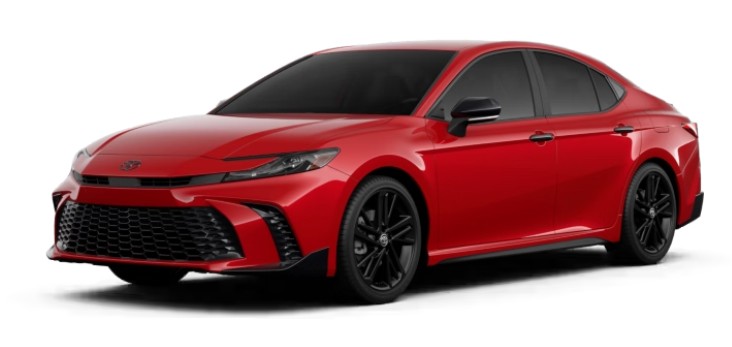
The modern Camry is more expressive than older versions. Its narrow headlights, sculpted bodywork, wide grille treatment, and available sport-oriented appearance packages give it genuine visual presence.
Still, the Camry remains relatively discreet. It does not shout about its abilities. That restraint will appeal to drivers who want an attractive sedan without drawing too much attention.
The longer body also helps the Camry look substantial. It resembles a traditional family sedan rather than a tightly wrapped performance car.
Lexus IS 350 Styling
The IS 350 looks lower, wider, and more aggressive. Its prominent spindle grille, sharp lighting, pronounced rear haunches, and F Sport details make it appear ready to move even while parked.
There is more visual tension in the Lexus. The body seems stretched over its wheels like fabric over an athlete’s shoulders.
That design does involve compromise. The sloping roof and compact proportions limit rear-seat accessibility and interior openness. Yet those same proportions give the IS its tightly controlled, driver-focused character.
Which One Looks Better?
Beauty remains subjective, but the Lexus has the more dramatic and premium appearance. The Camry looks modern and mature; the IS 350 looks expensive and athletic.
We would choose the Lexus for curb appeal and the Camry for understated sophistication.
Engine and Performance Comparison
Toyota Camry Hybrid Performance
The Camry’s hybrid system combines a 2.5-liter four-cylinder gasoline engine with electric motors. Front-wheel-drive versions produce 225 combined horsepower, while AWD versions produce 232 combined horsepower.
Electric assistance gives the Camry useful low-speed response. It moves away from traffic lights smoothly and reacts promptly during normal urban driving. Because the hybrid system can deliver immediate electric torque, the car often feels stronger around town than its specifications might suggest.
However, hard acceleration exposes the Camry’s efficiency-first priorities. The engine can become vocal, and the continuously variable transmission does not provide the stepped gear changes some drivers associate with sportiness.
The Camry is quick enough for real life. It is not designed to make us search for empty tunnels just to hear the engine.
Lexus IS 350 V6 Performance
The Lexus IS 350’s 3.5-liter V6 produces 311 horsepower and 280 lb-ft of torque. Unlike many modern luxury sedans, it does not rely on turbocharging.
That naturally aspirated design gives the Lexus a predictable, linear power delivery. Press the accelerator gently, and the car responds smoothly. Push harder, and the V6 builds speed with increasing urgency.
The Lexus feels considerably faster than the Camry during highway merging, passing, and full-throttle acceleration. It also sounds richer and more mechanical. The engine note rises naturally rather than arriving through artificial audio effects or exaggerated exhaust theatrics.
Rear-Wheel Drive Changes the Experience
The standard rear-wheel-drive layout is one of the IS 350’s greatest advantages. By sending power to the rear axle, Lexus separates steering duties from propulsion duties.
The result is cleaner steering feedback and a more balanced sensation through corners. Drivers who enjoy controlling a car with the accelerator will immediately notice the difference.
The Camry’s front-wheel-drive platform prioritizes stability, space, and predictable behavior. It is easy to drive quickly, but it does not communicate with the same enthusiasm.
Performance Winner: Lexus IS 350
The Lexus wins this category comfortably. It has more power, a more engaging drivetrain, better balance, and a stronger emotional connection.
The Camry’s performance is entirely adequate, but adequacy is not the same thing as excitement.
Fuel Economy: The Camry Strikes Back
Fuel efficiency is where the Toyota transforms this comparison.
The 2026 Camry can deliver up to an EPA-estimated 51 mpg combined in its most efficient configuration. Even Camry versions fitted with AWD remain designed around hybrid efficiency.
The Lexus IS 350’s V6, performance tires, heavier luxury equipment, and conventional automatic transmission require substantially more fuel. Lexus had not released final 2026 EPA figures when its initial model information was published, so buyers should confirm the official rating for their exact configuration before purchasing.
What the Difference Means in Daily Life
Imagine that we drive 15,000 miles each year.
A Camry averaging around 45 to 50 mpg might consume roughly 300 to 333 gallons annually. A sport sedan averaging in the mid-20-mpg range could use around 600 gallons over the same distance.
Actual results will vary with traffic, weather, driving style, fuel formulation, wheel size, and drivetrain. Nevertheless, the overall message is clear: the Camry can cut fuel consumption dramatically.
The Toyota also uses regular gasoline, while luxury performance vehicles may carry fuel recommendations that increase operating costs. Buyers should consult the Lexus owner’s manual and fuel-door label for the exact requirement of the vehicle they are considering.
Fuel-Economy Winner: Toyota Camry
For commuters and high-mileage drivers, this category alone may settle the debate. The Camry does not merely edge out the Lexus; it changes the financial equation.
Ride Comfort and Road Manners
Camry Ride Quality
The Camry provides a comfortable ride without feeling disconnected. Its suspension absorbs broken pavement well, and the hybrid system keeps low-speed operation quiet.
Trim selection matters. Models fitted with larger wheels and sportier suspension tuning may transmit more road texture into the cabin. More comfort-oriented configurations generally provide the softest ride and lowest tire costs.
The Camry also feels relaxed on long highways. Its steering is light, its controls are intuitive, and its cabin does not demand constant attention.
IS 350 Ride Quality
The IS 350 feels firmer and more controlled. It responds to steering inputs more quickly and resists body roll more effectively through bends.
That precision comes with a cost. Uneven pavement can feel sharper through the seats, especially with performance-oriented wheels and tires. The Lexus is not brutally uncomfortable, but it reminds us that handling was part of the engineering brief.
The cabin’s superior insulation and seat construction help offset the firmer suspension. At speed, the Lexus often feels more substantial and tightly assembled.
Comfort Winner: It Depends
Choose the Camry for soft-edged daily comfort and easy highway cruising.
Choose the IS 350 for supportive seats, stronger body control, and a more premium sensation.
Interior Design and Material Quality
Inside the Toyota Camry
The Camry’s cabin is functional, spacious, and increasingly sophisticated. Higher trims can include large digital displays, upgraded upholstery, ambient lighting, heated and ventilated seats, and premium audio equipment.
Toyota deserves credit for keeping the main controls approachable. Climate adjustments and frequently used functions do not require a treasure hunt through endless digital menus.
Material quality is good for a mainstream sedan, but we can still find harder plastics and simpler trim in less visible areas. That is reasonable given the Camry’s lower price.
Inside the Lexus IS 350
The Lexus offers denser padding, more carefully finished surfaces, stronger seat bolstering, and a greater sense of craftsmanship. Buttons and switches tend to move with deliberate resistance, and the cabin feels designed around the driver rather than around maximum passenger volume.
The dashboard architecture is not as airy as the Camry’s. Some drivers may even consider it dated compared with newer luxury competitors. Yet the controls are generally straightforward, and the physical layout can feel refreshingly direct.
It is like comparing a modern open-plan office with a tailored cockpit. The Camry feels brighter and more flexible. The Lexus feels tighter, richer, and more personal.
Interior-Quality Winner: Lexus IS 350
The Lexus justifies part of its premium through better materials, seat design, insulation, and tactile quality.
However, the Toyota may actually be easier to live with because of its greater openness and simpler family-oriented layout.
Passenger Space and Practicality
Front-Seat Experience
Both vehicles can accommodate adults comfortably in front. The difference lies in the seating position.
The Camry places occupants relatively upright and provides good outward visibility. Getting in and out is easy, and the center console does not feel overly intrusive.
The Lexus positions the driver lower and surrounds them more closely. Enthusiasts may love that arrangement, but taller or less mobile occupants may prefer the Camry.
Rear-Seat Space
The Camry is the clear winner in the back.
Its midsize proportions provide better legroom, easier access, and a more accommodating bench. Adults can sit behind adults without negotiating every inch of space.
The IS 350’s rear compartment is better suited to children, shorter trips, or occasional adult passengers. The low roofline and compact body make entry less graceful, and rear legroom is more limited.
Trunk and Everyday Utility
The Camry provides 15.1 cubic feet of cargo capacity, according to Toyota’s current comparison specifications.
Its trunk shape and family-sedan proportions make it useful for groceries, luggage, work equipment, and airport runs.
The Lexus trunk is less central to its mission. It can handle daily errands and weekend luggage, but the car’s compact dimensions and sport-sedan packaging make it less versatile.
Practicality Winner: Toyota Camry
Families, frequent travelers, and anyone carrying rear passengers regularly should lean strongly toward the Camry.
Technology and Infotainment
Camry Technology
Depending on trim and options, the Camry can provide:
- A large central touchscreen
- A digital instrument display
- Wireless smartphone integration
- Wireless device charging
- Multiple USB connections
- Connected navigation and voice features
- An available premium audio system
- Digital-key functionality on compatible configurations
Toyota’s interface is designed for broad accessibility. Most users can become comfortable with it quickly.
Lexus Technology
The IS 350 also offers modern connectivity, digital displays, smartphone integration, driver-assistance features, and premium audio availability.
Its technology presentation feels more upscale, but some parts of the interface may not seem as cutting-edge as systems in newer European luxury sedans. Lexus emphasizes usability and refinement over technological spectacle.
Which System Is Better?
The Camry offers more technology per dollar.
The Lexus presents similar functions in a more premium environment and may offer richer audio, display, and convenience configurations.
For pure value, the Toyota wins. For atmosphere and integration with luxury materials, the Lexus has the advantage.
Safety and Driver-Assistance Features
The Camry comes from a platform designed around high-volume family transportation, and safety is one of its strongest arguments.
The 2025–2026 Toyota Camry earned the Insurance Institute for Highway Safety’s Top Safety Pick+ designation under the organization’s applicable criteria. Those criteria include crashworthiness, headlight performance, and pedestrian crash-prevention evaluations.
Toyota also equips the Camry with a broad collection of driver-assistance systems. Exact functions can vary by trim, package, and model year.
The 2026 Lexus IS incorporates Lexus Safety System+ 3.0 features, including systems intended to support braking, lane guidance, distance management, and pedestrian or cyclist detection. Lexus also describes Proactive Driving Assist, which can provide gentle braking or steering support under certain operating conditions.
Important Safety Perspective
No driver-assistance package makes a vehicle autonomous. These systems may reduce workload or help in specific scenarios, but the driver remains responsible for steering, braking, observation, and decision-making.
Safety Winner: Toyota Camry
The Camry’s current IIHS recognition gives it the stronger documented advantage in this comparison. Still, shoppers should review ratings for the exact model year and configuration they intend to buy.
All-Wheel Drive Comparison
Both sedans are available with all-wheel drive, but the systems support different priorities.
Camry Electronic AWD
The Camry uses an additional electric motor to power the rear axle when extra traction is needed. This arrangement avoids a traditional mechanical driveshaft and supports the car’s efficiency-focused mission.
It can improve confidence during rain, light snow, slippery intersections, and steep starts. However, it does not transform the Camry into an off-road vehicle or performance machine.
Lexus IS 350 AWD
The Lexus AWD system accompanies the V6 with a six-speed automatic transmission. Its purpose is to help deploy power confidently while preserving the IS 350’s sporty character.
Drivers in snowy regions may appreciate the extra traction, although winter tires remain crucial. All-wheel drive helps a vehicle accelerate; appropriate tires also influence braking and cornering.
AWD Verdict
Choose Camry AWD for efficient, weather-friendly commuting.
Choose Lexus IS 350 AWD for V6 performance with added year-round traction.
Reliability and Long-Term Ownership
Toyota and Lexus both have strong reputations for durability, but reliability depends on more than the badge.
Maintenance history, operating conditions, collision repairs, tire quality, fluid changes, and driver behavior all matter. A neglected Lexus can become more troublesome than a carefully maintained Toyota, just as a poorly serviced Camry can fail earlier than expected.
Why the Camry May Cost Less to Own
The Camry has several structural advantages:
- Lower purchase price
- Far better fuel economy
- Mainstream replacement parts
- Broad dealer and independent-shop familiarity
- Less expensive wheel and tire options on many trims
- Lower financial exposure when routine wear items require replacement
Its hybrid system is more complex than a conventional non-hybrid powertrain, but Toyota has used hybrid technology across millions of vehicles and multiple generations.
Why the Lexus Costs More
The IS 350’s V6 is relatively conventional, but luxury ownership brings higher associated expenses.
Performance tires may wear faster and cost more. Larger brakes, premium trim pieces, sophisticated lighting, luxury electronics, and model-specific suspension components can also raise repair bills.
Insurance may be more expensive because of the Lexus’s higher value, stronger performance, and costlier replacement parts.
Ownership-Cost Winner: Toyota Camry
The Camry is the easier car to justify on a spreadsheet. The Lexus must earn its place through enjoyment, not savings.
Insurance, Depreciation, and Resale Value
The Camry usually appeals to a broad used-car audience. Commuters, families, students, fleet operators, and rideshare drivers all understand its value proposition.
The Lexus IS 350 attracts a narrower but enthusiastic audience. Well-maintained examples may remain desirable because naturally aspirated V6 sport sedans are becoming less common.
However, resale value depends heavily on:
- Mileage
- Service records
- Accident history
- Exterior color
- Interior condition
- Tire condition
- Modifications
- Regional demand
- Number of previous owners
An unmodified Lexus with complete maintenance documentation may be more desirable than one fitted with questionable suspension, exhaust, or engine changes.
The Camry is generally easier to sell. The Lexus may be more emotionally desirable to the right buyer.
Toyota Camry vs Lexus IS 350 for Commuting
The Camry is one of the stronger commuting choices available.
It is efficient in traffic, comfortable over long distances, spacious enough for coworkers or family members, and relatively inexpensive to operate. Its hybrid system performs especially well in stop-and-go conditions, where regenerative braking can recover energy that would otherwise be wasted.
The Lexus makes commuting more enjoyable, but at a higher cost. It delivers stronger acceleration, better seats, richer materials, and more satisfying handling. Yet much of its capability may go unused during congested urban driving.
Best Commuter: Toyota Camry
The Camry saves money every week. The Lexus makes some commutes more memorable.
Toyota Camry vs Lexus IS 350 for Families
The Camry wins because it offers:
- More useful rear-seat room
- Easier child-seat access
- Better fuel economy
- Greater trunk practicality
- Lower running costs
- A strong current safety profile
- More affordable entry pricing
The Lexus can work for a small household, especially when rear seats are rarely occupied. However, families with growing children may outgrow its compact rear compartment quickly.
Best Family Car: Toyota Camry
This is one of the least complicated decisions in the comparison.
Toyota Camry vs Lexus IS 350 for Driving Enthusiasts
The Lexus wins decisively.
Its naturally aspirated V6, rear-wheel-drive availability, lower seating position, stronger brakes, performance-oriented suspension, and more communicative chassis make it the more entertaining car.
The Camry can feel composed and surprisingly responsive, particularly in sportier trims. Nevertheless, its hybrid drivetrain and front-drive-based architecture prioritize efficiency and predictability.
The Lexus feels like a car we drive because we enjoy driving.
The Camry feels like a car we appreciate because driving it is so easy.
Should We Buy a Loaded Camry or a Base IS 350?
This is the most interesting version of the debate.
A well-equipped Camry can provide heated and ventilated seating, large displays, premium audio, a panoramic roof, driver-assistance technology, attractive upholstery, and AWD while remaining more efficient and practical than the Lexus.
A base IS 350 may not include every luxury option, but it gives us something the Camry cannot imitate: a rear-wheel-drive sport-sedan platform and a 311-horsepower V6.
The decision depends on what we consider luxury.
Is luxury having more equipment, space, and fuel savings?
Or is luxury having better materials, stronger performance, a premium badge, and a chassis engineered around the driver?
For most people, the loaded Camry is the better value. For enthusiasts, the base Lexus may be the more satisfying purchase.
Advantages of the Toyota Camry
The Camry’s most important strengths include:
- Outstanding hybrid fuel economy
- Lower purchase price
- More rear-seat space
- Better everyday practicality
- Lower expected operating costs
- Available electronic AWD
- Strong current IIHS safety recognition
- Easier entry and exit
- Better suitability for families
- More technology per dollar
Disadvantages of the Toyota Camry
Its limitations include:
- Less powerful than the Lexus
- No V6 option
- No rear-wheel-drive configuration
- Less engaging steering
- More engine noise under hard acceleration
- Mainstream interior materials
- Less prestigious badge
- Fewer opportunities for performance-focused driving
Advantages of the Lexus IS 350
The Lexus stands out with:
- A 311-horsepower naturally aspirated V6
- Rear-wheel-drive availability
- Stronger acceleration
- Sharper handling
- Premium interior materials
- Supportive sport seats
- More distinctive styling
- Better steering involvement
- Greater exclusivity
- A genuine compact luxury-sedan experience
Disadvantages of the Lexus IS 350
Its trade-offs include:
- Much higher purchase price
- Lower fuel economy
- Smaller rear seat
- Less practical trunk and cabin packaging
- Higher insurance potential
- More expensive tires and replacement parts
- Firmer ride quality
- Older-feeling interior architecture in some areas
- Six-speed transmission on AWD models
- Less value for buyers who do not care about performance
Which Car Should We Buy?
Buy the Toyota Camry If:
- Fuel economy is a top priority.
- We drive many miles every year.
- Rear-seat space matters.
- We regularly carry children or adults.
- We want lower ownership costs.
- We prefer a smooth, quiet commute.
- We want modern features without luxury-car pricing.
- We plan to keep the vehicle for many years.
- We need one sedan to handle nearly every household task.
Buy the Lexus IS 350 If:
- We genuinely enjoy driving.
- We want a naturally aspirated V6.
- Rear-wheel drive matters to us.
- Luxury materials justify a higher price.
- We rarely use the rear seats.
- Acceleration and cornering matter more than fuel consumption.
- We want a sedan that feels special each time we start it.
- We are comfortable paying more for tires, fuel, insurance, and maintenance.
Final Verdict: Camry for Logic, Lexus for Emotion
The Toyota Camry and Lexus IS 350 may share corporate DNA, but they answer different questions.
The Camry asks how much comfort, efficiency, technology, safety, and practicality we can obtain without pushing the price into luxury territory. Its all-hybrid powertrain, available AWD, generous passenger space, and up to 51-mpg combined rating make it the stronger all-around choice for most buyers.
The Lexus IS 350 asks how much personality we want from a compact sedan. Its 311-horsepower V6, rear-wheel-drive availability, firm chassis, premium cabin, and dramatic styling turn routine journeys into something more engaging.
For commuters, families, budget-conscious shoppers, and high-mileage drivers, we recommend the Toyota Camry.
For enthusiasts, luxury buyers, and drivers who view the journey as more than transportation, we recommend the Lexus IS 350.
The Camry is the sensible watch we wear every day because it is accurate, durable, and affordable.
The Lexus is the mechanical timepiece we occasionally catch ourselves staring at.
Neither choice is wrong. We simply need to decide whether our next sedan should make life easier or make driving more exciting.
Frequently Asked Questions
1. Is the Lexus IS 350 faster than the Toyota Camry?
Yes. The 2026 Lexus IS 350 produces 311 horsepower, while the 2026 Camry produces 225 combined horsepower with front-wheel drive or up to 232 combined horsepower with AWD. The Lexus also uses a sportier rear-wheel-drive-based platform, giving it a clear performance advantage.
2. Is the Toyota Camry more fuel-efficient than the Lexus IS 350?
Yes. The 2026 Camry can achieve up to an EPA-estimated 51 mpg combined. The Lexus IS 350 prioritizes V6 performance and will consume considerably more fuel in typical use.
3. Which has more interior space, the Camry or IS 350?
The Toyota Camry is more spacious, particularly in the rear seats. It is a midsize family sedan, whereas the Lexus IS 350 is a compact luxury sport sedan with tighter rear-seat packaging.
4. Is the Lexus IS 350 worth the extra money?
It can be worth the premium for buyers who value V6 power, rear-wheel-drive handling, luxury materials, stronger acceleration, and distinctive styling. Buyers focused on practicality and operating costs will obtain better value from the Camry.
5. Which is likely to cost less to own?
The Toyota Camry should generally cost less because of its lower purchase price, excellent fuel economy, more affordable mainstream components, and potentially lower tire and insurance expenses. Actual costs depend on location, mileage, driving history, trim, financing, and maintenance habits.
If you want to see other articles similar to Toyota Camry vs Lexus IS 350: Which Sedan Is Better? you can visit the Compare category.
Ford Bronco Pros and Cons: Complete Buyer’s Guide
2026 Ford Bronco Towing: Capacity, Equipment, and Real-World Limits
Ford Bronco Gas Tank Size: 2026 U.S. Guide
2026 Ford Bronco Big Bend vs Outer Banks: Features and Differences Explained
2026 Ford Bronco Trim Levels in Order: Complete U.S. Guide
Ford Bronco Models Explained for U.S. Buyers
Leave a Reply
Related Topics