
Toyota bZ vs bZ Woodland: Detailed 2026 Comparison

Contents in this publication
- Toyota bZ vs bZ Woodland at a Glance
- What Is the 2026 Toyota bZ?
- What Is the 2026 Toyota bZ Woodland?
- Exterior Design: Sleek Commuter or Rugged Explorer?
- Size and Everyday Maneuverability
- Interior Design and Cabin Experience
- Passenger Space
- Cargo Space: A Clear Woodland Victory
- Performance and Horsepower
- Ride and Handling
- All-Wheel Drive and Bad-Weather Capability
- Driving Range
- Charging Equipment and NACS Access
- DC Fast-Charging Speed
- Towing Capacity
- Ground Clearance and Outdoor Use
- Technology and Infotainment
- Safety and Driver Assistance
- Price and Value
- Operating Costs
- Which Model Is Better for Commuting?
- Which Is Better for Families?
- Which Is Better for Road Trips?
- Which Is Better in Snow?
- Which Is Better for Adventure?
- Reasons to Buy the Toyota bZ
- Reasons to Buy the Toyota bZ Woodland
- Potential Drawbacks of the Toyota bZ
- Potential Drawbacks of the bZ Woodland
- Toyota bZ vs bZ Woodland: Which Should We Buy?
- Final Verdict
- Frequently Asked Questions
The Toyota bZ vs bZ Woodland comparison is more interesting than it first appears. These two electric SUVs share Toyota badges, five-seat cabins, modern technology, and access to a greatly expanded fast-charging network. Yet they approach electric driving from noticeably different directions.
The regular 2026 Toyota bZ is the sensible all-rounder. It emphasizes efficiency, urban maneuverability, competitive range, and a relatively approachable starting price. The 2026 Toyota bZ Woodland takes the same basic electric-SUV idea and pulls on a pair of hiking boots. It adds more power, additional cargo room, higher ground clearance, standard all-wheel drive, genuine towing capability, and equipment intended for gravel roads, snow, campsites, and outdoor recreation.
So, which one deserves a place in our driveway?
For many buyers, the bZ will be the smarter financial and practical choice. For families carrying outdoor equipment, drivers facing difficult weather, or anyone who wants an electric SUV with noticeably more muscle, the bZ Woodland may justify its higher price.
Let us examine every meaningful difference.
Toyota bZ vs bZ Woodland at a Glance
The easiest way to understand these models is to think of the bZ as an electric crossover and the bZ Woodland as its larger, more adventurous sibling.
| Category | 2026 Toyota bZ | 2026 Toyota bZ Woodland |
|---|---|---|
| Starting MSRP | $34,900 | $45,300 |
| Drivetrain choices | Front-wheel drive or all-wheel drive | Standard dual-motor AWD |
| Maximum output | Up to 338 hp, depending on configuration | 375 hp |
| Maximum EPA-estimated range | Up to 314 miles | 281 miles |
| Range with all-terrain tires | Not applicable | 260 miles |
| Ground clearance | Approximately 8 inches, configuration-dependent | 8.4 inches |
| Maximum cargo volume | 67.1 cubic feet | 74.3 cubic feet |
| Maximum towing capacity | Not rated as its main purpose | 3,500 pounds |
| Charging connector | NACS | NACS |
| Main personality | Efficient everyday EV | Rugged, powerful adventure EV |
Toyota lists the bZ from $34,900, while the Woodland starts at $45,300 and the Woodland Premium at $47,400, before dealer processing and handling charges. That creates a substantial opening gap of $10,400 between the least expensive versions.
What Is the 2026 Toyota bZ?
The Toyota bZ is the renamed and significantly updated successor to the bZ4X. Toyota simplified the name for 2026 while giving the vehicle more than a cosmetic refresh.
Its mission is straightforward: provide a practical Toyota-branded electric crossover for commuting, family transportation, and ordinary road trips. The 2026 model brings improved range, more power in selected configurations, a standard 14-inch multimedia display, redesigned interior controls, battery preconditioning, and a native North American Charging System port.
The bZ lineup offers front-wheel-drive and all-wheel-drive configurations, allowing buyers to choose between maximum efficiency and additional traction. Its highest EPA-estimated range reaches 314 miles in the XLE FWD Plus, while the XLE AWD is rated at 288 miles.
That 314-mile figure matters. It gives the bZ enough theoretical range to feel like a regular family vehicle rather than a short-distance experiment. We still need to account for speed, climate, terrain, cabin heating, payload, and charging habits, but a rating above 300 miles creates welcome breathing room.
What Is the 2026 Toyota bZ Woodland?
The bZ Woodland is a distinct model rather than a simple appearance package.
Toyota stretches the body, raises the rear slightly, adds black overfenders, installs functional roof rails, and provides 8.4 inches of ground clearance. Underneath, dual electric motors deliver standard all-wheel drive and 375 combined horsepower.
It also includes X-MODE with Grip Control, which manages motor output and braking to help maintain traction on difficult surfaces. That does not transform it into an electric rock crawler, but it gives the Woodland a more serious toolkit for mud, snow, loose gravel, wet grass, and uneven access roads.
Toyota rates the Woodland at 281 miles of EPA-estimated range with its standard tires. Choosing the available all-terrain tires lowers that rating to 260 miles. It can tow as much as 3,500 pounds and provides 74.3 cubic feet of maximum cargo capacity with its rear seats folded.
In simple terms, the Woodland trades some range and affordability for power, space, traction, and utility.
Exterior Design: Sleek Commuter or Rugged Explorer?
Toyota bZ Styling
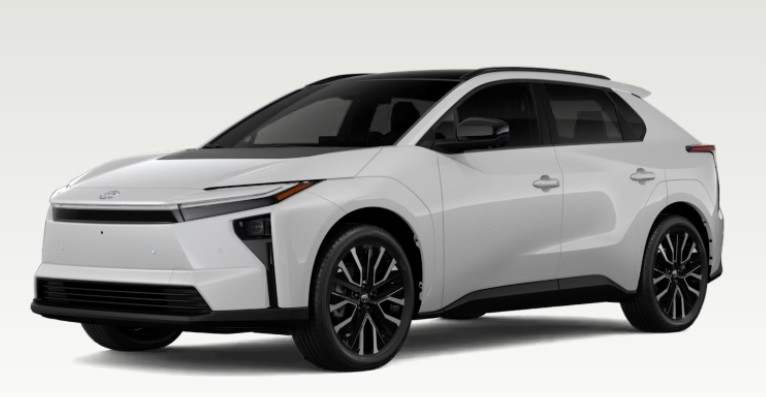
The regular bZ has a clean, futuristic shape that looks at home beside modern office buildings, suburban garages, and public charging stations. Its front end uses Toyota’s current hammerhead design language, with narrow lighting elements and smooth surfaces replacing the traditional grille.
It looks aerodynamic without becoming anonymous. The shape is still recognizably an SUV, although its low visual center and sharply angled details make it feel closer to a road-focused crossover.
The bZ is the less aggressive vehicle of the pair. That can be an advantage. Buyers who do not want plastic cladding, chunky tires, or outdoorsy styling may find its cleaner appearance easier to live with.
Toyota bZ Woodland Styling
The Woodland looks broader, tougher, and more purposeful. Black wheel-arch cladding, unique lower-body details, roof rails, and 18-inch wheels with black aerodynamic covers give it a more functional character.
Toyota says it is nearly six inches longer than the regular bZ and slightly taller at the rear. Those dimensional changes are not merely visual tricks; they help create the Woodland’s larger cargo area.
We could compare the difference to outdoor footwear. The bZ is a comfortable pair of running shoes. The Woodland is a waterproof hiking boot. Both can handle daily movement, but one is clearly designed for messier weekends.
Which Exterior Is Better?
Choose the bZ if we prefer:
- Cleaner urban styling
- Easier parking
- A less bulky appearance
- Maximum aerodynamic efficiency
- A conventional crossover personality
Choose the Woodland if we prefer:
- Rugged body cladding
- Functional roof rails
- Greater visual presence
- Extra clearance
- An adventure-oriented design
Neither is objectively more attractive. The better design is the one that matches how we actually use the vehicle.
Size and Everyday Maneuverability
The regular bZ is the easier model to position in tight spaces. Its shorter body should be more convenient in city parking structures, narrow driveways, and crowded shopping centers.
The Woodland’s additional length pays dividends behind the rear seats and with the seats folded, but we will notice that size during parallel parking. Fortunately, Toyota equips it with a Panoramic View Monitor and Multi-Terrain Monitor, which can reduce the stress of navigating close obstacles.
For most suburban households, the difference will not be troublesome. However, buyers living in dense neighborhoods should consider whether they genuinely need the Woodland’s extra cargo volume.
Bigger is useful until we have to squeeze it between two concrete pillars.
Interior Design and Cabin Experience
Both vehicles use Toyota’s updated electric-crossover cabin design, including a standard 14-inch Toyota Audio Multimedia touchscreen. Wireless Apple CarPlay and Android Auto compatibility help reduce cable clutter, while dual Bluetooth connectivity makes it easier to switch between devices.
The dashboard is slim and modern, and the digital instrument display is positioned relatively high in the driver’s field of vision. Some drivers appreciate this arrangement because it reduces the need to look far downward. Others may need time to find the right steering-wheel position without partially blocking the display.
Toyota also redesigned the center console for 2026, improving device storage and everyday usability. The cabin feels less experimental than the original bZ4X interior and more like a mature Toyota product.
Woodland Interior Advantages
The Woodland’s cabin emphasizes comfort alongside utility. Standard equipment includes:
- Heated front seats
- Heated outboard rear seats
- Heated steering wheel
- Dual wireless smartphone chargers
- Dual-zone automatic climate control
- Customizable ambient lighting
- Digital Key capability
- Four USB-C ports
- A 14-inch multimedia display
The Woodland Premium builds on that foundation with ventilated front seats, driver-seat memory, mirror memory, a digital rearview mirror, front radiant leg heaters, a panoramic fixed-glass roof, and a nine-speaker JBL audio system.
These additions make the Premium feel less like a muddy-trail special and more like a well-equipped touring SUV.
Is the Regular bZ Less Comfortable?
Not necessarily. The bZ remains comfortable and technologically competitive, especially in its better-equipped trims. The important difference is that the Woodland groups several cold-weather and convenience features into a more adventure-focused package.
Someone who mainly drives alone to work may not care about heated rear seats or a digital rearview mirror. A family regularly taking winter trips might value them every week.
Passenger Space
Both models seat five passengers, and both benefit from an electric platform that places the battery beneath the floor. With no traditional transmission tunnel dominating the cabin, the rear seating area feels relatively open.
The Woodland does not become a three-row SUV despite its extra length. Its main packaging benefit appears in the cargo area rather than an additional row of seats.
Adults should fit comfortably in either model, although the specific seat material, roof configuration, and front-seat position can influence the sense of room. The panoramic roof available on the Woodland Premium makes the cabin feel brighter but may slightly affect perceived headroom for unusually tall occupants.
Families should test child-seat installation in person. Specifications tell us a great deal, but a rear-facing child seat has a talent for exposing packaging compromises that no brochure mentions.
Cargo Space: A Clear Woodland Victory
Cargo capacity is one of the strongest reasons to choose the Woodland.
Toyota lists:
- Toyota bZ: 67.1 cubic feet behind the front seats
- Toyota bZ Woodland: 74.3 cubic feet behind the front seats
That is a difference of 7.2 cubic feet, which is meaningful when loading camping equipment, folding chairs, sports bags, luggage, pet carriers, or bulky purchases.
The Woodland also provides more than 30 cubic feet of cargo space behind its second row. Its longer rear section has a squarer, more utility-oriented profile, making it better suited to awkward equipment.
Who Needs the Extra Cargo Room?
The Woodland’s larger cargo area makes sense for:
- Camping households
- Cyclists and hikers
- Dog owners
- Families carrying strollers
- Skiing or snowboarding trips
- Home-improvement errands
- Frequent airport runs
- Road trips with four or five occupants
The regular bZ still has enough room for ordinary family life. We should not pay an additional five-figure sum merely because we occasionally buy groceries in bulk.
Performance and Horsepower
This is where the Woodland flexes its electric muscles.
Toyota bZ Performance
The bZ offers different outputs depending on drivetrain and battery configuration. Front-wheel-drive versions prioritize efficiency, while all-wheel-drive models use two motors for stronger acceleration and improved traction.
The most powerful AWD bZ configuration reaches 338 horsepower. That is already plenty for highway merging, passing, and rapid movement away from traffic lights.
Electric vehicles deliver torque immediately, so even the less powerful versions can feel lively at urban speeds. We do not need sports-car numbers to enjoy smooth, decisive acceleration.
Toyota bZ Woodland Performance
The Woodland produces 375 combined horsepower through its standard dual-motor AWD system. Toyota estimates a 0–60 mph time of 4.4 seconds.
That is seriously quick for a practical family SUV. Pressing the accelerator can turn a peaceful cabin into a silent slingshot.
The extra power helps in several situations:
- Passing on two-lane highways
- Merging while carrying passengers
- Climbing steep grades
- Towing a small trailer
- Maintaining momentum on loose surfaces
- Responding confidently in heavy traffic
Still, we should be honest with ourselves. Few drivers genuinely need 375 horsepower. It is enjoyable, but enjoyment and necessity are different columns on the spreadsheet.
Ride and Handling
The regular bZ should feel more road-focused and efficient. Its lower mass in selected configurations, less aggressive tires, and shorter body make it the more natural urban companion.
The Woodland carries the same basic low-center-of-gravity advantage common to battery-electric vehicles. Its battery lies beneath the floor, helping the vehicle feel planted despite the raised ride height.
However, physics does not disappear because we install electric motors. The Woodland’s additional size, equipment, AWD hardware, and possible all-terrain tires may make it feel heavier and less crisp than the most efficient bZ configuration.
The available all-terrain tires can also generate more road noise and less precise steering than road-biased tires. That is the price of improved durability and loose-surface traction.
Which One Feels Better?
The bZ is likely preferable for:
- City commuting
- Smooth highway cruising
- Tight roads
- Efficiency-focused driving
- Drivers who prefer lighter responses
The Woodland should suit:
- Snowy or muddy routes
- Gravel roads
- Mountain travel
- Towing
- Drivers who enjoy stronger acceleration
- Households carrying heavy recreational gear
All-Wheel Drive and Bad-Weather Capability
All-wheel drive is available on the regular bZ but standard on the Woodland.
The difference extends beyond simply powering four wheels. The Woodland includes X-MODE and Grip Control. At low speeds, Grip Control can regulate motor output to help the vehicle maintain steady movement on difficult surfaces, allowing the driver to concentrate on steering.
This is useful on:
- Snow-covered driveways
- Loose gravel
- Muddy campground roads
- Wet boat ramps
- Uneven dirt tracks
- Slippery inclines
The regular bZ AWD should still perform well in normal rain and snow, especially with suitable tires. Tires remain enormously important. An advanced AWD system wearing inappropriate rubber is like a mountain climber wearing dress shoes.
Is the Woodland a True Off-Roader?
It is better described as a soft-roader with enhanced capability.
Its 8.4 inches of ground clearance, traction systems, protective cladding, and optional all-terrain tires make it better prepared than the regular bZ. Nevertheless, it lacks the low-range transfer case, extreme suspension articulation, underbody armor, and rugged construction associated with serious off-road vehicles.
It is built for reaching the trailhead—not necessarily becoming part of the trail.
Driving Range
Range may be the deciding factor for many buyers.
The most efficient bZ reaches an EPA-estimated 314 miles. The XLE AWD is rated at 288 miles, while other grades and configurations may differ. The Woodland delivers 281 miles with standard tires or 260 miles with the optional all-terrain tires.
Range Comparison
| Model or Configuration | EPA-Estimated Range |
|---|---|
| bZ XLE FWD Plus | 314 miles |
| bZ XLE AWD | 288 miles |
| bZ Woodland | 281 miles |
| bZ Woodland Premium | 281 miles |
| Either Woodland trim with all-terrain tires | 260 miles |
The maximum difference between the bZ and Woodland is 33 miles. With all-terrain tires, the difference grows to 54 miles.
That could mean arriving home comfortably instead of stopping for a brief charge. On the other hand, a buyer who rarely drives more than 100 miles in a day may barely notice it.
Real-World Range Considerations
EPA estimates are comparison tools, not promises. Actual range can change significantly due to:
- Cold weather
- High highway speeds
- Cabin heating or cooling
- Strong headwinds
- Elevation changes
- Heavy payloads
- Towing
- Tire selection
- Driving style
- Battery age
- Charging habits
Toyota specifically warns that speed, temperature, accessory use, tires, driving patterns, and battery aging can reduce range.
Towing will be especially demanding. The Woodland may be rated to pull 3,500 pounds, but connecting a tall or heavy trailer can sharply reduce how far it travels between charges.
Charging Equipment and NACS Access
Both vehicles adopt a native NACS charging inlet for 2026. That is one of the most important practical improvements in Toyota’s electric lineup.
The connector opens access to compatible Tesla Supercharger locations as well as other growing NACS networks. Toyota says 2026 bZ drivers can access more than 25,000 additional North American charging plugs through the Tesla Supercharger Network.
Both models also support Plug & Charge at participating networks after setup. Instead of opening an app, locating a charger, and manually initiating a session each time, the vehicle and charger can handle identification and billing automatically.
Toyota includes J1772 and CCS1 adapters, preserving compatibility with older Level 2 and DC fast-charging equipment. That is a thoughtful detail during the industry’s connector transition.
Home Charging
The Woodland includes a dual-voltage charging cable that works with:
- A conventional 120-volt outlet for Level 1 charging
- A compatible 240-volt NEMA 14-50 outlet for Level 2 charging
Toyota recommends using a licensed electrician for outlet or charging-equipment installation.
The 11-kW onboard charger can take advantage of a sufficiently powerful Level 2 home unit. For most EV owners, reliable overnight charging is more important than dramatic public fast-charging figures. Waking up with a replenished battery is one of the quiet pleasures of electric ownership.
DC Fast-Charging Speed
Toyota estimates that the bZ Woodland can charge from 10% to 80% in approximately 30 minutes under ideal conditions. It also includes battery preconditioning, which warms or cools the battery toward a temperature suitable for faster charging.
The regular 2026 bZ receives similar charging-focused improvements, including battery preconditioning and NACS compatibility.
Thirty minutes is respectable, although charging performance depends on much more than the vehicle’s advertised capability. Battery temperature, charger output, starting charge level, congestion, and the charging curve all matter.
A vehicle may briefly reach a high peak rate but slow considerably as the battery fills. That is why the 10%–80% window is more informative than a single maximum-kilowatt number.
Towing Capacity
The Woodland’s 3,500-pound towing capacity gives it a major advantage.
That rating may accommodate:
- A small utility trailer
- Lightweight camping trailers
- Personal watercraft
- Certain small boats
- Motorcycles
- Landscaping equipment
- Compact recreational trailers
The regular bZ is not marketed around towing and should not be selected for that purpose without carefully reviewing the owner’s manual and Toyota’s official limits.
Should We Buy the Woodland Mainly for Towing?
Only after considering range and charging logistics.
Electric motors provide excellent low-speed torque, making the actual pulling experience smooth and confident. However, trailers increase aerodynamic drag and weight, sometimes reducing EV range dramatically.
We should map charging locations that can physically accommodate a connected trailer. A charger may be compatible electrically while being frustratingly designed for vehicles without anything attached.
Ground Clearance and Outdoor Use
The Woodland provides 8.4 inches of ground clearance. That is enough to improve confidence on rutted access roads, shallow snow, uneven campsites, and gravel routes.
Its standard roof rails also support accessories such as cargo carriers and bicycle racks, subject to Toyota’s load limits.
The regular bZ remains capable of handling maintained dirt roads and ordinary winter conditions, particularly in AWD form. However, its design philosophy is clearly more pavement-oriented.
For someone whose greatest outdoor challenge is a gravel parking lot at a state park, the bZ may be entirely sufficient. The Woodland becomes worthwhile when rougher routes are a routine part of life rather than an annual fantasy.
Technology and Infotainment
Both SUVs include a large 14-inch touchscreen running Toyota Audio Multimedia. Features include wireless smartphone integration, voice commands, cloud-based navigation services, and connected-service functionality.
The Woodland adds two wireless charging pads, making it easier for the driver and front passenger to charge compatible phones simultaneously. Its four USB-C ports also help families avoid the familiar argument over whose battery percentage is lowest.
The Woodland Premium’s nine-speaker JBL system includes an amplifier and subwoofer, offering a meaningful upgrade for music lovers.
Connected services may require trials or paid subscriptions after an included period. Buyers should distinguish permanent vehicle equipment from software features that may later create recurring costs.
Safety and Driver Assistance
Toyota equips both models with its current suite of active safety and driver-assistance systems. Exact equipment can vary by trim, but buyers can expect modern functions intended to assist with collision avoidance, lane awareness, adaptive cruising, and parking.
The Woodland’s Panoramic View Monitor and Multi-Terrain Monitor are especially useful given its larger body and off-pavement ambitions. Camera views cannot replace careful observation, but they can expose obstacles hidden below the hood line or near the wheels.
We should treat driver aids as assistants, not substitutes. No camera or radar system grants permission to stop paying attention.
Price and Value
The starting-price difference is substantial:
- Toyota bZ: $34,900
- Toyota bZ Woodland: $45,300
- Toyota bZ Woodland Premium: $47,400
That means the base Woodland costs $10,400 more than the entry bZ before destination charges, taxes, registration, options, insurance, and dealer-added products.
The Woodland does include considerable additional hardware:
- Standard dual-motor AWD
- 375 horsepower
- Larger body
- More cargo capacity
- 3,500-pound towing ability
- 8.4 inches of clearance
- Roof rails
- X-MODE with Grip Control
- Heated front and rear seating
- Dual wireless chargers
- Additional adventure-focused equipment
Therefore, the comparison is not simply “the same vehicle with plastic cladding.” The Woodland delivers real functional upgrades.
Still, value depends on use. Paying for capability we never exercise is like buying an expedition tent for a night in the backyard.
Potential Incentives
Federal, state, utility, manufacturer, and leasing incentives can change frequently. Vehicle eligibility may depend on assembly location, battery sourcing, purchase method, income limits, price caps, and other rules.
Buyers should verify current eligibility using official government and Toyota information at the time of purchase. A lease may be structured differently from a direct purchase, so the advertised monthly payment is not always a reliable measure of total cost.
Operating Costs
Both vehicles avoid gasoline, oil changes, spark plugs, exhaust systems, and many conventional engine-maintenance items. Regenerative braking can also reduce wear on friction brakes.
However, EV ownership is not maintenance-free. Costs may include:
- Tires
- Wheel alignment
- Cabin air filters
- Brake-fluid service
- Coolant inspections
- Suspension components
- Insurance
- Home charging installation
- Public fast charging
- Registration fees
- Connected-service subscriptions
The Woodland may consume tires faster because of its greater power and weight. Optional all-terrain tires may also cost more to replace and reduce efficiency.
Electricity cost varies enormously. Home charging during off-peak hours may be inexpensive, while frequent highway fast charging can cost considerably more.
Which Model Is Better for Commuting?
The regular bZ wins for most commuters.
Its lower starting price, potentially longer range, smaller footprint, and availability with front-wheel drive make it a more rational daily vehicle. A 314-mile rating also provides a generous buffer for errands, traffic diversions, and unexpected trips.
The Woodland can certainly commute comfortably, but using a 375-horsepower adventure EV for a short solo drive every morning may be unnecessary unless we also exploit its capability on weekends.
Best commuting choice: Toyota bZ
Which Is Better for Families?
This depends on the family.
The bZ should serve smaller households well, particularly when most trips involve school, work, shopping, and occasional vacations.
The Woodland becomes more appealing when family life includes:
- Several large suitcases
- Strollers and sports equipment
- Dogs
- Camping gear
- Winter travel
- Bikes or roof-mounted accessories
- A small trailer
- Frequent long weekends outdoors
Its heated rear seats, larger cargo hold, extra charging ports, and stronger AWD system are practical family advantages rather than marketing decorations.
Best choice for active families: Toyota bZ Woodland
Which Is Better for Road Trips?
The bZ holds the range advantage, particularly in XLE FWD Plus form. More rated miles can reduce charging stops and provide greater flexibility in regions where stations are widely spaced.
The Woodland counters with more luggage room, stronger acceleration, AWD confidence, and better equipment for destinations beyond smooth pavement.
Our answer depends on the road trip:
- Interstate hotel trip: bZ
- Mountain cabin trip: Woodland
- Long-distance efficiency run: bZ
- Camping trip with four people: Woodland
- Winter highway journey: Woodland AWD capability may matter more
- Sparse charging region: Longer-range bZ may be safer
Which Is Better in Snow?
The Woodland has the stronger factory setup because AWD, X-MODE, Grip Control, and additional ground clearance come standard.
Yet winter tires remain the deciding factor. A front-wheel-drive bZ with excellent winter tires may stop and turn more effectively than a Woodland on unsuitable all-season tires.
AWD helps us move. Tires help us move, turn, and stop.
Best factory choice for difficult winter conditions: bZ Woodland
Which Is Better for Adventure?
The Woodland wins decisively.
It has:
- More ground clearance
- Standard AWD
- X-MODE
- Grip Control
- Roof rails
- Optional all-terrain tires
- More cargo volume
- A 3,500-pound towing rating
- Additional horsepower
- A body designed around outdoor utility
The regular bZ can visit campsites and trailheads, but the Woodland approaches those activities with better tools and fewer compromises.
Reasons to Buy the Toyota bZ
The regular bZ is the smarter choice when we want:
- A lower purchase price
- Up to 314 miles of range
- Better efficiency
- A smaller exterior footprint
- Front-wheel-drive availability
- Optional AWD
- Modern NACS charging
- A comfortable everyday EV
- Less emphasis on towing or rough roads
- Maximum value within Toyota’s electric lineup
It offers the capabilities most drivers use every day without charging extra for an outdoor lifestyle they may not actually live.
Reasons to Buy the Toyota bZ Woodland
Choose the Woodland when we need:
- Standard dual-motor AWD
- 375 horsepower
- 4.4-second estimated 0–60 mph acceleration
- 8.4 inches of ground clearance
- X-MODE and Grip Control
- 3,500 pounds of towing capability
- 74.3 cubic feet of maximum cargo volume
- Functional roof rails
- Optional all-terrain tires
- Better equipment for snow and unpaved roads
- A more spacious adventure vehicle
The Woodland is not just more aggressive-looking. Its increased size, output, towing rating, and traction equipment create legitimate functional value.
Potential Drawbacks of the Toyota bZ
Before choosing the bZ, consider:
- Less cargo space than the Woodland
- Lower maximum output
- No equivalent 3,500-pound towing focus
- Less rugged styling and equipment
- Reduced capability on rough access roads
- Some desirable equipment may require higher trims
Its limitations are mostly relevant to specialized use. For ordinary commuting, they may not feel like limitations at all.
Potential Drawbacks of the bZ Woodland
The Woodland’s disadvantages include:
- A much higher starting price
- Less maximum range
- Only 260 miles of rated range with all-terrain tires
- A longer body
- Potentially higher tire costs
- Reduced efficiency
- More capability than some owners need
- Towing can significantly reduce real-world range
It is easy to fall in love with the image of spontaneous wilderness travel. We should buy for our calendar, not our imagination.
Toyota bZ vs bZ Woodland: Which Should We Buy?
For most U.S. electric-SUV buyers, the Toyota bZ is the better overall value. It starts more than $10,000 lower, offers up to 314 miles of EPA-estimated range, supports modern NACS charging, and provides enough passenger and cargo space for normal family life.
The bZ Woodland is the better specialized vehicle. Its 375-horsepower AWD system, larger cargo hold, 8.4-inch clearance, X-MODE, roof rails, and 3,500-pound towing capacity make it significantly more useful for outdoor recreation and challenging weather.
Our decision can be reduced to one question:
Will we regularly use the Woodland’s extra capability?
When the answer is yes, the premium may be worthwhile. When the answer is “perhaps someday,” the standard bZ will probably leave more money in our bank account while traveling farther on a charge.
Final Verdict
The Toyota bZ and bZ Woodland are siblings, but they are not twins.
The bZ is calm, efficient, approachable, and practical. It is the version we would recommend to commuters, value-conscious EV shoppers, urban households, and buyers seeking the longest available range.
The Woodland is larger, faster, stronger, and more versatile. It feels like Toyota took the regular bZ, packed a tent in the cargo area, strapped bicycles to the roof, and pointed it toward the mountains.
Choose the Toyota bZ for efficiency, affordability, and everyday driving.
Choose the Toyota bZ Woodland for cargo space, towing, winter traction, outdoor equipment, and genuine adventure-oriented capability.
Neither model is automatically better. The winner is the one whose strengths appear in our real life—not merely in the brochure.
Frequently Asked Questions
1. Is the Toyota bZ Woodland bigger than the regular bZ?
Yes. The Woodland is nearly six inches longer and slightly taller at the rear. It provides 74.3 cubic feet of maximum cargo space, compared with 67.1 cubic feet in the regular bZ.
2. Does the bZ Woodland have more range than the bZ?
No. The Woodland has an EPA-estimated range of 281 miles with standard tires and 260 miles with optional all-terrain tires. The longest-range bZ configuration reaches 314 miles.
3. Can the Toyota bZ Woodland tow a trailer?
Yes. Toyota rates the 2026 bZ Woodland to tow up to 3,500 pounds when properly equipped. Trailer weight, weather, terrain, and speed can substantially reduce driving range.
4. Is all-wheel drive standard on both models?
No. The bZ is offered with front-wheel drive or all-wheel drive, depending on trim. Every bZ Woodland uses a standard dual-motor AWD system producing 375 combined horsepower.
5. Is the bZ Woodland worth the extra money?
It is worth considering when we regularly need more cargo capacity, towing ability, higher clearance, powerful AWD performance, or better rough-road equipment. The regular bZ is the better value when range, commuting, and affordability matter more.
If you want to see other articles similar to Toyota bZ vs bZ Woodland: Detailed 2026 Comparison you can visit the Compare category.
Ford Bronco Pros and Cons: Complete Buyer’s Guide
2026 Ford Bronco Towing: Capacity, Equipment, and Real-World Limits
Ford Bronco Gas Tank Size: 2026 U.S. Guide
2026 Ford Bronco Big Bend vs Outer Banks: Features and Differences Explained
2026 Ford Bronco Trim Levels in Order: Complete U.S. Guide
Ford Bronco Models Explained for U.S. Buyers
Leave a Reply
Related Topics