

Toyota Camry vs Tesla Model 3: Which Sedan Wins?

Contents in this publication
- Toyota Camry vs Tesla Model 3 at a Glance
- What Makes This Comparison So Interesting?
- Exterior Design: Familiar Confidence or Minimalist Futurism?
- Interior Design and Cabin Experience
- Inside the Toyota Camry
- Passenger Space and Everyday Comfort
- Ride Quality and Highway Comfort
- Performance: Smooth Hybrid Power vs Instant Electric Torque
- Toyota Camry Performance
- Handling and Steering
- Fuel Economy vs Electric Efficiency
- Charging the Tesla Model 3
- Range and Long-Distance Travel
- Cold Weather and Winter Driving
- Cargo Space and Practicality
- Technology and Infotainment
- Toyota Camry Technology
- Driver-Assistance and Safety
- Reliability and Mechanical Complexity
- Maintenance Requirements
- Insurance Costs
- Purchase Price and Incentives
- Five-Year Ownership Costs
- Environmental Considerations
- Road-Trip Comparison
- Daily Commuting Comparison
- Which Car Is Better for Families?
- Which Car Is Better for First-Time Buyers?
- Toyota Camry Pros and Cons
- Tesla Model 3 Pros and Cons
- Toyota Camry vs Tesla Model 3: Who Should Buy the Camry?
- Toyota Camry vs Tesla Model 3: Who Should Buy the Tesla?
- Final Verdict: Toyota Camry or Tesla Model 3?
- Frequently Asked Questions
Choosing between the Toyota Camry and Tesla Model 3 is not simply a matter of comparing two midsize sedans. It is a choice between two different ways of owning, driving, and living with a car.
The Toyota Camry represents a polished version of the familiar. It uses gasoline, carries a proven hybrid system, refuels almost anywhere, and fits neatly into the routines most American drivers already know. The Tesla Model 3 pulls us in another direction. It replaces the gas station with a charging cable, trades traditional controls for a large touchscreen, and delivers the instant acceleration that has become an electric-car trademark.
One feels like a dependable pair of running shoes. The other feels like a new smartphone on wheels.
So, which one deserves a place in our driveway? The answer depends on where we live, how far we travel, whether we can charge at home, and what we value most: predictability or innovation.
In this Toyota Camry vs Tesla Model 3 comparison, we will examine pricing, performance, efficiency, comfort, technology, charging, practicality, reliability, safety, ownership costs, and everyday usability.
Toyota Camry vs Tesla Model 3 at a Glance
Before we get into the fine print, here is the core difference:
| Category | Toyota Camry | Tesla Model 3 |
|---|---|---|
| Powertrain | Gas-electric hybrid | Fully electric |
| Fuel source | Regular gasoline | Electricity |
| Drivetrain | Front-wheel drive or AWD | Rear-wheel drive or AWD, depending on version |
| Best strength | Easy, efficient ownership | Performance and EV technology |
| Refueling time | A few minutes | Varies by charger |
| Home charging needed | No | Strongly recommended |
| Driving character | Smooth and predictable | Quick and responsive |
| Controls | Conventional dashboard and touchscreen | Touchscreen-centered interface |
| Long-trip convenience | Excellent nationwide | Strong where fast charging is available |
| Best for | Drivers wanting low-effort efficiency | Drivers ready for an EV lifestyle |
The 2026 Camry uses an all-hybrid lineup, producing up to 232 combined horsepower with available all-wheel drive. Its most efficient configuration is rated at up to 51 mpg combined.
The Model 3 is entirely electric and offers dramatically quicker acceleration in its more powerful configurations. Tesla also lists 24.1 cubic feet of total cargo volume with five passengers when the rear trunk and front trunk are combined.
What Makes This Comparison So Interesting?
The Camry and Model 3 compete for many of the same buyers even though they operate very differently.
Both are four-door sedans. Both seat five. Both prioritize efficiency. Both can serve as commuters, family cars, road-trip vehicles, or daily transportation for someone who simply wants a comfortable way to get to work.
Yet they solve the same problem with opposite philosophies.
The Camry asks, “How can we make a conventional car more efficient and dependable?”
The Model 3 asks, “Why keep the conventional formula at all?”
That contrast makes this comparison far more meaningful than a simple horsepower contest.
Exterior Design: Familiar Confidence or Minimalist Futurism?
Toyota Camry Styling
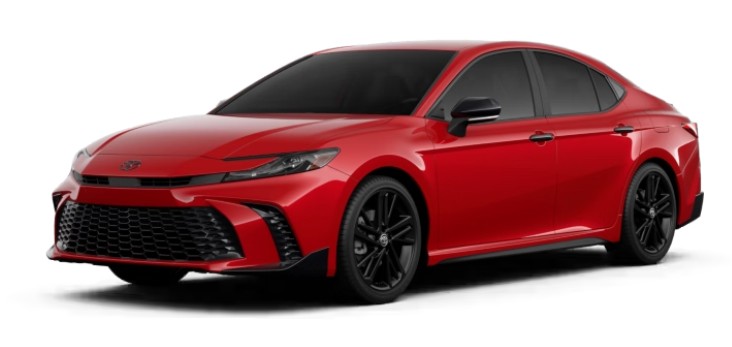
The modern Camry is sharper and more expressive than the conservative models many of us remember. Its wide grille treatment, sculpted bodywork, slim lighting, and available sport-oriented trims give it a more athletic stance.
It still looks unmistakably like a mainstream sedan, though. That may sound like faint praise, but it is an advantage for drivers who do not want their vehicle to feel experimental.
The Camry blends in when we want it to, yet it carries enough detail to avoid disappearing in a parking lot.
Tesla Model 3 Styling
The Model 3 takes a cleaner approach. Its body has fewer visual interruptions, a low nose, flush door handles, and a smooth roofline. The design is shaped heavily by aerodynamics, which helps efficiency while giving the car a sleek, almost pebble-like form.
It looks more futuristic than the Camry, but it is no longer unusual on American roads. The Model 3 has become recognizable enough that its once-radical silhouette now feels familiar.
Which One Looks Better?
Design is personal, but we can describe the difference clearly:
- Choose the Camry for a traditional sedan shape with stronger visual detailing.
- Choose the Model 3 for a cleaner, lower, more minimalist appearance.
- Choose a sport-oriented Camry trim when you want a more aggressive look.
- Choose the Tesla when aerodynamic simplicity matters more than decorative styling.
Neither design is objectively superior. The Camry wears a tailored jacket; the Tesla wears a fitted technical shell.
Interior Design and Cabin Experience
Inside the Toyota Camry
The Camry cabin follows a recognizable layout. We get a steering wheel with physical controls, a driver display, a central infotainment screen, climate controls, storage areas, and familiar switches.
That conventional arrangement reduces the learning curve. We can enter the car and understand most functions within seconds.
Toyota’s interior also offers a greater sense of separation between systems. Climate settings, driving information, media, and vehicle controls do not all depend on a single display.
This matters more than it may seem. A physical button can be used by touch, while a touchscreen usually requires us to look away from the road.
Inside the Tesla Model 3
The Model 3 goes in the opposite direction. Its dashboard is almost empty, with the central touchscreen acting as the command center for navigation, entertainment, climate settings, vehicle controls, energy information, and many other functions.
The result feels spacious and modern. There is less visual clutter, and the cabin can seem more open because no large instrument cluster rises behind the steering wheel.
However, minimalism creates trade-offs. Drivers accustomed to conventional controls may need time to learn where functions are located. Simple actions can sometimes require screen interaction rather than a direct button press.
The Tesla interior can feel elegant or overly sparse, depending on our expectations.
Cabin Winner
The Camry wins for intuitive operation and familiarity.
The Model 3 wins for visual simplicity and digital integration.
For drivers who like physical controls, the Camry is the safer choice. For drivers who manage nearly everything through a smartphone and enjoy software-based interfaces, the Tesla may feel more natural.
Passenger Space and Everyday Comfort
Both vehicles can accommodate five people, but neither is a limousine in the rear seat.
The Camry provides the kind of seating position most midsize-sedan buyers expect. Entry is straightforward, visibility is generally easy to judge, and the ride is tuned for daily comfort.
The Model 3 has a low floor structure shaped around its battery pack. Its glass roof adds a sense of openness, although some passengers may notice more heat entering the cabin in sunny climates. Rear-seat posture can also feel different because the floor and seat relationship is not identical to that of a conventional sedan.
Tesla lists 42.7 inches of front legroom and 34.5 inches of rear legroom for the Model 3.
In practical terms, both cars work well for couples, small families, and occasional adult passengers. Buyers who regularly carry tall adults in the rear should sit in both vehicles before making a decision.
Ride Quality and Highway Comfort
Camry Ride Quality
The Camry is designed to absorb daily imperfections without feeling disconnected from the road. It usually handles potholes, expansion joints, broken pavement, and long freeway journeys with composed manners.
Sportier versions may feel firmer, but the overall character remains approachable.
The Camry is the sort of car that settles into the background during a long trip. That is a compliment. A good commuter does not need to demand attention every minute.
Model 3 Ride Quality
The Model 3 generally feels more immediate. Its low center of gravity helps it stay planted through corners, but larger wheels and performance-oriented versions can transmit more road texture into the cabin.
Recent versions have improved refinement compared with earlier cars, yet wheel size still matters. Large wheels may sharpen handling and appearance while reducing tire sidewall cushioning.
Which Is More Comfortable?
For relaxed cruising, the Camry often has the advantage.
For a more connected, responsive driving sensation, the Model 3 is more engaging.
Our choice should depend on whether we want the road softened or communicated.
Performance: Smooth Hybrid Power vs Instant Electric Torque
Toyota Camry Performance
The Camry’s hybrid system combines a gasoline engine with electric assistance. Front-wheel-drive versions produce 225 combined horsepower, while all-wheel-drive configurations can reach 232 combined horsepower.
Those numbers are more than sufficient for commuting, highway merging, passing, and ordinary family use.
The power delivery is smooth rather than explosive. Electric assistance helps the Camry move away from a stop promptly, while the gasoline engine supports sustained acceleration.
It does not shove us into the seat like a high-performance EV. Instead, it delivers speed in a controlled, predictable stream.
Tesla Model 3 Performance
Instant torque is one of the Model 3’s defining traits. Press the accelerator, and the response arrives immediately. There is no traditional automatic transmission changing gears and no gasoline engine building revs.
Even non-performance versions feel lively in urban traffic.
The Performance model pushes the experience much further, offering sports-car-like acceleration with dual-motor all-wheel drive. Tesla’s Canadian specifications, for example, list a 3.1-second 0–100 km/h time for the Model 3 Performance, illustrating how dramatically quicker it is than a conventional family hybrid.
Performance Winner
The Model 3 wins easily for acceleration and immediate response.
The Camry counters with smoother familiarity and less temptation to burn through expensive tires.
Do we need dramatic speed during a grocery run? Probably not. Will many of us enjoy having it anyway? Absolutely.
Handling and Steering
The battery in the Model 3 sits low in the chassis, which lowers the center of gravity. This helps the car remain stable during quick direction changes and cornering.
The steering feels direct, and the car responds quickly to accelerator inputs. Regenerative braking also allows us to slow down significantly by lifting off the accelerator, creating a one-pedal driving experience once we become accustomed to it.
The Camry feels lighter in spirit and easier to approach. Its steering and brake behavior are more conventional, so there is almost no adaptation period.
Sport-focused Camry versions provide sharper responses than the comfort-oriented models, but the Tesla remains the more athletic machine.
For enthusiastic driving, the Model 3 wins.
For effortless, predictable control, the Camry may be more satisfying.
Fuel Economy vs Electric Efficiency
This category is not a direct apples-to-apples comparison because one vehicle burns gasoline and the other consumes electricity.
Camry Fuel Economy
The most efficient 2026 Camry LE is rated at 53 mpg city, 50 mpg highway, and 51 mpg combined.
That is outstanding for a roomy gasoline-powered sedan. It allows many drivers to travel hundreds of miles between fuel stops while using ordinary gas stations.
The hybrid system also performs especially well in stop-and-go driving, where regenerative braking captures energy that would otherwise be lost as heat.
Model 3 Energy Use
The Model 3 does not use gasoline, so its operating cost depends on:
- Local electricity prices
- Charging location
- Driving speed
- Weather
- Wheel size
- Battery temperature
- Use of climate control
- Charging losses
Home charging is usually the key to unlocking the Model 3’s financial advantage. Charging overnight at residential electricity rates can cost much less per mile than buying gasoline.
Public fast charging is more expensive, and prices vary by location and time. A driver who relies almost entirely on public charging may save less than expected.
The Honest Efficiency Verdict
The Model 3 is more energy-efficient in mechanical terms. Electric motors convert a larger share of stored energy into motion than gasoline engines.
The Camry is more flexible in infrastructure terms. It can refuel nearly anywhere in a few minutes.
The winner depends on access, not just efficiency.
Charging the Tesla Model 3
Home Charging Changes Everything
A Model 3 makes the most sense when we can charge where we sleep.
With a properly installed home charging setup, the routine can be simple:
- Arrive home.
- Plug in the car.
- Let it charge overnight.
- Leave the next morning with the desired battery level.
This can be more convenient than stopping for gas because the car charges while we are doing something else.
What Happens Without Home Charging?
Without home or workplace charging, EV ownership becomes more complicated.
We may need to visit public chargers, plan around charging availability, wait during charging sessions, or pay higher rates at fast-charging stations.
Apartment residents should confirm the following before buying:
- Whether charging installation is permitted
- Whether assigned parking has electrical access
- How electricity use is billed
- Whether nearby public chargers are reliable
- Whether chargers are available during peak hours
Buying an EV before solving the charging question is like buying a boat before finding water.
Road-Trip Charging
Tesla’s fast-charging network is one of the Model 3’s strongest advantages. The navigation system can plan charging stops and estimate battery levels along the route.
Even so, charging takes longer than filling a gasoline tank. Stops may fit naturally into meal and restroom breaks, but they still require planning.
The Camry remains the easier road-trip machine when time, route flexibility, and remote-area travel are top priorities.
Range and Long-Distance Travel
The Camry can travel a long distance on one tank, particularly in efficient front-wheel-drive form. Once the tank runs low, thousands of gas stations are available across the United States.
The Model 3’s usable travel distance depends on the version, wheel choice, speed, temperature, elevation, and climate-control demand. Real-world range may differ from the official estimate, especially during cold weather or sustained high-speed driving.
For predictable long-distance travel, the Camry has fewer variables.
For drivers who travel mainly within a familiar region and charge at home, the Model 3’s range may be more than enough.
The practical question is not, “Which car has the bigger number?”
It is, “How often do we drive farther than the Tesla can comfortably travel between charges?”
Cold Weather and Winter Driving
Cold weather affects both cars, but the impact is more noticeable in an EV.
A Model 3 may use battery energy to warm the cabin and condition the battery. Range can decline when temperatures fall, especially on short trips where the vehicle repeatedly heats itself from cold.
The Camry’s fuel economy can also decrease in winter, but refueling remains quick and predictable.
Both vehicles offer all-wheel-drive configurations, which can improve traction during acceleration. However, AWD does not replace winter tires. Braking and cornering grip still depend heavily on the rubber touching the road.
For severe winters and unpredictable travel, the Camry offers greater logistical simplicity.
For winter commuters with home charging and proper tires, the Model 3 can still be an excellent daily vehicle.
Cargo Space and Practicality
The Camry uses a conventional trunk, which is easy to understand and works well for groceries, luggage, backpacks, and everyday cargo.
The Model 3 provides both a rear cargo area and a small front trunk. Tesla lists 21 cubic feet behind the second row and 3.1 cubic feet in the front trunk, totaling 24.1 cubic feet with five passengers aboard.
Cargo-volume measurements can differ between manufacturers, so the numbers should not be treated as a perfect direct comparison. Shape matters as much as volume.
The Model 3’s folding rear seats and additional front storage make it surprisingly versatile. The Camry’s trunk opening and traditional layout may be easier for drivers who prefer straightforward loading.
For distributed storage and flexibility, the Tesla has an edge.
For traditional sedan practicality, the Camry remains perfectly capable.
Technology and Infotainment
Toyota Camry Technology
The Camry combines a central touchscreen with physical controls and a dedicated driver information display. Smartphone integration allows many owners to use familiar apps for navigation, music, messages, and calls.
The system aims to complement the driving experience rather than dominate it.
This is ideal for drivers who want modern features without reorganizing their habits around the car.
Tesla Model 3 Technology
Technology is central to the Model 3’s identity.
The touchscreen manages most major functions, and software updates can add features, alter interfaces, improve certain systems, or refine vehicle behavior over time.
Tesla’s route planning, charging integration, mobile app, energy display, and remote controls create a deeply connected ownership experience.
However, placing so many functions inside one system also creates dependency. When we prefer buttons, traditional gauges, or separate controls, Tesla’s approach may feel unnecessarily complicated.
Tech Winner
The Model 3 wins for software integration, app functionality, and digital novelty.
The Camry wins for usability, familiarity, and lower cognitive load.
The Tesla feels like a device that happens to be a car. The Camry feels like a car that happens to include modern devices.
Driver-Assistance and Safety
Both vehicles offer a broad collection of driver-assistance technologies, including systems designed to support braking, lane positioning, collision avoidance, and cruise control.
However, no driver-assistance package makes a car autonomous. Drivers must remain attentive, understand system limitations, and keep control of the vehicle.
The Camry earned strong recognition from the Insurance Institute for Highway Safety, including a Top Safety Pick+ designation for the 2025–26 model years under the organization’s 2025 award criteria.
The Tesla Model 3 was listed as a 2025 Top Safety Pick by IIHS.
Safety ratings can vary by model year, production date, equipment, and testing criteria. We should verify the exact vehicle configuration before buying rather than assuming every version receives identical results.
Reliability and Mechanical Complexity
Toyota Camry Reliability Approach
Toyota’s hybrid systems have been used across millions of vehicles. The Camry still contains a gasoline engine, cooling system, exhaust system, fuel system, lubricants, filters, and other conventional components, but the hybrid design can reduce stress on certain parts.
The engine does not need to operate constantly, and regenerative braking can reduce wear on friction brakes.
The Camry’s major advantage is familiarity. Independent repair shops understand Toyota vehicles, parts are widely distributed, and servicing infrastructure is extensive.
Tesla Model 3 Reliability Approach
An electric powertrain has fewer routine service items than a gasoline engine. There are no engine-oil changes, spark plugs, exhaust components, or conventional transmission shifts.
Yet fewer moving parts do not guarantee that nothing will fail.
EV ownership can involve concerns such as:
- Electronic components
- Sensors and cameras
- Door hardware
- Suspension components
- Climate systems
- Charging hardware
- Touchscreen or software issues
- Body and trim quality
- Tire wear
- Battery or drive-unit repairs outside warranty
The Tesla may require less scheduled mechanical maintenance, but repairs can be more specialized.
Reliability Winner
The Camry wins for long-established serviceability and predictable support.
The Model 3 wins for reducing routine engine-related maintenance.
Drivers planning to keep a vehicle for 10 or 15 years may feel more comfortable with Toyota’s repair network. Drivers focused on avoiding oil changes and routine engine service may prefer Tesla.
Maintenance Requirements
Typical Camry Maintenance
A Camry owner should expect items such as:
- Engine-oil and filter changes
- Tire rotations
- Cabin and engine air filters
- Brake inspections
- Fluid checks
- Coolant service at specified intervals
- Wiper blades
- Tires
- Alignment
- Eventual spark-plug and related service
The hybrid battery and electric components also need monitoring, although they are designed for long service life.
Typical Model 3 Maintenance
A Model 3 eliminates many gasoline-car service items. Owners still need to consider:
- Tire rotations
- Tire replacement
- Wheel alignment
- Cabin air filters
- Brake-fluid checks
- Windshield-washer fluid
- Wiper blades
- Suspension inspections
- Air-conditioning service
- Brake cleaning in regions using road salt
The Model 3’s weight and acceleration can increase tire wear, especially when we frequently enjoy its instant torque.
That silent launch may feel free, but the tires remember every one.
Insurance Costs
Insurance can significantly alter the financial comparison.
The Model 3 may cost more to insure because of its performance, repair procedures, parts pricing, sensor integration, body-shop requirements, or regional claim patterns. Rates vary widely by insurer and driver.
The Camry is also a newer, technologically complex vehicle, but its repair ecosystem is broad and familiar.
Before choosing either model, we should obtain actual quotes using:
- The exact trim
- Our ZIP code
- Annual mileage
- Driver history
- Desired deductible
- Coverage limits
- Financing or leasing requirements
A vehicle with lower energy costs can still be more expensive overall when insurance rises sharply.
Purchase Price and Incentives
Vehicle prices change frequently, and the final amount depends on trim, destination fees, options, financing, taxes, inventory, and available incentives.
The 2026 Camry starts in the upper-$20,000 range in the United States, with Toyota listing a starting MSRP of $29,300 for the Camry LE in one official comparison.
Tesla pricing can change more often, and the Model 3’s effective cost may be influenced by promotional financing, inventory adjustments, state programs, utility rebates, and federal tax rules.
Tax-credit eligibility can depend on current law, vehicle configuration, buyer income, purchase method, battery sourcing, and delivery date. We should confirm eligibility immediately before signing because EV incentive rules can change.
The important figure is not the advertised price. It is the complete out-the-door and long-term cost.
Five-Year Ownership Costs
A useful ownership comparison should include more than fuel.
We should estimate:
- Purchase price
- Financing interest
- Insurance
- Gasoline or electricity
- Home-charger installation
- Public-charging costs
- Maintenance
- Tires
- Registration fees
- Depreciation
- Expected resale value
- Potential out-of-warranty repairs
The Tesla can save substantially on energy when charged cheaply at home. The Camry can avoid the upfront expense of installing charging equipment and may provide more predictable resale and service options.
Neither vehicle automatically wins every financial scenario.
A high-mileage homeowner with inexpensive electricity may save more with the Model 3.
A low-mileage apartment resident relying on public fast charging may find the Camry less expensive and far easier to live with.
Environmental Considerations
The Model 3 produces no tailpipe emissions while driving. Its total environmental impact still includes battery production, vehicle manufacturing, electricity generation, shipping, and eventual recycling.
The Camry produces tailpipe emissions, but its hybrid system uses significantly less gasoline than many conventional vehicles. It can be an effective middle step for drivers who want lower fuel consumption without depending on charging infrastructure.
Which choice is greener depends partly on:
- Local electrical generation
- Annual mileage
- Vehicle lifespan
- Battery production
- Gasoline consumption
- Charging habits
- Whether the vehicle replaces a less-efficient car
The Model 3 generally offers the stronger path toward eliminating direct gasoline use. The Camry offers meaningful efficiency gains without changing how we refuel.
Road-Trip Comparison
Why the Camry Excels
The Camry is almost effortless on a long trip.
We can drive until the fuel level drops, stop at nearly any gas station, refuel in minutes, and continue. Detours, remote destinations, towing disruptions, broken chargers, and extreme temperatures require little extra thought.
Why the Model 3 Can Still Work Well
The Model 3 can be an enjoyable road-trip car when the route follows reliable fast-charging corridors.
Charging breaks can encourage us to stretch, eat, or rest instead of rushing from one fuel stop to another. The navigation system helps reduce planning pressure by directing us toward charging locations.
Yet the experience becomes less convenient when:
- Chargers are busy
- A station is unavailable
- Weather reduces range
- The destination lacks charging
- We travel far from major highways
- We are on a tight schedule
The Camry wins for spontaneous travel.
The Tesla works best when routes and charging are predictable.
Daily Commuting Comparison
For daily commuting, the Model 3 may be the more convenient car—provided we have home charging.
Starting every morning with a charged battery can eliminate routine fuel stops. Preconditioning the cabin through the app is another useful advantage during hot summers or cold winters.
The Camry remains remarkably easy. Its excellent fuel economy means gas-station visits are infrequent, and there is no need to install equipment or manage charging.
For a predictable commute with home charging, the Tesla shines.
For renters, street parkers, and drivers with changing routes, the Camry is safer.
Which Car Is Better for Families?
Families often prioritize comfort, safety, cargo access, insurance, reliability, and trip flexibility over maximum acceleration.
The Camry is likely the better fit when the household:
- Takes frequent long trips
- Has no home charging
- Lives far from service centers
- Wants physical controls
- Plans to keep the car for many years
- Prefers conventional ownership
- Needs simple refueling for multiple drivers
The Model 3 may suit a family that:
- Can charge at home
- Drives mostly predictable routes
- Enjoys technology
- Values strong acceleration
- Wants to avoid gasoline
- Uses apps and digital controls comfortably
- Lives near dependable charging and service options
Both can serve a small family. The deciding factor is usually infrastructure, not seating capacity.
Which Car Is Better for First-Time Buyers?
The Camry is easier to recommend to a first-time buyer because it demands fewer lifestyle changes.
There is no charging strategy to learn, no home installation to arrange, and no need to evaluate public-charging coverage. Maintenance and repair choices are also easier to understand.
The Model 3 can still be a good first car when the buyer has secure home charging, affordable insurance, and enough budget for potential tire or repair costs.
A low advertised monthly payment should not distract us from total ownership expenses.
Toyota Camry Pros and Cons
Camry Pros
- Excellent hybrid fuel economy
- Quick gasoline refueling
- Available all-wheel drive
- Familiar controls
- Broad dealer and service network
- Comfortable everyday ride
- Strong long-distance flexibility
- Proven hybrid experience
- No home charger required
Camry Cons
- Slower than the Model 3
- Still requires gasoline
- More routine engine maintenance
- Less dramatic technology
- No silent all-electric operation
- Conventional rather than futuristic driving experience
Tesla Model 3 Pros and Cons
Model 3 Pros
- Instant acceleration
- Quiet electric operation
- Low energy use
- Convenient home charging
- Strong software integration
- Useful mobile app
- Front and rear storage
- Fewer routine engine-related services
- Engaging handling
Model 3 Cons
- Charging takes longer than refueling
- Home charging may require installation
- Public charging can be inconvenient or expensive
- Touchscreen dependence may frustrate some drivers
- Insurance may cost more
- Tire wear can be significant
- Range varies with conditions
- Repairs may require specialized service
Toyota Camry vs Tesla Model 3: Who Should Buy the Camry?
The Camry is the stronger choice for drivers who value predictability above novelty.
Buy the Toyota when we want a car that:
- Works almost anywhere
- Refuels quickly
- Delivers excellent efficiency
- Requires little behavioral adjustment
- Can be serviced through a broad network
- Handles road trips without charging plans
- Uses familiar controls
- Offers long-term ownership confidence
The Camry is not boring. It is disciplined.
It performs its job with the quiet competence of a reliable colleague who never misses a deadline.
Toyota Camry vs Tesla Model 3: Who Should Buy the Tesla?
The Model 3 is the stronger choice when we are ready to organize our driving around electricity.
Buy the Tesla when we:
- Have dependable home charging
- Want strong acceleration
- Prefer a software-centered cabin
- Drive predictable daily routes
- Want to stop buying gasoline
- Appreciate app-based controls
- Live near reliable charging infrastructure
- Accept some planning on longer trips
The Model 3 turns routine commuting into something more energetic. Even an ordinary traffic-light launch can feel like the first drop on a roller coaster.
Final Verdict: Toyota Camry or Tesla Model 3?
The Toyota Camry vs Tesla Model 3 contest does not produce one universal champion.
The Tesla Model 3 is the more exciting car. It accelerates harder, uses energy more efficiently, offers a deeply integrated digital experience, and can be wonderfully convenient when charged at home.
The Toyota Camry is the more adaptable car. It delivers excellent hybrid economy, familiar operation, fast refueling, broad service access, and fewer concerns about route planning or charging availability.
For most buyers who cannot charge at home, the Camry is the clear recommendation.
For homeowners with dependable overnight charging and a predictable driving routine, the Model 3 becomes much more compelling.
Our final decision can be reduced to one question:
Do we want the car to fit our current life, or are we prepared to reshape part of our life around the car?
The Camry fits almost anywhere.
The Model 3 rewards the right environment.
Neither answer is wrong—but one will feel far more natural every day.
Frequently Asked Questions
1. Is a Tesla Model 3 cheaper to operate than a Toyota Camry?
It can be. A Model 3 charged at home with affordable electricity may cost less per mile than a Camry using gasoline. However, insurance, tire wear, public-charging prices, charger installation, depreciation, and repair costs must also be included. The Camry’s excellent hybrid economy narrows the gap.
2. Is the Toyota Camry better for long road trips?
For maximum flexibility, yes. The Camry can be refueled in minutes at gas stations across the country. The Model 3 can handle road trips through Tesla’s fast-charging network, but charging stops take longer and require more route planning.
3. Which is faster, the Toyota Camry or Tesla Model 3?
The Tesla Model 3 is considerably faster, especially in dual-motor or Performance form. The Camry provides adequate everyday power, but it is tuned for smooth efficiency rather than dramatic acceleration.
4. Does the Tesla Model 3 require less maintenance?
It eliminates oil changes, spark plugs, exhaust-system service, and many other gasoline-engine maintenance items. It still requires tires, filters, suspension checks, brake-fluid inspections, alignment, climate-system service, and occasional repairs.
5. Which vehicle is likely to be easier to own for ten years?
The Camry may be easier for many long-term owners because Toyota has an extensive service network, widely available parts, and long experience with hybrid vehicles. A Model 3 can also last many years, but access to qualified service, battery health, insurance, software support, and out-of-warranty repair costs should be considered.
If you want to see other articles similar to Toyota Camry vs Tesla Model 3: Which Sedan Wins? you can visit the Compare category.
Ford Bronco Pros and Cons: Complete Buyer’s Guide
2026 Ford Bronco Towing: Capacity, Equipment, and Real-World Limits
Ford Bronco Gas Tank Size: 2026 U.S. Guide
2026 Ford Bronco Big Bend vs Outer Banks: Features and Differences Explained
2026 Ford Bronco Trim Levels in Order: Complete U.S. Guide
Ford Bronco Models Explained for U.S. Buyers
Leave a Reply
Related Topics