

Toyota Camry vs Chevy Malibu: Which Midsize Sedan Is Better?

Contents in this publication
- Toyota Camry vs Chevy Malibu at a Glance
- The Most Important Difference: One Survives, One Does Not
- Exterior Design: Modern Sharpness vs Conservative Simplicity
- Engine and Powertrain Comparison
- Toyota Camry Hybrid Performance
- Chevy Malibu Turbo Performance
- Fuel Economy: A Decisive Camry Victory
- Ride Comfort and Highway Manners
- Handling and Driving Enjoyment
- All-Wheel Drive and Bad-Weather Confidence
- Interior Quality and Cabin Design
- Inside the Toyota Camry
- Inside the Chevy Malibu
- Passenger Space and Everyday Practicality
- Trunk Space and Cargo Usefulness
- Infotainment and Connectivity
- Safety and Driver Assistance
- Reliability and Long-Term Ownership
- Maintenance Costs
- Resale Value and Depreciation
- New-Car Price vs Used-Car Value
- Which One Is Better for Commuting?
- Which Sedan Is Better for Road Trips?
- Which Is Better for Families?
- Which Is Better for First-Time Buyers?
- Toyota Camry Pros and Cons
- Chevy Malibu Pros and Cons
- Toyota Camry vs Chevy Malibu: Who Should Buy Which?
- Final Verdict: Toyota Camry Wins the Comparison
- Frequently Asked Questions
The Toyota Camry vs Chevy Malibu debate once represented one of the most familiar matchups in the American midsize-sedan market. Both cars promised comfortable seating, manageable running costs, a useful trunk, and enough refinement to make the daily commute feel less like punishment.
However, this comparison has changed dramatically.
The 2025 Chevrolet Malibu was the final model year, while the Toyota Camry remains in production and enters 2026 with an all-hybrid lineup, available all-wheel drive, and updated technology. Chevrolet now officially lists the Malibu among its discontinued vehicles.
That means shoppers are no longer simply choosing between two equivalent new sedans. We are comparing a current, electrified Toyota with the final version of a traditional gasoline-powered Chevrolet. The Malibu may still appear as unsold dealer inventory or as a lightly used bargain, but the Camry offers a clearer future.
So, is the Camry automatically the winner? Not necessarily for every buyer. The Malibu can still make sense when price, simplicity, and traditional sedan comfort matter more than cutting-edge efficiency.
Let us examine where each car shines, where each one falls behind, and which sedan deserves a place in our driveway.
Toyota Camry vs Chevy Malibu at a Glance
Before we dig into the details, here is the basic personality of each sedan.
| Category | Toyota Camry | Chevy Malibu |
|---|---|---|
| Current status | Still in production | Discontinued after 2025 |
| Main powertrain | Hybrid | Turbocharged gasoline |
| Available AWD | Yes | No |
| Fuel-efficiency focus | Excellent | Average |
| Driving personality | Smooth and responsive | Relaxed and familiar |
| Technology | More modern | Simpler |
| Best for | Long-term ownership and efficiency | Value-focused used-car buyers |
| Overall advantage | Toyota Camry | — |
The Camry feels like a sedan prepared for the next decade. The Malibu feels like a comfortable final chapter from the previous one.
The Most Important Difference: One Survives, One Does Not
We cannot discuss Toyota Camry vs Chevrolet Malibu without addressing the elephant parked in the showroom.
Chevrolet ended Malibu production after the 2025 model year. The company’s own discontinued-vehicle page confirms that 2025 marked the sedan’s final year.
Meanwhile, the Camry continues for 2026 with a hybrid powertrain across the entire range. Toyota advertises up to 232 net combined horsepower with all-wheel drive and up to an EPA-estimated 51 mpg combined in its most efficient configuration.
Why Discontinuation Matters
A discontinued vehicle does not instantly become a bad vehicle. Plenty of excellent cars remain dependable long after production ends.
However, discontinuation can affect:
- New-vehicle availability
- Trim and color selection
- Future resale demand
- Model-specific aftermarket development
- Dealer familiarity over the long term
- The frequency of major technology updates
Replacement parts and servicing should remain available for many years, especially because the Malibu sold in significant numbers. Still, the model no longer has an evolving future.
The Camry, by contrast, remains central to Toyota’s sedan strategy. That continuing support gives buyers greater confidence that the nameplate, parts ecosystem, and resale market will remain strong.
Exterior Design: Modern Sharpness vs Conservative Simplicity
Design is subjective, but these sedans communicate very different messages.
Toyota Camry Styling
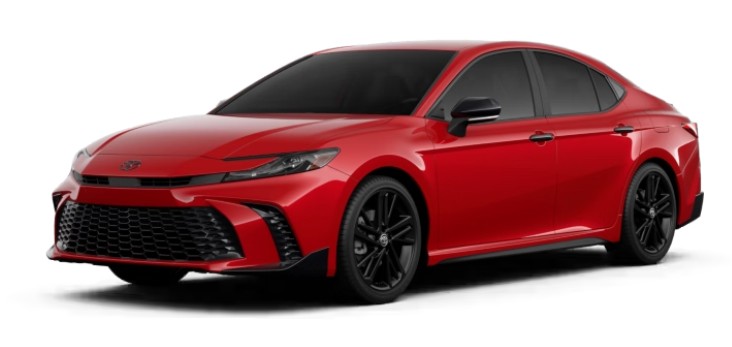
The newer Camry looks lower, sharper, and more athletic than many people expect from a practical family sedan. Its front fascia has a wide, sculpted appearance, while the roofline and body creases make the car seem more energetic.
Sport-oriented SE, XSE, and Nightshade versions add visual drama through larger wheels, darker exterior details, and more aggressive trim. Toyota introduced a Nightshade Edition for 2026 with black badging, black exterior accents, and 19-inch satin-black wheels.
The Camry no longer looks like an appliance wearing license plates. It has found a little swagger.
Chevy Malibu Styling
The Malibu takes a calmer route. Its proportions remain clean and balanced, but the design dates back to an older generation of Chevrolet styling.
That is not necessarily a criticism. Some buyers prefer a car that blends into the background rather than shouting across the parking lot.
The Malibu’s shape is sleek enough to avoid looking clumsy, yet restrained enough for business use, rental fleets, long-distance commuting, or family duty. It wears familiarity like a comfortable jacket.
Which Sedan Looks Better?
The Camry looks fresher and more distinctive. The Malibu looks simpler and less demanding.
We would choose the Camry for visual presence, but shoppers who dislike oversized grilles, sharp details, and sport-inspired styling may appreciate the Malibu’s quieter design.
Engine and Powertrain Comparison
The mechanical difference between these cars is not subtle.
Toyota Camry Hybrid Performance
The current Camry combines a 2.5-liter four-cylinder gasoline engine with Toyota’s hybrid system.
Front-wheel-drive models produce approximately 225 net combined horsepower, while available all-wheel-drive versions deliver up to 232 net combined horsepower. Toyota’s electronic on-demand AWD system uses an additional electric motor to help drive the rear wheels when conditions require extra traction.
This system does not need to be plugged in. The hybrid battery charges through the engine and regenerative braking.
What the Camry Feels Like
The Camry moves away from traffic lights with satisfying urgency because the electric motor provides immediate assistance. Acceleration feels smooth rather than explosive.
The electronic continuously variable transmission does not shift like a conventional automatic. Instead, engine speed rises and falls according to power demand. Some drivers love the seamless feeling. Others miss the physical sensation of gears changing.
For ordinary commuting, the powertrain works brilliantly. It is quiet at low speeds, responsive around town, and efficient in traffic.
Chevy Malibu Turbo Performance
The final Malibu uses a 1.5-liter turbocharged four-cylinder engine producing roughly 163 horsepower. Power travels to the front wheels through a continuously variable transmission.
The Malibu has enough power for daily driving, highway merging, and routine family use. However, it does not feel as energetic as the hybrid Camry.
Press the accelerator hard and the engine works noticeably. The Malibu gets the job done, but it rarely makes the process exciting.
Which Engine Is Better?
The Camry wins comfortably.
It offers:
- More horsepower
- Quicker response
- Better fuel economy
- Available all-wheel drive
- A newer powertrain strategy
- Stronger low-speed electric assistance
The Malibu’s advantage is familiarity. Its turbocharged gasoline engine is conceptually simpler for drivers who do not want a hybrid, although a modern turbocharger and CVT are hardly primitive pieces of machinery.
Fuel Economy: A Decisive Camry Victory
Fuel economy may be the clearest difference in the entire Camry vs Malibu comparison.
Toyota says the 2026 Camry can achieve up to an EPA-estimated 51 mpg combined, depending on trim and configuration.
The Malibu’s gasoline-only powertrain generally returns fuel economy in the high-20-mpg range in combined driving, depending on conditions and specification.
That difference can become substantial over several years.
A Simple Ownership Example
Imagine that we drive 15,000 miles annually.
At 50 mpg, the Camry would use approximately 300 gallons of fuel.
At 30 mpg, the Malibu would consume approximately 500 gallons.
That is a difference of about 200 gallons every year. Multiply that by five years and the Camry could save around 1,000 gallons.
Actual results vary with driving style, temperature, traffic, tire pressure, and trim. Even so, the mathematical direction is obvious: the Camry visits gas stations far less often.
Why the Camry Excels in Traffic
Hybrid systems thrive in stop-and-go conditions because they can:
- Shut off the gasoline engine when appropriate
- Use electric assistance at low speeds
- Recover energy during braking
- Reduce fuel wasted while idling
- Smooth out frequent acceleration
The Malibu behaves like a conventional gasoline sedan. It can be reasonably economical on the highway, but urban congestion exposes the limits of its non-hybrid design.
Ride Comfort and Highway Manners
Both vehicles understand that midsize-sedan buyers generally want comfort before corner-carving drama.
Camry Ride Quality
The Camry feels controlled and composed. Its suspension absorbs ordinary bumps without allowing the body to float excessively.
Sportier trims may ride more firmly, particularly when equipped with larger wheels and lower-profile tires. The trade-off is sharper steering response and a more planted appearance.
Base and comfort-focused trims are generally the better choice for drivers who prioritize quiet commuting.
Malibu Ride Quality
The Malibu’s relaxed ride remains one of its better qualities. It glides over many road imperfections with the soft, easygoing character we expect from an American family sedan.
Its steering is light, and the car feels uncomplicated in parking lots and city streets.
At higher speeds, the Malibu is stable and comfortable, although its cabin isolation and structural refinement do not feel as modern as the newer Camry’s.
Which Is More Comfortable?
The Malibu can feel softer over rough pavement, especially on modestly sized wheels. The Camry feels more polished and better controlled.
Think of the Malibu as a cushioned sofa and the Camry as a supportive office chair. One initially feels softer; the other may keep us more comfortable during a long day.
Handling and Driving Enjoyment
Neither car is a dedicated sports sedan, but one feels more engaged.
Camry on a Curvy Road
The Camry turns into corners with greater confidence. The steering is predictable, body movement is controlled, and the hybrid powertrain provides useful response when accelerating out of bends.
SE and XSE trims sharpen the presentation further, although buyers should not expect rear-wheel-drive sports-car behavior.
The Camry is enjoyable in the way a well-designed everyday tool can be enjoyable. It does what we ask without drama.
Malibu Behind the Wheel
The Malibu prioritizes ease. Its light steering makes it pleasant around town, but the car offers less communication and enthusiasm on winding roads.
Push harder and the Malibu begins to feel like it would rather return to the interstate, select cruise control, and listen to a podcast.
Handling Winner
The Toyota Camry wins for steering response, body control, and powertrain confidence.
The Malibu remains perfectly acceptable for calm drivers, but it does not encourage us to take the scenic route.
All-Wheel Drive and Bad-Weather Confidence
The Malibu is front-wheel drive only.
The Camry offers electronic on-demand all-wheel drive on selected trims. The system can send electric power to the rear wheels when additional traction is needed.
That makes the Camry more attractive for drivers who regularly encounter:
- Snow-covered roads
- Heavy rain
- Slippery hills
- Gravel driveways
- Changing mountain weather
All-wheel drive does not replace appropriate tires. A front-wheel-drive Malibu equipped with quality winter tires may outperform an AWD Camry on unsuitable tires.
Nevertheless, the Camry provides an option the Malibu cannot match.
Interior Quality and Cabin Design
Inside the Toyota Camry
The Camry’s cabin has a more contemporary layout, with a dashboard shaped around the driver and a stronger emphasis on digital displays.
Material quality varies by trim. Lower versions remain practical rather than luxurious, while upper trims introduce more attractive upholstery, larger displays, additional convenience equipment, and decorative surfaces.
The design feels current without burying every function inside a touchscreen. Physical controls remain available for frequently used features, which we appreciate when adjusting settings while moving.
Inside the Chevy Malibu
The Malibu interior is straightforward and spacious, but its age is visible.
The dashboard uses a traditional layout, and the controls are generally easy to understand. That simplicity can be refreshing. We do not need a software tutorial just to change the cabin temperature.
However, several plastics and design elements look less sophisticated than those in newer competitors.
Cabin Winner
The Camry has the more modern, attractive, and technologically advanced cabin.
The Malibu counters with simplicity. A buyer moving from an older vehicle may find its layout immediately familiar.
Passenger Space and Everyday Practicality
Both sedans accommodate five passengers, but comfort depends on seating position and passenger size.
Front-Seat Comfort
The Camry’s front seats provide supportive cushioning and a good range of adjustment. Sport trims may use more pronounced bolstering, while upscale trims focus on softer materials and convenience.
The Malibu also offers comfortable front seating, particularly for relaxed highway driving. Its cabin feels open, and the control layout does not create a steep learning curve.
Rear-Seat Experience
Rear passengers in both cars receive useful legroom, though the experience may vary with front-seat positioning.
The Camry’s sloping roofline can make entry feel slightly lower for tall passengers. The Malibu’s rear seat is reasonably accommodating, but neither car provides the vast space of a large crossover.
For two adults, either rear seat works well. Three adults will quickly become close friends—or bitter rivals.
Trunk Space and Cargo Usefulness
Sedans cannot swallow tall cargo like SUVs, but both provide practical trunks for normal life.
They can handle:
- Grocery bags
- Carry-on luggage
- Strollers
- Backpacks
- Sports equipment
- Small home-improvement supplies
The Malibu has traditionally offered a generously shaped trunk, making it practical for airport runs and family trips.
The Camry’s trunk is also useful, and the hybrid system is integrated without turning the cargo area into an awkward battery storage box.
The difference is unlikely to determine the winner unless a buyer regularly carries unusually bulky items. In that case, an SUV, hatchback, or wagon may be the better answer altogether.
Infotainment and Connectivity
Technology is one area where the Camry’s newer platform becomes obvious.
Camry Technology
Depending on trim, the Camry offers modern touchscreen interfaces, digital instrumentation, smartphone integration, available wireless charging, and upgraded audio options.
The system looks more current and better aligned with what buyers expect from a new vehicle in 2026.
Malibu Technology
The Malibu provides the essential features most drivers use, including a central touchscreen and smartphone compatibility.
Its system is not necessarily difficult or unpleasant. It simply lacks the freshness, screen presentation, and broader feature potential of the Camry.
Technology Winner
The Camry wins.
The Malibu’s simpler system may appeal to buyers who mainly want music, navigation from a connected phone, and a clear reversing-camera display. However, technology-conscious shoppers will find more to explore in the Toyota.
Safety and Driver Assistance
Safety should involve more than counting electronic features, but modern assistance systems can reduce fatigue and help drivers respond to hazards.
The Camry offers Toyota Safety Sense technology, including a collection of collision-warning, braking, lane-assistance, and cruise-control functions. NHTSA selected the 2025 Camry Hybrid for testing under its New Car Assessment Program, while official vehicle-rating information remains searchable through the agency’s database.
The final Malibu includes several available or standard safety technologies depending on trim and equipment, but its older architecture means it does not present the same sense of a recently redesigned safety package.
Important Safety Reminder
Driver-assistance systems do not make a vehicle autonomous. We still need to:
- Watch the road
- Keep our hands ready
- Maintain safe following distances
- Check blind spots
- Adjust speed for conditions
- Use appropriate tires
- Avoid driving while tired or distracted
The Camry offers the more advanced overall safety proposition, but responsible driving remains the feature that matters most.
Reliability and Long-Term Ownership
Toyota has built much of the Camry’s identity around longevity. The model has been used by families, commuters, taxi operators, and fleet buyers precisely because it tends to tolerate heavy use when maintained correctly.
The Malibu can also deliver dependable service, especially when maintenance history is documented. However, used examples vary widely. Former rental cars, neglected fleet vehicles, and high-mileage commuter cars require careful inspection.
Camry Long-Term Advantages
The Camry benefits from:
- Continued production
- A large dealer network
- Strong model recognition
- Broad parts availability
- Established hybrid experience
- Consistent used-market demand
Toyota has sold hybrid vehicles for decades, so the Camry’s electrification is not an experimental first attempt.
Malibu Long-Term Considerations
A Malibu shopper should pay attention to:
- CVT operation
- Turbocharger performance
- Oil-change history
- Cooling-system condition
- Warning lights
- Accident repairs
- Interior wear
- Fleet or rental history
- Outstanding recalls
- Tire wear and alignment
Discontinuation does not mean parts disappear overnight. Chevrolet continues to provide owner support resources, manuals, warranty information, and service guidance for its vehicles.
Still, the Camry offers the safer long-term bet.
Maintenance Costs
The Malibu may appear mechanically conventional, but turbocharged engines and continuously variable transmissions require proper fluid and oil maintenance.
The Camry adds hybrid components, yet it also reduces certain forms of wear. Regenerative braking can lower demand on conventional friction brakes, and the gasoline engine does not need to operate continuously in all situations.
Routine Costs Both Cars Require
Both vehicles still need:
- Engine-oil and filter changes
- Tire rotations and replacements
- Cabin and engine air filters
- Brake inspections
- Cooling-system service
- Alignment checks
- Battery inspections
- Wiper blades and washer fluid
- Suspension and steering checks
The hybrid Camry is not maintenance-free. It simply uses energy differently.
Over time, the Camry’s fuel savings and expected resale strength may outweigh a higher initial purchase price.
Resale Value and Depreciation
The Camry usually benefits from strong name recognition in the used market. Buyers know what it is, mechanics understand it, and dealerships are comfortable selling it.
The Malibu may depreciate more aggressively because:
- It has been discontinued
- Demand for sedans has declined
- Former fleet vehicles can influence used pricing
- Buyers may worry about long-term model support
- The Camry and Accord carry stronger reputations
That depreciation creates both a weakness and an opportunity.
It is bad for someone purchasing a nearly new Malibu at a high price. It may be excellent for someone finding a well-maintained used Malibu at a steep discount.
The Camry is more likely to preserve value. The Malibu may offer more vehicle per dollar at the moment of purchase.
New-Car Price vs Used-Car Value
A direct price comparison is complicated because the Malibu is no longer a continuing new model.
Chevrolet previously advertised the 2025 Malibu with a starting price around $25,800, although actual transaction prices, remaining inventory, incentives, taxes, and dealer charges vary.
The Camry’s hybrid technology and active model status may produce a higher purchase price, especially in well-equipped trims.
When the Camry Is Worth Paying More
Choose the Camry when we value:
- Superior fuel economy
- Newer technology
- Strong resale prospects
- Available AWD
- More horsepower
- Continued production
- Long-term ownership confidence
When the Malibu Is the Smarter Bargain
Choose the Malibu when:
- It costs substantially less
- The vehicle has a clean history
- A mechanic approves its condition
- We drive relatively few miles
- We prefer a traditional gasoline sedan
- Advanced features are not a priority
- The discount outweighs expected resale differences
A cheap car is not automatically a good value. A good value is a car whose condition, price, operating costs, and expected life make sense together.
Which One Is Better for Commuting?
The Camry is the stronger commuter.
Its hybrid system works particularly well in congestion, where repeated braking and low-speed movement allow it to recover and reuse energy.
Drivers who spend hours navigating urban traffic will appreciate:
- Fewer fuel stops
- Quiet low-speed operation
- Smooth acceleration
- Adaptive cruise-control availability
- Modern driver-assistance technology
- Strong efficiency even in city use
The Malibu remains comfortable and easy to drive, but it cannot match the Camry’s fuel-saving ability.
For a 10-mile commute, the cost difference may feel small. For a 70-mile daily round trip, it can become a major part of the ownership calculation.
Which Sedan Is Better for Road Trips?
This category is closer.
The Malibu provides a soft ride, comfortable seats, a practical trunk, and relaxed highway behavior. A well-priced Malibu can be a pleasant long-distance cruiser.
The Camry adds stronger acceleration, better fuel economy, newer safety technology, and fewer fuel stops.
We would choose the Camry for a cross-country trip because it combines comfort with efficiency and passing power. The Malibu remains appealing when purchase price matters more than ultimate fuel savings.
Which Is Better for Families?
The Camry is the more complete family sedan because it offers:
- Current safety technology
- Strong fuel economy
- Useful rear-seat space
- A practical trunk
- Available AWD
- Better resale potential
- Continued manufacturer development
The Malibu can serve a family well, particularly as an affordable used vehicle. However, the Camry gives parents a broader combination of efficiency, technology, and future value.
Which Is Better for First-Time Buyers?
This depends heavily on budget.
A used Malibu may appear tempting because of its lower price. First-time buyers should not focus only on the monthly payment, though. Insurance, fuel, depreciation, maintenance, and repair risk all matter.
The Camry may cost more upfront but could be easier to own over a longer period.
A first-time buyer considering a Malibu should always obtain:
- A vehicle-history report
- A pre-purchase inspection
- A recall check
- Service records
- An insurance quote
- A complete out-the-door price
The same advice applies to a used Camry. A famous badge cannot reverse years of neglect.
Toyota Camry Pros and Cons
Camry Advantages
- Excellent hybrid fuel economy
- More power than the Malibu
- Available all-wheel drive
- Modern cabin technology
- Strong long-term reputation
- Continued production
- Better expected resale value
- Comprehensive safety features
- Smooth city performance
Camry Disadvantages
- Potentially higher purchase price
- Sport trims may ride firmly
- Hybrid driving feel may not suit everyone
- Some trims become expensive with options
- Rear styling and front fascia may divide opinions
Chevy Malibu Pros and Cons
Malibu Advantages
- Potentially attractive used prices
- Comfortable highway ride
- Simple controls
- Practical trunk
- Familiar gasoline-car behavior
- Wide availability on the used market
- Unobtrusive exterior design
Malibu Disadvantages
- Discontinued after 2025
- Lower power output
- No all-wheel-drive option
- Weaker fuel economy
- Older cabin design
- Less advanced technology
- Greater depreciation risk
- Limited remaining new inventory
Toyota Camry vs Chevy Malibu: Who Should Buy Which?
Buy the Toyota Camry When…
We should buy the Camry when we want a sedan to keep for many years, drive substantial annual mileage, or reduce fuel consumption without plugging in.
It is also the stronger choice for buyers who live in areas where AWD is useful or who want the latest convenience and driver-assistance features.
Buy the Chevy Malibu When…
We should consider the Malibu when we find a clean, well-maintained example at a significantly lower price than a comparable Camry.
It works best as a value purchase rather than a head-to-head technological competitor.
The key phrase is significantly lower price. If the Malibu costs nearly as much as the Camry, the Toyota’s efficiency, power, resale potential, and current production status make it the obvious choice.
Final Verdict: Toyota Camry Wins the Comparison
The Toyota Camry wins the Toyota Camry vs Chevy Malibu comparison.
It is more powerful, dramatically more fuel-efficient, available with all-wheel drive, equipped with newer technology, and likely to retain value more effectively. Most importantly, it remains an active model rather than a discontinued one.
The Malibu is not a disaster rolling toward the scrapyard. It remains a roomy, comfortable, straightforward sedan that can provide dependable transportation when purchased carefully.
However, the two cars now occupy different positions.
The Camry is a forward-looking new-car choice. The Malibu is a potentially affordable used-car opportunity.
If prices are close, choose the Camry without hesitation. If the Malibu is thousands of dollars cheaper, has complete maintenance records, and passes an independent inspection, it may be the better short-term value.
Ultimately, the Camry is the stronger car. The Malibu’s best argument is no longer superiority—it is affordability.
Frequently Asked Questions
1. Is the Toyota Camry better than the Chevy Malibu?
Yes, for most buyers. The Camry offers better fuel economy, more horsepower, available AWD, newer technology, stronger expected resale value, and continued production. The Malibu mainly competes by offering a potentially lower used-car price.
2. Is the Chevy Malibu discontinued?
Yes. Chevrolet states that the 2025 model year was the Malibu’s final year. Existing vehicles will continue to receive service and parts support, but no continuing 2026 Malibu lineup exists.
3. Which gets better gas mileage, the Camry or Malibu?
The Camry wins by a wide margin. Toyota advertises up to an EPA-estimated 51 mpg combined for the 2026 Camry, while the gasoline-powered Malibu generally delivers considerably lower combined fuel economy.
4. Does the Chevy Malibu offer all-wheel drive?
No. The Malibu is front-wheel drive. The Camry offers electronic on-demand all-wheel drive on selected configurations, giving it an advantage in rain, snow, and other slippery conditions.
5. Is a used Chevy Malibu still worth buying?
It can be. A used Malibu may represent good value when it is substantially cheaper than a comparable Camry, has a clean maintenance history, and passes an independent inspection. Buyers should account for depreciation, fuel costs, CVT condition, and the model’s discontinued status.
If you want to see other articles similar to Toyota Camry vs Chevy Malibu: Which Midsize Sedan Is Better? you can visit the Compare category.
Ford Bronco Pros and Cons: Complete Buyer’s Guide
2026 Ford Bronco Towing: Capacity, Equipment, and Real-World Limits
Ford Bronco Gas Tank Size: 2026 U.S. Guide
2026 Ford Bronco Big Bend vs Outer Banks: Features and Differences Explained
2026 Ford Bronco Trim Levels in Order: Complete U.S. Guide
Ford Bronco Models Explained for U.S. Buyers
Leave a Reply
Related Topics