
Ford Bronco Quality in the US: Is It Really Built Tough?

Contents in this publication
- What Does Ford Bronco Quality Actually Mean?
- The Modern Ford Bronco’s Build Philosophy
- How Good Is the Ford Bronco’s Exterior Quality?
- Ford Bronco Interior Quality
- Infotainment and Technology Quality
- Ford Bronco Engine Quality
- Transmission Quality
- Suspension and Chassis Quality
- Steering and Braking Quality
- Wind Noise, Road Noise, and Rattles
- Recall History and What It Says About Quality
- Ford Bronco Warranty Coverage in the US
- Early Broncos Versus Newer Models
- How Modifications Affect Bronco Quality
- Ford Bronco Quality Compared With the Jeep Wrangler
- Ford Bronco Quality Compared With the Toyota 4Runner
- Is the Ford Bronco a Good Daily Driver?
- What Owners Can Do to Improve Long-Term Quality
- How to Inspect a Used Ford Bronco
- Who Should Buy a Ford Bronco?
- Who Should Think Twice?
- Overall Ford Bronco Quality Verdict
- Conclusion: Is the Ford Bronco High Quality?
- Frequently Asked Questions
The Ford Bronco returned to the United States with the confidence of a rock star walking back onto the stage. It had heritage, unmistakable styling, removable body panels, serious four-wheel-drive hardware, and enough trim levels to fill a dealership lot with personality.
But attractive styling and off-road capability are only part of the ownership story. Buyers also want to know whether Ford Bronco quality in the US matches the SUV’s rugged image. Does it feel solid? Is it dependable? Are the materials worthy of the price? And, perhaps most importantly, can we trust it after the warranty expires?
The honest answer is nuanced.
The modern Bronco is exceptionally capable and thoughtfully designed for adventure. It can be comfortable enough for daily driving while tackling terrain that would stop an ordinary crossover in its tracks. At the same time, its quality record has included recalls, roof complaints, wind noise, electrical concerns, and some early-production engine problems.
In other words, the Bronco is not a flawless luxury vault. It is more like a high-end multitool: immensely useful, exciting, and cleverly engineered, but full of moving parts that demand realistic expectations.
What Does Ford Bronco Quality Actually Mean?
Vehicle quality is broader than whether an engine starts every morning. When we evaluate the Ford Bronco, we need to separate several categories that buyers often mix together.
Quality includes:
- Material quality
- Assembly consistency
- Mechanical durability
- Electrical reliability
- Ride refinement
- Noise control
- Long-term dependability
- Dealer and warranty support
- Resistance to off-road abuse
- Overall owner satisfaction
A Bronco may score brilliantly in one category and only adequately in another. For example, it can feel extraordinarily capable on a rocky trail while allowing more wind noise into the cabin than a similarly priced conventional SUV.
That distinction matters. The Bronco was designed as a removable-roof, removable-door off-roader. Expecting it to be as quiet and tightly sealed as a fixed-roof luxury crossover would be like expecting hiking boots to feel like bedroom slippers.
The Modern Ford Bronco’s Build Philosophy
Ford did not design the Bronco merely to look adventurous. Beneath the retro-inspired body is a body-on-frame platform created for towing, articulation, durability, and severe terrain.
Unlike most family crossovers, the Bronco uses construction more closely related to a truck. That gives it a tough foundation and helps it withstand twisting forces when one wheel is climbing over a rock while another hangs lower in a rut.
The vehicle is also deliberately modular. Depending on the configuration, owners can remove doors, roof sections, fender flares, and other exterior components. Ford provides accessory-ready switches and numerous mounting possibilities for lights, racks, winches, and trail equipment.
This modularity is one of the Bronco’s greatest strengths, yet it also creates quality challenges. Every removable panel needs seals, fasteners, alignment points, and drainage channels. More joints mean more opportunities for rattles, air leaks, water intrusion, or inconsistent panel fit.
Rugged Construction Versus Luxury Refinement
The Bronco’s structure generally feels substantial. The doors close with reasonable weight, the driving position feels commanding, and the chassis communicates the sturdiness we expect from a purpose-built off-road vehicle.
However, not every surface feels expensive. Many cabin areas use hard plastics chosen for durability and easy cleaning. On lower and midrange trims, this makes practical sense. Mud can be wiped away without treating the interior like fine furniture.
The problem appears when a heavily optioned Bronco reaches premium-SUV pricing. At that level, buyers may reasonably expect softer materials, quieter operation, and more polished switchgear.
The Bronco sometimes asks us to pay for capability rather than elegance.
How Good Is the Ford Bronco’s Exterior Quality?
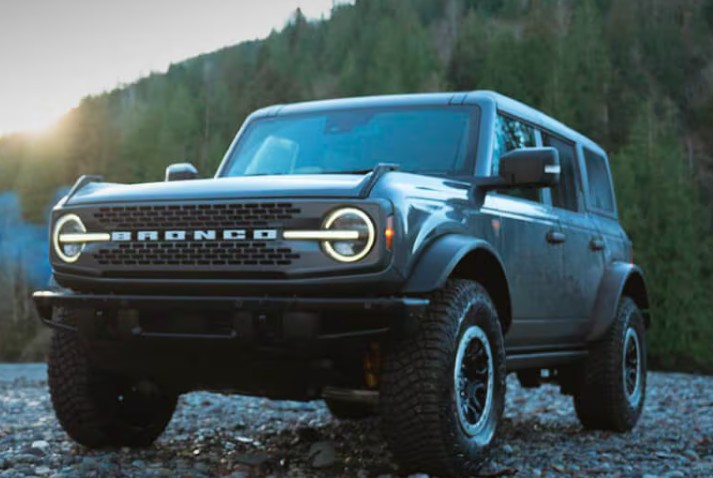
The Bronco’s exterior is one of its strongest attributes. Its upright shape, wide stance, exposed recovery points, round headlights, and short overhangs create a design that looks functional rather than decorative.
Most body components feel appropriate for the vehicle’s intended mission. The squared-off bumpers, protective trim, and easily replaceable fender flares are useful on narrow trails where scratches are almost inevitable.
Body Panel Alignment and Paint Quality
Panel alignment varies somewhat between individual vehicles, especially when removable doors and roof components are involved. Small differences in gaps do not necessarily indicate structural problems, but buyers should inspect a specific Bronco carefully before accepting delivery.
We should examine:
- Door alignment
- Hood gaps
- Tailgate operation
- Fender flare fit
- Roof-panel alignment
- Weather seals
- Paint consistency around hinges
- Chips or scratches from transportation
Paint quality is generally acceptable, although off-road use can quickly expose vulnerable areas. Wide tires may throw stones against doors and rear quarter panels, particularly when aggressive aftermarket setups are installed.
Mud flaps, paint-protection film, and rocker protection can help preserve the finish.
The Removable Roof: Brilliant but Imperfect
The removable roof defines the Bronco experience. Few vehicles can transform from an enclosed commuter into an open-air trail machine so quickly.
Yet the roof has also been a recurring source of owner criticism. Some drivers have reported wind noise, squeaks, rattles, water leakage, seal concerns, and cosmetic irregularities in certain molded hardtops.
Even when everything functions correctly, the cabin is unlikely to be whisper-quiet. The roof consists of multiple sections, and the vehicle’s boxy shape pushes through the air like a refrigerator wearing hiking gear.
That does not automatically mean poor quality. It is partly an unavoidable consequence of the design. Nevertheless, excessive whistling, visible seal damage, water intrusion, or movement between panels should be inspected by a dealer.
How to Inspect a Bronco Roof Before Buying
During a test drive, we should:
- Drive at both city and highway speeds.
- Listen for concentrated whistling near the windshield header.
- Check the headliner and carpeting for moisture.
- Inspect seals for folding, tearing, or poor placement.
- Remove and reinstall roof panels when possible.
- Look for discoloration or rough edges on hardtop surfaces.
- Confirm that all latches engage smoothly.
A ten-minute visual inspection may reveal problems that become irritating during years of ownership.
Ford Bronco Interior Quality
The Bronco’s cabin is designed around usability. Controls are large, major off-road functions are easy to locate, and the dashboard has a broad, upright shape that suits the vehicle.
Grab handles, rubberized surfaces, drain-friendly materials in certain configurations, and washable flooring reinforce its outdoor personality.
Are the Interior Materials Cheap?
Some areas feel durable rather than luxurious. Hard plastics appear on the dashboard, doors, center console, and lower cabin surfaces. They resist scratches reasonably well and are easier to clean than delicate materials.
However, a Bronco can become expensive once larger engines, premium packages, leather upholstery, advanced suspension equipment, and special-edition features are added. At those prices, the abundance of hard plastic becomes harder to ignore.
This is one of the Bronco’s central quality contradictions: the interior works well for its purpose, but it does not always look or feel as expensive as the window sticker suggests.
Seats and Driving Comfort
Front-seat comfort is generally good, particularly for drivers who appreciate an upright posture. Visibility over the hood is helped by the squared body and trail sights mounted near the front corners.
The rear-seat experience depends heavily on body style. Four-door models are far more practical for families, while two-door Broncos prioritize style, maneuverability, and trail proportions over passenger convenience.
Seat materials range from practical cloth and marine-grade vinyl to leather-trimmed options. Marine-grade vinyl is especially appealing for outdoor owners because it suits muddy clothing, wet equipment, and frequent cleaning.
Infotainment and Technology Quality
Modern Broncos offer large displays, smartphone connectivity, available surround-view cameras, trail-oriented camera views, and Ford’s SYNC infotainment system.
The interface is visually modern and usually straightforward. Physical controls remain available for many frequently used features, which is valuable when we are bouncing along a trail or wearing gloves.
Common Technology Frustrations
As with many modern vehicles, occasional issues may involve:
- Frozen screens
- Delayed startup
- Wireless connection interruptions
- Camera display problems
- Software glitches
- Sensor warnings
- Battery-related electronic behavior
Some problems can be resolved through software updates or system resets. Others may require dealer diagnostics.
Technology quality matters especially on the Bronco because so many functions are connected. Cameras, drive modes, locking differentials, driver-assistance systems, and infotainment features all depend on electronic communication.
A minor software fault can make an otherwise mechanically healthy vehicle feel unreliable.
Ford Bronco Engine Quality
The current-generation Bronco has been offered with turbocharged engines designed to deliver strong torque without requiring enormous displacement. Common configurations include a turbocharged four-cylinder and twin-turbocharged V6 options, depending on model year and trim.
The standard turbo four-cylinder provides enough power for everyday driving and offers the availability of a manual transmission in compatible configurations. The larger V6 delivers stronger acceleration and is often preferred by owners adding heavy accessories or oversized tires.
The 2.3-Liter Turbocharged Four-Cylinder
The four-cylinder engine is not merely a budget choice. It produces useful low-end torque and can move the Bronco confidently.
Its advantages include:
- Lower initial cost
- Less front-end weight
- Manual-transmission availability on eligible models
- Adequate performance for most owners
- Potentially lower fuel consumption than larger engines
Because the Bronco is heavy and aerodynamically blunt, no engine turns it into an efficiency champion. Drivers who install large tires, roof racks, armor, or other accessories should expect fuel economy to decline further.
The 2.7-Liter Twin-Turbo V6
The available 2.7-liter V6 offers stronger torque and a more relaxed feel during highway merging, climbing, or carrying additional weight.
However, certain early Ford vehicles equipped with 2.7-liter and related 3.0-liter engines were investigated after reports of intake-valve failures that could cause sudden loss of power. The concern included some 2021 and 2022 Broncos. Ford indicated that a valve design change had been implemented during 2021 production.
This history does not mean every V6 Bronco is defective. It does mean that shoppers considering an early used model should review its production date, service history, recall completion, and remaining warranty coverage.
The Bronco Raptor’s 3.0-Liter V6
The Bronco Raptor uses a more powerful twin-turbocharged V6 and extensive chassis upgrades. It is engineered for high-speed off-road driving rather than merely slow technical trails.
Its quality should be judged in the context of its complexity. Advanced suspension components, wide-track bodywork, large tires, and performance hardware deliver extraordinary ability, but they can also increase maintenance and replacement costs.
A damaged Raptor suspension component will rarely be priced like a basic crossover part.
Transmission Quality
The Bronco has offered both a 10-speed automatic and a seven-speed manual transmission, with availability depending on engine and model configuration.
The 10-Speed Automatic
The automatic provides broad gearing for low-speed control, highway cruising, and acceleration. In normal operation, it may shift frequently because it has so many ratios available.
Some owners interpret frequent shifting as uncertainty, especially at lower speeds. Software adaptation, driving style, tire size, and calibration can influence how smooth the transmission feels.
During a test drive, we should watch for:
- Harsh engagement from Park to Drive
- Delayed acceleration
- Repeated hunting between gears
- Abnormal clunks
- Warning messages
- Fluid leakage
- Shuddering under light throttle
A busy transmission is not necessarily a failing one. A violent or inconsistent transmission deserves investigation.
The Seven-Speed Manual
The manual transmission gives the Bronco old-school charm. Its seven-speed designation includes a crawler gear intended for very low-speed off-road use.
For enthusiasts, this setup makes the Bronco feel more interactive and distinctive. Clutch feel and shift quality should be evaluated carefully on a used vehicle, especially if it has been modified or driven extensively off-road.
Suspension and Chassis Quality
Here the Bronco shines.
Ford chose independent front suspension rather than the solid front axle used by the Jeep Wrangler. This decision improves steering precision, ride comfort, and stability on uneven pavement.
The rear uses a solid axle, preserving durability and articulation where it matters.
On-Road Ride Quality
For a serious body-on-frame off-roader, the Bronco can be surprisingly civilized. It tracks confidently, absorbs broken pavement reasonably well, and feels less nervous than some traditional off-road rivals.
Still, tire choice dramatically changes the experience. A Bronco equipped with large mud-terrain tires may feel louder, heavier, and less precise than one wearing moderate all-terrain tires.
Suspension packages also matter. A standard Bronco, a Sasquatch-equipped model, and a Bronco Raptor may share a family resemblance, but they do not ride or handle identically.
Off-Road Durability
The Bronco’s available hardware can include:
- Low-range four-wheel drive
- Front and rear locking differentials
- Electronic sway-bar disconnect
- Trail-control technology
- Terrain-management modes
- High-clearance suspension
- Underbody protection
- Beadlock-capable wheels
- Advanced position-sensitive dampers
These are not decorative features. They allow the vehicle to climb, crawl, and maintain traction in situations where normal SUVs would struggle.
Mechanical quality is especially convincing when the Bronco is used as intended. Its controls feel purpose-built, its visibility is helpful, and its chassis allows drivers to approach obstacles with confidence.
Steering and Braking Quality
Steering is relatively direct for a tall off-road SUV. It is easier to place on narrow roads and trails than its broad body might suggest.
Braking performance depends on tires, weight, road surface, and configuration. Consumer Reports has criticized the Bronco for long stopping distances in testing, along with elevated wind noise and modest fuel economy.
That is worth considering because aggressive off-road tires may sacrifice some pavement grip. Owners should leave additional following distance, maintain proper tire pressure, and replace worn tires with products suitable for their actual driving habits.
Wind Noise, Road Noise, and Rattles
Noise is one of the most common Bronco quality complaints, but context is essential.
The Bronco has:
- An upright windshield
- Exposed hinges
- Removable doors
- A removable roof
- Large mirrors
- Boxy bodywork
- Available aggressive tires
Every one of those features can generate sound.
At highway speed, wind noise may become prominent around the windshield, mirrors, roof seals, or door frames. Tire roar can also be substantial on models equipped with large off-road tires.
Occasional rattles may emerge as seals age, panels are removed repeatedly, or accessories are installed.
When Noise Indicates a Real Defect
Normal aerodynamic noise is broad and consistent. A defect may produce a sharper whistle, tapping sound, water leak, or vibration from a particular area.
Possible causes include:
- Misaligned roof panels
- Damaged weather stripping
- Loose trim
- Improperly installed doors
- Worn roof latches
- Aftermarket accessory interference
- Loose spare-tire hardware
- Tailgate adjustment problems
We should not accept every sound as “normal for a Bronco.” A rugged vehicle can still have a genuine fitment issue.
Recall History and What It Says About Quality
Recalls do not automatically make a vehicle poor quality. Modern vehicles contain thousands of parts and millions of lines of software, and even respected manufacturers issue safety campaigns.
However, the number, severity, and handling of recalls matter.
In July 2026, Ford announced a U.S. recall affecting approximately 565,000 Bronco and Bronco Raptor SUVs from the 2021 through 2026 model years. The issue involved engine-compartment wiring that could rub against nearby components, potentially exposing wires and increasing the risk of a short circuit or fire. Ford’s remedy involves adding protective sheathing and abrasion-resistant tape.
Ford identified 15 related fire incidents, while no crashes or injuries had been reported at the time of the announcement. The affected population was estimated to have a relatively low defect rate, but owners still need to take the recall seriously.
NHTSA advises owners to check for open recalls using a vehicle identification number rather than assuming every vehicle from a particular year is included. The agency also recommends checking periodically because new campaigns and updates can be issued over time.
Does a Recall Mean We Should Avoid the Bronco?
Not necessarily.
A completed recall can be preferable to an unidentified defect because the manufacturer has acknowledged the problem and provided a repair procedure.
The warning signs are different:
- An owner ignores an open recall
- A dealer cannot document completed repairs
- The vehicle has repeated unresolved warnings
- Damage occurred before the recall remedy
- The SUV has a questionable maintenance history
- Aftermarket modifications complicate repair work
A used Bronco with documented recall completion and careful maintenance may be a better purchase than a neglected vehicle from a theoretically less troublesome model year.
Ford Bronco Warranty Coverage in the US
Ford advertises a three-year or 36,000-mile new-vehicle limited warranty for the 2026 Bronco, subject to the terms and exclusions in its official warranty guide.
Additional powertrain, corrosion, emissions, roadside-assistance, and restraint-system coverage may apply according to the official guide and vehicle specifications.
Buyers should read the warranty rather than relying on a salesperson’s summary. Modifications, misuse, racing, environmental damage, improper maintenance, and unrelated aftermarket failures may not be covered.
Should We Buy an Extended Warranty?
An extended service plan may appeal to owners who plan to keep a Bronco after the factory warranty expires, particularly if the vehicle includes advanced electronics, expensive suspension systems, or numerous convenience features.
Ford offers extended plans with varying levels of component coverage and term limits.
Before buying any plan, compare:
- Deductible
- Covered components
- Exclusions
- Maximum term
- Maximum mileage
- Rental-car provisions
- Towing benefits
- Transferability
- Cancellation rules
- Accepted repair facilities
The most important question is not merely, “How much does it cost?” It is, “What expensive failure would this actually cover?”
Early Broncos Versus Newer Models
First-year vehicles often experience more production and supplier issues because factories, dealers, and engineering teams are still learning how the product behaves in large-scale real-world use.
The reborn Bronco launched for the 2021 model year, making early examples more likely to have experienced initial hardtop concerns, software updates, recalls, or component revisions.
That does not make every 2021 Bronco a poor purchase. Many owners have driven them successfully for years. But a later model may benefit from revised manufacturing procedures and accumulated fixes.
Why Service History Matters More Than Model-Year Rumors
A clean service history tells us more than internet generalizations.
A desirable used Bronco should have:
- Regular oil changes
- Documented recall completion
- No unexplained warning lights
- Matching quality tires
- Evidence of proper differential service when required
- No major underbody impact damage
- No water accumulation inside
- No poorly installed modifications
- Smooth roof and door operation
- Consistent cold-start behavior
An abused late-model Bronco can be worse than a carefully maintained early one.
How Modifications Affect Bronco Quality
The Bronco’s accessory ecosystem is enormous. Owners can add lifts, bumpers, winches, roof tents, lights, steps, racks, armor, larger tires, and performance tuning.
These additions can make the vehicle more useful, but poor modifications are among the greatest threats to long-term quality.
Large Tires and Suspension Changes
Oversized tires add rotating mass and increase stress on:
- Wheel bearings
- Steering components
- Axles
- Brakes
- Suspension joints
- Transmission behavior
- Differential gearing
A well-engineered setup can work properly. A cheap lift combined with extremely heavy tires may create vibration, wandering, accelerated wear, and reduced braking performance.
Electrical Accessories
Auxiliary switches make accessory installation easier, but wiring still needs proper protection, grounding, fusing, and weather sealing.
A badly installed light bar can create more reliability trouble than the factory electrical system ever would.
Roof Racks and Wind Noise
Roof racks, cargo boxes, tents, and light bars disturb airflow. Owners sometimes blame Ford for noise that actually comes from an aftermarket accessory.
Before diagnosing a whistle, temporarily remove external equipment when practical.
Ford Bronco Quality Compared With the Jeep Wrangler
The Bronco and Wrangler are natural rivals. Both offer removable doors, removable roofs, serious four-wheel-drive systems, and vast aftermarket support.
The Wrangler’s solid front axle can provide an advantage in extreme articulation and simplicity. The Bronco’s independent front suspension generally delivers better steering precision and road comfort.
In quality terms, neither vehicle should be mistaken for a silent luxury crossover. Both can produce wind noise, rattles, and compromises related to modular construction.
The Bronco may feel more modern and stable on pavement. The Wrangler offers decades of continuous development and unmatched cultural familiarity.
The better choice depends on whether we value road manners, trail geometry, modification culture, cabin layout, dealer experience, or a particular mechanical configuration.
Ford Bronco Quality Compared With the Toyota 4Runner
The Toyota 4Runner traditionally appeals to buyers prioritizing proven durability and long-term reputation. The Bronco emphasizes modularity, technology, engine performance, and open-air fun.
The 4Runner may feel more conservative. The Bronco feels more experimental and customizable.
A buyer seeking the simplest ownership experience may lean toward Toyota. A buyer who wants removable panels, advanced trail tools, and greater configuration variety may find the Ford more exciting.
Quality is not always about which vehicle has fewer complaints. Sometimes it is about whether the product successfully delivers the experience we purchased it for.
Is the Ford Bronco a Good Daily Driver?
Yes, provided we accept its personality.
The Bronco offers a commanding seating position, useful cargo space in four-door form, modern technology, confident winter traction, and reasonable highway stability.
Its daily-driver disadvantages include:
- Wind noise
- Modest fuel economy
- Wide body dimensions
- Heavy doors and roof panels
- Expensive off-road tires
- Firm or busy ride in some configurations
- Limited rear access in two-door models
- Potential parking difficulty with oversized setups
A Bronco on moderate tires can be pleasantly manageable. A lifted Sasquatch-equipped vehicle with a roof rack and mud-terrain tires may feel far more cumbersome.
What Owners Can Do to Improve Long-Term Quality
Bronco durability depends partly on how we maintain and use it.
Follow Severe-Use Maintenance When Appropriate
Off-roading, towing, dusty conditions, frequent short journeys, and extreme temperatures can require more attentive maintenance than relaxed highway driving.
Owners should inspect fluids, filters, brakes, steering joints, suspension parts, and underbody protection after demanding trips.
Clean It Properly After Off-Roading
Mud is not merely cosmetic. It can trap moisture, block drainage points, hide damage, and collect around suspension or cooling components.
After trail use:
- Rinse the underbody carefully.
- Remove packed mud from wheel wells.
- Inspect skid plates.
- Check brake lines and hoses.
- Look for fluid leaks.
- Examine tires for cuts.
- Clean roof and door seals.
- Confirm that drains remain clear.
Avoid Delaying Small Repairs
A minor roof leak can become damaged carpeting, odor, corrosion, or electronic trouble. A small vibration can become a worn bearing or damaged tire.
Quality is easier to preserve when small symptoms are addressed early.
How to Inspect a Used Ford Bronco
A used Bronco deserves a more specialized inspection than an ordinary crossover.
Exterior Inspection
Check for:
- Misaligned removable panels
- Scratched hinges
- Damaged roof edges
- Cracked fender flares
- Bent recovery points
- Paint damage around accessories
- Tailgate sag
- Loose spare-tire carrier hardware
Underbody Inspection
Look for:
- Dented skid plates
- Scraped differential housings
- Bent suspension mounts
- Damaged exhaust components
- Fluid leaks
- Mud packed into structural cavities
- Corrosion
- Poorly routed aftermarket wiring
Trail scratches are not automatically alarming. Deep impact damage is different.
Mechanical Test Drive
Evaluate the vehicle when cold if possible. Listen for unusual startup noises and confirm that warning lights complete their normal self-check.
Test:
- Four-wheel-drive engagement
- Steering at low and highway speeds
- Braking
- Transmission shifts
- Drive modes
- Cameras
- Differential lockers where safe
- Air conditioning
- Infotainment
- Roof noise
- Window operation
A pre-purchase inspection by a technician familiar with off-road vehicles is strongly recommended.
Who Should Buy a Ford Bronco?
The Bronco is a strong match for drivers who value:
- Genuine off-road ability
- Removable doors and roof panels
- Distinctive styling
- Customization
- Powerful turbocharged engines
- Modern trail technology
- A lively owner community
- Adventure-oriented practicality
It is less suitable for shoppers whose top priorities are silent highway cruising, maximum fuel efficiency, soft-touch cabin materials, or minimal maintenance complexity.
Who Should Think Twice?
We should think carefully before buying one when:
- We rarely leave paved roads
- Wind noise bothers us
- Fuel cost is a major concern
- We want luxury materials above all else
- We dislike tracking recalls and updates
- We need the simplest long-term ownership experience
- We cannot tolerate occasional rattles
- We plan to buy a heavily modified used example without an inspection
The Bronco makes the most sense when its special abilities will actually be used.
Overall Ford Bronco Quality Verdict
Ford Bronco quality in the US is best described as capable but inconsistent.
Its fundamental design is strong. The chassis feels durable, the off-road systems are genuinely useful, the engines deliver healthy performance, and the vehicle offers an experience few SUVs can reproduce.
Yet the Bronco has also faced meaningful quality concerns. Early roof issues, software complaints, wind noise, engine-related investigations, and safety recalls prevent us from calling it an unquestioned reliability leader.
The recent wiring-harness recall covering many 2021–2026 Broncos is especially important for current owners to verify by VIN.
Still, quality is not simply the absence of imperfections. It is also the ability to perform the job for which a vehicle was created. On a trail, with the roof removed and the tires gripping loose earth, the Bronco’s purpose becomes crystal clear.
It is not a polished city shoe pretending to be a boot. It is a real boot—with thick soles, a few rough edges, and mud already waiting at the door.
Conclusion: Is the Ford Bronco High Quality?
The Ford Bronco is high quality in capability, design character, chassis engineering, and off-road functionality. It is more average in cabin refinement, noise isolation, and consistency across individual vehicles.
A carefully inspected, properly maintained Bronco with all recall work completed can be an excellent choice. Buyers should enter ownership with open eyes, realistic expectations, and a willingness to maintain a complex adventure vehicle properly.
We would not recommend buying one solely because it looks rugged. We would recommend it to drivers who understand its compromises and genuinely value what it can do.
That is where the Bronco makes sense. It does not win by being perfect. It wins by making ordinary roads feel like the beginning of a story.
Frequently Asked Questions
1. Is the Ford Bronco considered reliable in the US?
The Bronco has mixed reliability indicators. Many owners report satisfying experiences, but the model has also experienced recalls, software complaints, roof concerns, and some early engine-related issues. Reliability depends heavily on the model year, maintenance history, configuration, and whether recall work has been completed.
2. Which Ford Bronco model years should buyers inspect most carefully?
Early 2021 and 2022 models deserve particularly careful inspection because they were produced during the first years of the revived Bronco and may have encountered early roof, software, or engine-related concerns. However, later vehicles may also be subject to recalls, so buyers should always check the individual VIN.
3. Why is the Ford Bronco so noisy on the highway?
The Bronco’s upright body, large mirrors, removable doors, removable roof, exposed seams, and aggressive tires generate more wind and road noise than a conventional fixed-roof SUV. Some noise is normal, but concentrated whistling, tapping, or water leakage may indicate a seal or alignment problem.
4. Does modifying a Bronco reduce its reliability?
Modifications can reduce reliability when they are poorly engineered or installed. Heavy tires, cheap suspension lifts, improper wiring, performance tunes, and oversized accessories may increase stress on factory components. High-quality parts and professional installation reduce, but do not eliminate, these risks.
5. Is the Ford Bronco worth buying despite its quality concerns?
It can be worth buying for drivers who prioritize off-road performance, removable body panels, styling, and customization. Buyers seeking maximum refinement, quietness, fuel economy, or uncomplicated long-term ownership may be happier with a more conventional SUV.
If you want to see other articles similar to Ford Bronco Quality in the US: Is It Really Built Tough? you can visit the Buying category.
How Does Ford F 150 Hybrid Work? A Clear Guide to PowerBoost Technology
Are Ford F 150 Trucks Reliable? A Real-World Look at America’s Favorite Pickup
Ford F-150 Tire Size: The Complete Guide to Choosing the Right Tires
What questions to ask when buying an engine?
How to avoid buying a stolen engine
Engine compatibility checklist for swaps
Leave a Reply
Related Topics