

Toyota Camry vs RAV4: Which Toyota Fits Your Life?

Contents in this publication
- Toyota Camry vs RAV4 at a Glance
- What Is the Main Difference Between the Camry and RAV4?
- Exterior Design: Sleek Sedan or Confident SUV?
- Interior Comfort and Driving Position
- Passenger Space: Does the RAV4 Feel Bigger?
- Cargo Space and Practicality
- Performance and Power
- Fuel Economy: Camry Takes the Lead
- Ride Quality and Handling
- AWD and Bad-Weather Confidence
- Ground Clearance and Rough-Road Use
- Towing Capacity
- Technology and Infotainment
- Safety Features
- City Driving and Parking
- Highway Driving and Long Trips
- Family Practicality
- Dog-Friendly Practicality
- Purchase Price and Value
- Insurance and Maintenance Costs
- Reliability and Long-Term Ownership
- Which One Is Better for First-Time Buyers?
- Toyota Camry vs RAV4 for Different Drivers
- Pros and Cons of the Toyota Camry
- Pros and Cons of the Toyota RAV4
- Toyota Camry vs RAV4: Which Should We Buy?
- Final Verdict
- Frequently Asked Questions
Choosing between the Toyota Camry and Toyota RAV4 can feel like deciding between a comfortable pair of running shoes and a rugged pair of hiking boots. Both are practical, dependable, efficient, and easy to live with. Yet they approach everyday transportation from completely different angles.
The Camry is a midsize sedan built for smooth commutes, long highway journeys, and impressive fuel economy. The RAV4 is a compact SUV designed around flexible cargo space, a higher seating position, and greater capability when roads or plans become unpredictable.
For 2026, the comparison is particularly interesting because both models lean heavily into electrification. The Camry is exclusively hybrid, while the redesigned RAV4 offers hybrid and plug-in hybrid powertrains. The Camry can achieve up to an EPA-estimated 51 mpg combined, while the RAV4 offers up to an estimated 47 mpg city and 40 mpg highway, depending on configuration.
So, which Toyota should we choose? Let’s compare the Toyota Camry vs RAV4 across performance, comfort, efficiency, cargo space, family practicality, winter driving, towing, ownership costs, and everyday usability.
Toyota Camry vs RAV4 at a Glance
Before we explore the details, here is the basic personality of each vehicle:
| Category | Toyota Camry | Toyota RAV4 |
|---|---|---|
| Vehicle type | Midsize sedan | Compact SUV |
| Powertrain focus | Standard hybrid | Hybrid or plug-in hybrid |
| Best fuel economy | Up to 51 mpg combined | Up to 47 city/40 highway mpg |
| Maximum output | Up to 232 hp | Up to 324 hp in plug-in hybrid form |
| Drivetrain | FWD or AWD | FWD or AWD, depending on trim |
| Cargo advantage | Secure trunk | Large, flexible cargo area |
| Driving position | Lower and more car-like | Higher and more commanding |
| Maximum towing | Not designed around towing | Up to 3,500 pounds |
| Best for | Commuters and highway drivers | Families and active lifestyles |
Toyota lists up to 232 net combined horsepower for the Camry and as much as 37.8 cubic feet of cargo capacity for the RAV4. Properly configured RAV4 models can tow up to 3,500 pounds.
What Is the Main Difference Between the Camry and RAV4?
The main difference is simple: the Camry prioritizes driving comfort and fuel efficiency, while the RAV4 prioritizes versatility and utility.
The Camry sits lower to the ground. Its shape slips through the air more cleanly, its suspension feels composed on pavement, and its trunk keeps luggage hidden from view. It behaves like a traditional family sedan should—quiet, stable, and almost effortless.
The RAV4 sits higher, provides more vertical space, and uses a rear hatch instead of a conventional trunk. That hatch transforms the way we use the vehicle. Groceries, bicycles, camping equipment, pet carriers, flat-pack furniture, and oversized luggage are easier to load.
Neither philosophy is automatically better. The right answer depends on what we carry, where we drive, and how we want to feel behind the wheel.
Exterior Design: Sleek Sedan or Confident SUV?
Toyota Camry Styling
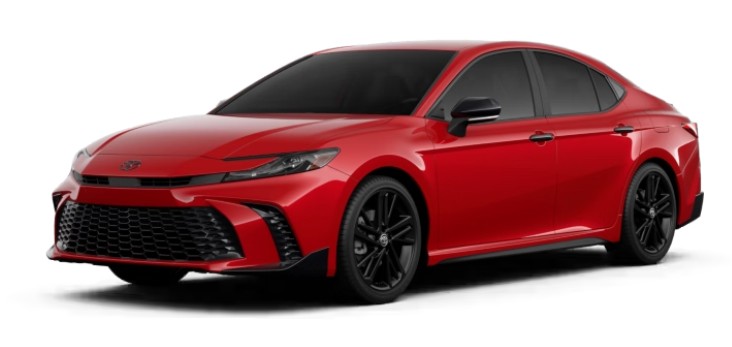
The Camry has moved far beyond the anonymous styling associated with older family sedans. Its modern shape is low, sharp, and athletic. The wide front end and sculpted body give it a more planted appearance than we might expect from an efficiency-focused hybrid.
For 2026, Toyota offers the Camry in LE, SE, Nightshade, XLE, and XSE grades. The Nightshade Edition adds dark exterior details and 19-inch satin-black wheels for drivers who want a more dramatic appearance.
The Camry looks most at home in a business district, suburban driveway, or highway fast lane. It appears polished without shouting for attention.
Toyota RAV4 Styling
The redesigned 2026 RAV4 follows a tougher visual formula. It has a more upright body, a broad stance, and styling themes divided into Core, Rugged, and Sport personalities across the lineup.
That variety gives the RAV4 broader visual appeal. Some versions look clean and urban, while others lean toward outdoor adventure. It is the vehicle we choose when we want practicality to be visible rather than disguised.
Which One Looks Better?
The Camry looks sleeker and more elegant. The RAV4 looks tougher and more adventurous.
Our preference may come down to one question: do we want to glide through the world or stand above it?
Interior Comfort and Driving Position
The Camry Feels More Like a Lounge
The Camry’s lower seating position creates a connected, car-like feeling. We sit closer to the road, stretch our legs forward, and settle into the cabin rather than climbing into it.
This layout tends to work especially well during long highway trips. The sedan’s lower center of gravity reduces body movement through curves, while its aerodynamic body helps limit wind noise. The result is a relaxed atmosphere that feels like a quiet lounge traveling at 70 mph.
Front-seat passengers receive generous room, and the rear seat is suitable for adults. The Camry is not a tiny economy car wearing a larger badge. It is a proper midsize sedan built to transport four adults comfortably.
The RAV4 Offers Easier Access
The RAV4’s seats are positioned higher, which can make entry and exit easier. Instead of dropping down into the cabin, we slide across into the seat.
That difference may sound minor until we regularly transport:
- Young children in car seats
- Older parents or relatives
- Passengers with limited mobility
- Dogs that enter through the rear doors
- Bags that must be lifted from the floor
The higher seating position also improves forward visibility. In busy traffic, the RAV4 can feel less enclosed and more confidence-inspiring.
Which Is More Comfortable?
For smooth pavement and extended highway driving, the Camry generally has the advantage.
For easy entry, visibility, and day-to-day family convenience, the RAV4 is often the better fit.
Passenger Space: Does the RAV4 Feel Bigger?
The RAV4 looks considerably larger because of its taller roof and boxier shape. However, visual size does not tell the entire story.
The Camry uses its long wheelbase efficiently, giving passengers substantial legroom. Rear-seat occupants can sit comfortably without feeling as though their knees are negotiating with the front seatbacks.
The RAV4’s advantage is vertical space. It feels airier, offers more headroom, and gives passengers a more upright seating posture. That shape is especially useful when installing child seats or carrying taller passengers.
Best Choice for Adults
The Camry may surprise us with its spaciousness. Adults who prioritize legroom and ride comfort should not assume the SUV automatically wins.
Best Choice for Families
The RAV4 is usually more convenient for families because its taller doors, elevated seats, and open cargo area simplify everyday routines.
Cargo Space and Practicality
This is where the RAV4 lands its strongest punch.
Toyota lists up to 37.8 cubic feet of cargo capacity behind the RAV4’s rear seats. Fold those seats down and the SUV becomes dramatically more useful for bulky objects.
The Camry has a conventional trunk. It offers useful space for groceries, suitcases, work bags, and sports equipment, but the trunk opening limits the height and shape of items we can carry.
Why the Camry Trunk Still Works Well
The Camry’s enclosed trunk has several advantages:
- Valuables remain hidden
- Road noise from loose cargo stays isolated
- Groceries are less likely to invade the passenger area
- Luggage remains separate from pets and passengers
- The trunk is sufficient for most ordinary errands
Why the RAV4 Cargo Area Wins
The RAV4 is better for:
- Strollers
- Bicycles
- Camping equipment
- Home-improvement supplies
- Large pet crates
- Musical instruments
- Airport trips with multiple passengers
- Weekend adventures involving unpredictable cargo
If we frequently fold seats, carry tall objects, or discover at the store that our purchase is much larger than expected, the RAV4 saves the day.
Performance and Power
Toyota Camry Hybrid Performance
Every 2026 Camry uses a hybrid powertrain. Front-wheel-drive versions produce 225 horsepower, while all-wheel-drive models increase output to 232 horsepower.
Those figures are more than adequate for everyday driving. Electric assistance helps the Camry move away from traffic lights smoothly, while the gasoline engine supports sustained acceleration at higher speeds.
The Camry does not feel like an old-fashioned hybrid that must apologize whenever we press the accelerator. It delivers responsive, predictable power and remains calm during highway merging.
Toyota RAV4 Hybrid Performance
The 2026 RAV4 Hybrid brings stronger utility-focused performance. Toyota’s published information places output at up to 236 net combined horsepower in certain hybrid AWD configurations.
The RAV4 feels energetic enough for family driving, steep roads, and highway travel. Its taller body means it will not feel quite as planted as the Camry, but its power delivery suits its practical mission.
RAV4 Plug-in Hybrid Performance
The RAV4 Plug-in Hybrid changes the conversation entirely. Toyota lists up to 324 net combined horsepower, an estimated 54 miles of electric range on the SE grade, and a claimed 0–60 mph time of 5.4 seconds.
That makes it significantly more powerful than the Camry. It can operate as an electric vehicle for many short journeys, then continue as a hybrid after the battery’s electric range is used.
Performance Winner
The standard RAV4 Hybrid and Camry feel reasonably close in normal driving. The Camry handles more sharply, while the RAV4 provides a stronger sense of utility.
The RAV4 Plug-in Hybrid is the clear acceleration champion.
Fuel Economy: Camry Takes the Lead
Fuel efficiency is one of the Camry’s greatest strengths. Toyota states that the 2026 Camry can deliver up to an EPA-estimated 51 mpg combined. The LE front-wheel-drive grade is rated at 53 mpg city, 50 mpg highway, and 51 mpg combined.
The 2026 RAV4 is also highly efficient for an SUV. Toyota advertises up to an estimated 47 mpg city and 40 mpg highway, while certain configurations reach approximately 43 or 44 mpg combined.
Why the Camry Uses Less Fuel
The Camry benefits from:
- A lower body
- Reduced aerodynamic drag
- Less frontal area
- Lower weight in comparable configurations
- Road-focused tires
- A powertrain calibrated for sedan efficiency
The difference may seem small during one journey, but it can accumulate over years of commuting.
Could the RAV4 Plug-in Hybrid Cost Less to Run?
Potentially, yes.
Drivers who charge at home and complete most daily trips within the RAV4 Plug-in Hybrid’s electric range may use very little gasoline. However, the real cost depends on local electricity prices, charging habits, purchase price, and the length of each journey.
For buyers who do not want to plug in, the Camry is the simpler efficiency champion.
Ride Quality and Handling
Camry: Lower, Smoother, and More Composed
The Camry’s sedan architecture gives it a natural advantage on pavement. It feels stable in crosswinds, secure through sweeping curves, and settled during quick direction changes.
Its steering is straightforward rather than thrilling, but the car responds cleanly. Sport-oriented SE and XSE trims add a firmer personality, while LE and XLE versions focus more heavily on comfort.
The Camry is the better choice for drivers who enjoy the sensation of being connected to the road without sacrificing everyday refinement.
RAV4: Confident but More Upright
The RAV4’s higher center of gravity creates more body movement in corners. That does not make it clumsy; it simply feels like an SUV.
Its strengths appear when pavement becomes uneven. The taller ride height and more practical proportions help it cope with broken surfaces, steep driveways, snow-covered roads, and gravel routes.
Which One Is Better to Drive?
The Camry is the more satisfying road car.
The RAV4 is the more adaptable all-rounder.
AWD and Bad-Weather Confidence
Both vehicles offer all-wheel drive, although the system’s purpose is not to transform either model into a serious off-roader.
Every 2026 Camry trim can be configured with front-wheel drive or Electronic On-Demand AWD.
The RAV4 offers front-wheel drive or all-wheel drive depending on powertrain and grade. Its increased ground clearance and SUV proportions give it an additional advantage in deeper snow, muddy parking areas, and rough access roads.
Camry AWD Is Best For
- Wet highways
- Light or moderate snow
- Cold-weather commuting
- Drivers who want sedan efficiency with extra traction
RAV4 AWD Is Best For
- Snowier climates
- Unpaved roads
- Mountain trips
- Outdoor recreation
- Drivers who regularly face uneven terrain
Tires remain crucial. A front-wheel-drive Camry with excellent winter tires may outperform an AWD vehicle using unsuitable all-season tires. AWD helps us move; good tires help us turn and stop.
Ground Clearance and Rough-Road Use
Ground clearance may not matter during a perfect commute, but real roads are rarely perfect.
The Camry is designed for pavement. It can handle speed bumps, maintained gravel roads, and normal driveways, but we must be more cautious around deep potholes, tall snow, steep entrances, and rocky tracks.
The RAV4 gives us more breathing room beneath the vehicle. That additional clearance reduces the fear of scraping the front bumper or underbody.
The RAV4 is not automatically an off-road vehicle, but it offers a larger safety margin when the road begins to resemble a suggestion rather than a finished surface.
Towing Capacity
This category is straightforward.
The Camry is not intended to serve as a meaningful tow vehicle. Buyers who need to pull trailers should focus on a vehicle designed and rated for that task.
The RAV4 can tow up to 3,500 pounds when properly equipped, although capacity varies by configuration.
That makes the RAV4 suitable for certain:
- Small utility trailers
- Lightweight camping trailers
- Personal watercraft
- Small boats
- Motorcycle trailers
- Light recreational equipment
We must always verify the rating of the exact trim, account for passengers and cargo, and remain within all weight limits.
Technology and Infotainment
Both vehicles belong to Toyota’s modern generation of connected cabins. Available features may include large touchscreens, wireless smartphone integration, digital gauge displays, premium audio systems, wireless charging, and connected services.
The redesigned RAV4 introduces a new generation of Toyota Audio Multimedia and Toyota’s Arene software platform. It also incorporates Toyota Safety Sense 4.0, according to Toyota’s launch information.
The Camry’s technology is integrated into a lower, more driver-focused dashboard. The RAV4’s screen sits in a more upright cabin with storage areas intended for family use.
The difference is less about what the systems can do and more about how the cabins are organized around them.
Safety Features
Both models are designed around Toyota’s suite of active driver-assistance technology. Depending on model and configuration, features may support:
- Automatic emergency braking
- Pedestrian detection
- Lane-departure warning
- Lane-centering assistance
- Adaptive cruise control
- Road-sign recognition
- Blind-spot monitoring
- Rear cross-traffic alerts
No driver-assistance system replaces attention. These features work like an extra set of eyes, not an invisible chauffeur.
The RAV4’s higher seating position may help some drivers feel more aware of surrounding traffic. The Camry’s lower body, however, can feel more stable during emergency maneuvers.
City Driving and Parking
The Camry and RAV4 create different urban experiences.
Why the Camry Works in the City
The Camry’s excellent fuel economy is valuable in stop-and-go traffic. Its hybrid system can recover energy during braking, and the gasoline engine may shut down when power demand is low.
Its lower body also makes it feel composed on multilane roads. However, the sedan is relatively long, and its low seating position may make it harder to judge curbs or see around larger vehicles.
Why the RAV4 Works in the City
The RAV4’s upright driving position improves outward visibility. Its hatchback cargo area is ideal for shopping, and its shape can be easier to judge when reversing.
The SUV may consume slightly more fuel and feel larger in narrow garages, but many urban drivers appreciate its compact footprint relative to larger three-row SUVs.
Highway Driving and Long Trips
The Camry is in its natural habitat on the highway. It tracks straight, uses little fuel, and delivers a relaxed ride. Its lower profile also helps it resist wind and remain quiet at speed.
The RAV4 is still an excellent road-trip vehicle, particularly when we carry several passengers and plenty of luggage. The cabin’s vertical space makes it feel open, and the cargo area swallows equipment that would challenge a sedan trunk.
Choose the Camry for Road Trips When
- Most journeys involve one to four people
- Fuel economy matters more than cargo height
- We prefer a quieter, more planted ride
- We rarely carry bulky equipment
Choose the RAV4 for Road Trips When
- We travel with children, pets, or outdoor gear
- We need to fold the rear seats
- We encounter snow or rough roads
- We may tow a small trailer
- Cargo flexibility matters more than maximum mpg
Family Practicality
The RAV4 is generally the easier family vehicle.
Its elevated rear seat reduces the amount of bending required when securing a child into a safety seat. The wide hatch provides space for strollers, diaper bags, sports gear, and groceries without forcing us to play a real-life game of Tetris.
The Camry can still serve a small family extremely well. It has a comfortable rear seat, a secure trunk, and lower fuel costs. Parents who do not carry bulky equipment may discover that the Camry provides everything they need.
The question is not whether the Camry can handle family life. It can. The question is whether we value the RAV4’s extra flexibility enough to pay for it.
Dog-Friendly Practicality
Dog owners often prefer the RAV4 because pets can travel in the rear cargo area behind the second row, provided they are properly secured and the space is safely ventilated.
The Camry requires dogs to ride in the passenger compartment. That may work well for small or calm pets, but it can be less convenient when muddy paws, wet fur, or large crates enter the equation.
For regular trips to parks, trails, or veterinary clinics, the RAV4 is the stronger choice.
Purchase Price and Value
Pricing varies by trim, drivetrain, options, destination charges, location, and dealer inventory. In general, the Camry tends to provide more efficiency and comfort for the money, while the RAV4 charges a premium for SUV utility and market demand.
A basic Camry may give us many of the features we actually use without paying for extra cargo capacity we rarely need.
The RAV4 can justify its higher cost when it replaces the need for a larger SUV, rental vehicle, or secondary utility car.
The Better Value Depends on Use
The Camry is better value when we prioritize:
- Commuting
- Fuel economy
- Highway comfort
- Sedan handling
- A lower initial price
The RAV4 is better value when we prioritize:
- Cargo space
- Family flexibility
- Ground clearance
- Towing
- Outdoor recreation
- Easier entry and exit
Value is not the lowest number on a window sticker. It is the amount of useful life we receive from every dollar spent.
Insurance and Maintenance Costs
Both models benefit from Toyota’s broad dealer network and widespread availability of replacement parts. Their hybrid systems are designed for mainstream ownership rather than specialist experimentation.
The Camry may be less expensive to operate because it uses less fuel and often wears less costly tires than upper RAV4 trims. Its sedan body can also result in lower purchase and insurance costs, although premiums depend heavily on the driver, location, coverage, trim, and insurer.
The RAV4 may require more expensive tires, particularly on versions with larger wheels. Plug-in hybrid models also contain a larger battery and more complex charging hardware, though they can dramatically reduce gasoline consumption when used correctly.
Always compare insurance quotes for the exact trim before purchasing. Two vehicles with similar prices can produce surprisingly different premiums.
Reliability and Long-Term Ownership
Camry and RAV4 buyers often choose Toyota because they want predictability. Neither vehicle is maintenance-free, but both are positioned as mainstream products designed for high-volume, long-term ownership.
The smartest approach is more important than the badge:
- Follow the maintenance schedule
- Use the correct fluids
- Inspect tires regularly
- Address warning lights promptly
- Keep software and recalls up to date
- Review service history when buying used
- Obtain a pre-purchase inspection
Hybrid batteries should not automatically frighten us. Modern Toyota hybrids have been sold in large numbers for years. Nevertheless, battery condition, warranty coverage, and repair history matter when evaluating an older used example.
Which One Is Better for First-Time Buyers?
The Camry is an excellent first vehicle for drivers who want straightforward controls, low fuel consumption, and predictable road manners.
The RAV4 is better for first-time buyers who expect changing needs. A new job, growing family, outdoor hobby, or upcoming move may make its flexible cargo area more valuable over time.
We should avoid buying more vehicle than we need, but we should also think beyond next Tuesday. The best purchase fits both our current routine and our likely life a few years from now.
Toyota Camry vs RAV4 for Different Drivers
Daily Commuter
Winner: Camry
Its superior fuel economy, stable highway behavior, and comfortable ride make it the stronger commuting tool.
Growing Family
Winner: RAV4
The hatchback cargo area, easier child-seat access, and taller cabin simplify family life.
Frequent Road-Tripper
Winner: Camry for two adults; RAV4 for families
The Camry is efficient and refined. The RAV4 is more useful when luggage, children, pets, or equipment join the journey.
Outdoor Enthusiast
Winner: RAV4
Ground clearance, cargo space, available AWD, and towing capacity give it a decisive advantage.
Budget-Conscious Driver
Winner: Camry
The Camry usually offers lower fuel consumption and may cost less to purchase, insure, and equip with tires.
Performance-Focused Buyer
Winner: RAV4 Plug-in Hybrid
Its output and electric-assisted acceleration place it well ahead of the standard Camry.
Older Driver or Passenger
Winner: RAV4
The higher seat can make getting in and out easier, although individual mobility needs vary.
Driver Who Loves Sedans
Winner: Camry
No SUV can fully duplicate the low, planted, smooth character of a well-designed sedan.
Pros and Cons of the Toyota Camry
Camry Pros
- Excellent hybrid fuel economy
- Smooth and quiet highway ride
- Lower, more stable handling
- Spacious passenger compartment
- Available all-wheel drive
- Secure enclosed trunk
- Usually lower operating costs
- Attractive sedan styling
Camry Cons
- Less cargo flexibility
- Lower ground clearance
- No meaningful towing advantage
- Harder to load tall items
- Lower seating position may not suit everyone
- Less practical for large dogs or bulky hobbies
Pros and Cons of the Toyota RAV4
RAV4 Pros
- Large and flexible cargo area
- Higher seating position
- Easier entry and exit
- Available AWD
- Better rough-road confidence
- Up to 3,500 pounds of towing capacity
- Hybrid and plug-in hybrid choices
- Strong family practicality
RAV4 Cons
- Generally more expensive
- Lower fuel economy than the Camry
- More body movement in corners
- Potentially higher tire and insurance costs
- More road and wind noise than a low sedan
- Plug-in hybrid value depends on regular charging
Toyota Camry vs RAV4: Which Should We Buy?
We should buy the Toyota Camry when our driving life revolves around commuting, highway travel, fuel economy, and paved roads. It is the rational choice for drivers who want a comfortable, efficient vehicle without carrying the visual or financial weight of an SUV.
We should buy the Toyota RAV4 when flexibility matters most. Its cargo area, seating height, ground clearance, available AWD, and towing capability make it easier to adapt when our plans change.
Here is the simplest way to decide:
Choose the Camry if we carry people more often than equipment.
Choose the RAV4 if we carry equipment as often as people.
The Camry is the better road car. The RAV4 is the better life tool.
Final Verdict
The Toyota Camry vs RAV4 debate has no universal winner because these vehicles solve different problems.
The Camry delivers the strongest combination of fuel efficiency, refinement, road manners, and everyday affordability. It turns long commutes into something gentler, almost as if the highway’s rough edges have been sanded down.
The RAV4 trades some of that sedan smoothness for freedom. It lets us bring more luggage, sit higher, travel farther beyond clean pavement, and respond to spontaneous plans without measuring every object before loading it.
For most commuters and value-focused drivers, the Toyota Camry is the smarter purchase.
For families, dog owners, outdoor enthusiasts, and buyers who need maximum flexibility, the Toyota RAV4 is the more practical choice.
The winning Toyota is not the one with the longest feature list. It is the one whose strengths match the shape of our real life.
Frequently Asked Questions
1. Is the Toyota Camry more fuel-efficient than the RAV4?
Yes. The 2026 Camry can achieve up to an EPA-estimated 51 mpg combined, while the RAV4 offers up to an estimated 47 mpg city and 40 mpg highway, depending on configuration. The RAV4 Plug-in Hybrid may use less gasoline during short trips when charged regularly.
2. Is the RAV4 more spacious than the Camry?
The RAV4 is more spacious for cargo because it provides up to 37.8 cubic feet behind the rear seats and allows the second row to fold for larger items. The Camry remains roomy for passengers and may offer competitive legroom, but its trunk is less flexible.
3. Which is better in snow, the Camry or RAV4?
The RAV4 is generally better in deeper snow because of its higher ground clearance and available AWD. The Camry also offers AWD and can perform very well in ordinary winter conditions, especially with suitable winter tires.
4. Can a Toyota Camry tow as much as a RAV4?
No. The RAV4 is the clear choice for towing and can pull up to 3,500 pounds when properly configured. The Camry is not designed around regular trailer towing.
5. Is the Camry or RAV4 better for a family?
The RAV4 is usually better for families because it offers easier child-seat access, a taller cabin, and a more flexible cargo area. The Camry is still an excellent choice for smaller families that prioritize fuel economy, comfort, and lower running costs.
If you want to see other articles similar to Toyota Camry vs RAV4: Which Toyota Fits Your Life? you can visit the Compare category.
Ford Bronco Pros and Cons: Complete Buyer’s Guide
2026 Ford Bronco Towing: Capacity, Equipment, and Real-World Limits
Ford Bronco Gas Tank Size: 2026 U.S. Guide
2026 Ford Bronco Big Bend vs Outer Banks: Features and Differences Explained
2026 Ford Bronco Trim Levels in Order: Complete U.S. Guide
Ford Bronco Models Explained for U.S. Buyers
Leave a Reply
Related Topics