

Toyota Camry Gas Type: What Fuel Should You Use?

Contents in this publication
- What Gas Does a Toyota Camry Take?
- Understanding Octane Ratings
- Does the Toyota Camry Require Premium Gas?
- Toyota Camry Four-Cylinder Gas Type
- Toyota Camry V6 Gas Type
- Toyota Camry Hybrid Gas Type
- Toyota Camry TRD Gas Type
- Can We Use Mid-Grade Gas in a Camry?
- What Happens If We Use Low-Octane Fuel?
- Can a Toyota Camry Use E10 Gasoline?
- Can We Use Diesel in a Toyota Camry?
- How to Choose Quality Gasoline
- Should We Add Fuel-System Cleaners?
- How to Confirm the Correct Toyota Camry Gas Type
- Final Thoughts
- Frequently Asked Questions
Choosing the correct Toyota Camry gas type should be simple, yet many owners still hesitate when they arrive at the pump. Should we use regular gasoline, mid-grade fuel, or premium? Does a Camry Hybrid need a different type of gas? And could using a higher octane rating improve performance or fuel economy?
For most Toyota Camry models, the answer is refreshingly straightforward: regular unleaded gasoline is usually the correct fuel. Most gasoline-powered and hybrid Camry models are engineered to run efficiently on regular fuel, commonly rated at 87 octane in the United States and Canada.
However, octane labels differ between countries, and recommended fuel may vary by model year, engine, and market. That is why we should always check the fuel-door label or owner’s manual before filling the tank.
What Gas Does a Toyota Camry Take?
Most Toyota Camry models use regular unleaded gasoline with an octane rating of 87 AKI or higher. This applies to many Camry sedans equipped with four-cylinder engines, V6 engines, and hybrid powertrains.
Toyota designs the Camry as a practical family sedan, so it makes sense that the vehicle generally does not demand expensive premium fuel. Regular gasoline helps owners control running costs while still receiving the performance, reliability, and fuel efficiency expected from the car.
The basic recommendation is:
- Use regular unleaded gasoline.
- Select at least 87 octane under the AKI system.
- Avoid leaded gasoline.
- Check the owner’s manual for model-specific instructions.
- Use fuel from a reliable service station.
Premium gasoline usually will not harm the engine, but in most Camry models, it is unnecessary.
Understanding Octane Ratings
Octane indicates a fuel’s resistance to premature combustion, often called engine knocking or pinging. It does not measure the fuel’s cleanliness, energy content, or overall quality.
A higher octane rating means the gasoline can withstand more compression before igniting. High-performance engines with turbochargers or very high compression ratios may need premium gasoline to operate correctly.
The Toyota Camry’s engine management system is generally designed around regular fuel. Pouring premium gasoline into a Camry that only requires regular is like buying hiking boots to walk across the living room. They work, but we probably do not need the extra capability.
AKI Versus RON Fuel Ratings
Fuel ratings can become confusing because countries use different measurement systems.
The United States and Canada commonly display AKI, which stands for Anti-Knock Index. Many other countries use RON, or Research Octane Number.
As a general comparison:
- 87 AKI is approximately equivalent to 91–92 RON.
- 89 AKI is approximately equivalent to 93–94 RON.
- 91 AKI is approximately equivalent to 95–96 RON.
- 93 AKI is approximately equivalent to 98 RON.
Therefore, a Camry requiring 87-octane fuel in the United States may use fuel labeled 91 or 92 RON in another country. We should not compare the numbers directly without considering the rating system.
Most Camry models do not require premium gasoline. Regular unleaded is usually enough for normal driving, highway travel, city commuting, and long-distance journeys.
Premium fuel has a higher octane rating, but it does not automatically provide more horsepower. An engine must be specifically designed or calibrated to benefit from higher-octane gasoline.
If the owner’s manual states “87 octane or higher,” premium fuel is optional rather than necessary. The car can operate properly on regular fuel, and paying more for premium may provide little or no noticeable advantage.
In a standard Camry, most drivers will not notice a meaningful performance difference after switching from regular to premium gasoline. Acceleration, throttle response, and cruising behavior will generally remain similar.
Modern engines use sensors and electronic controls to adjust ignition timing and combustion. However, when the engine is optimized for regular gasoline, premium fuel usually does not unlock hidden power.
Some drivers may report smoother operation, but that experience can be subjective. Changes in weather, traffic, fuel formulation, tire pressure, and driving style can all influence how a vehicle feels.
Premium gasoline rarely delivers enough additional fuel economy to recover its higher price in a Camry designed for regular fuel.
Suppose premium costs considerably more per gallon. Even if fuel economy improved slightly, which is not guaranteed, the savings would probably not offset the additional expense.
A better way to improve Camry fuel economy is to:
- Maintain correct tire pressure.
- Avoid rapid acceleration.
- Remove unnecessary cargo.
- Follow the recommended maintenance schedule.
- Drive at consistent speeds.
- Replace a clogged air filter when required.
These habits usually matter more than buying higher-octane fuel.
Toyota Camry Four-Cylinder Gas Type
Most Camry four-cylinder engines use regular unleaded gasoline. These engines are designed to balance power, fuel economy, and everyday reliability.
The four-cylinder Camry is popular because it delivers comfortable performance without excessive fuel consumption. Using the recommended regular fuel allows the engine to operate as intended.
We should avoid assuming that a newer or more powerful engine automatically needs premium gasoline. Even modern Camry engines with advanced fuel injection and high compression ratios may still be engineered to use regular fuel through careful combustion control.
Toyota Camry V6 Gas Type
Many Toyota Camry models equipped with a V6 engine also use regular unleaded gasoline. This may surprise drivers who associate larger engines with premium fuel.
Although the V6 offers stronger acceleration and additional horsepower, Toyota has traditionally positioned the Camry as an accessible, easy-to-own sedan. Requiring premium gasoline would increase operating costs, so many V6 versions remain compatible with regular fuel.
Nevertheless, requirements can vary between years and markets. Owners of older, imported, or performance-oriented Camry versions should confirm the recommendation printed in the manual.
Toyota Camry Hybrid Gas Type
The Toyota Camry Hybrid generally uses the same type of regular unleaded gasoline as the conventional Camry. The hybrid system does not require special gasoline.
A Camry Hybrid combines a gasoline engine with one or more electric motors and a high-voltage battery. Electricity assists the engine, particularly during low-speed driving and acceleration. However, the gasoline portion of the powertrain still depends on ordinary unleaded fuel.
Does the Hybrid Battery Change the Fuel Requirement?
No. The hybrid battery affects how energy is stored and delivered, not the octane rating required by the gasoline engine.
We do not need to buy premium fuel simply because the vehicle is a hybrid. Regular gasoline remains the practical choice unless the owner’s manual specifies otherwise.
The Camry Hybrid achieves strong efficiency through regenerative braking, electric assistance, aerodynamic design, and engine management—not through premium fuel.
Toyota Camry TRD Gas Type
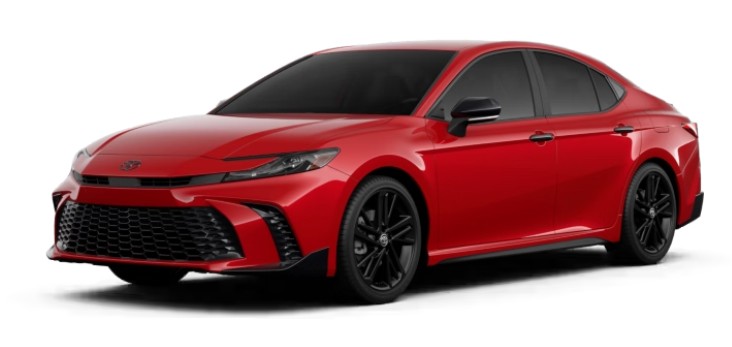
The Camry TRD has sportier styling, suspension tuning, exhaust components, and V6 performance, but it generally does not require premium gasoline in markets where Toyota recommends regular fuel for its engine.
This is an important distinction. A sporty appearance does not automatically mean a car needs high-octane fuel. The TRD may look ready to attack a racetrack, yet its fuel requirements can remain as practical as those of other Camry trims.
Owners should still verify the instructions for their specific model year because equipment and recommendations can change.
Can We Use Mid-Grade Gas in a Camry?
Yes, mid-grade gasoline can normally be used in a Camry that accepts regular fuel. However, it is usually unnecessary.
Mid-grade fuel typically falls between regular and premium in both octane rating and price. It will not generally damage the engine, but it may not provide measurable benefits either.
If regular fuel is unavailable, using a higher grade is normally acceptable. The key rule is that we should not use gasoline with an octane rating below the minimum recommended by Toyota.
What Happens If We Use Low-Octane Fuel?
Using fuel below the recommended octane level may cause knocking, reduced performance, rough operation, or lower efficiency. Modern engine controls can often compensate to some extent, but repeatedly using inadequate fuel is not a good habit.
Possible symptoms include:
- Metallic pinging during acceleration.
- Sluggish response.
- Reduced engine power.
- Lower fuel economy.
- Check-engine warning lights in severe cases.
If the correct fuel is accidentally mixed with a small amount of lower-octane gasoline, the vehicle may continue operating normally. We should drive gently and refill with the proper fuel when possible.
Can a Toyota Camry Use E10 Gasoline?
Many modern Camry models can use gasoline containing up to 10% ethanol, commonly known as E10. This blend is widely sold as standard unleaded gasoline.
Ethanol helps increase octane and reduce reliance on pure petroleum, but it contains less energy per gallon than gasoline. As a result, fuel economy may be slightly lower with ethanol-blended fuel.
Owners should confirm the maximum permitted ethanol content for their vehicle.
Can a Toyota Camry Use E15 or E85?
We should not assume that a Camry can use E15 or E85.
E15 contains up to 15% ethanol, while E85 may contain between approximately 51% and 83% ethanol. E85 is intended for flex-fuel vehicles specifically engineered for high ethanol concentrations.
Most Toyota Camry models are not flex-fuel vehicles. Using E85 in a non-flex-fuel Camry may lead to poor starting, warning lights, reduced performance, or fuel-system problems.
Always follow the ethanol limit stated in the owner’s manual.
Can We Use Diesel in a Toyota Camry?
No. A gasoline-powered Toyota Camry must never be filled with diesel fuel.
Diesel and gasoline operate differently. Putting diesel into a gasoline Camry can prevent the engine from running and may contaminate the fuel system.
If diesel is accidentally added, do not start the engine. Starting the car circulates the incorrect fuel through pumps, injectors, and fuel lines, potentially increasing the repair cost. Contact roadside assistance and have the tank drained professionally.
How to Choose Quality Gasoline
Octane is only part of the equation. Fuel quality also matters.
We should purchase gasoline from busy, reputable service stations with well-maintained storage systems. High customer turnover often means the fuel is replenished regularly.
Quality detergent gasoline can help reduce deposits on injectors and intake components. However, buying premium fuel is not the only way to obtain detergent additives. Many regular gasoline brands contain effective cleaning packages.
Signs of Possible Bad Fuel
Contaminated or poor-quality gasoline may cause:
- Hard starting.
- Engine hesitation.
- Rough idling.
- Sudden loss of power.
- Warning lights.
- Unusual exhaust behavior.
These symptoms can also result from mechanical or electrical faults, so proper diagnosis is important.
Should We Add Fuel-System Cleaners?
A well-maintained Camry using quality gasoline may not need frequent aftermarket fuel additives.
Some cleaners can be useful when recommended by a qualified technician, but adding random products at every fill-up can waste money. Incompatible or excessive additives may also create complications.
Toyota’s maintenance instructions should guide us. If the engine runs smoothly, receives regular servicing, and uses reputable gasoline, the fuel system may already be getting what it needs.
How to Confirm the Correct Toyota Camry Gas Type
The most reliable sources are:
- The fuel-door label.
- The owner’s manual.
- Toyota’s official documentation.
- An authorized Toyota service department.
The manual may also explain ethanol limits, prohibited fuels, fuel-tank capacity, and regional specifications.
This matters because a Camry sold in North America may not have exactly the same specifications as one sold in Europe, Australia, Asia, or Latin America.
Final Thoughts
For most Toyota Camry models, the recommended gas type is regular unleaded gasoline with a minimum rating of approximately 87 AKI, equivalent to roughly 91–92 RON. Premium gasoline is generally safe but unnecessary unless Toyota specifically recommends or requires it for the model.
The smartest approach is not to buy the most expensive fuel at the station. It is to use the correct fuel consistently, maintain the car properly, and follow the instructions for the exact model year.
The Camry was built to make everyday driving uncomplicated. Its fuel requirements follow the same philosophy: regular gasoline, sensible maintenance, and no unnecessary drama at the pump.
Frequently Asked Questions
1. What octane gas does a Toyota Camry use?
Most Toyota Camry models use regular unleaded gasoline rated at 87 AKI or higher. In countries using RON, the equivalent may be around 91–92 RON.
Premium gasoline normally will not damage a Camry designed for regular fuel. However, it usually provides little benefit and costs more.
No. Most Camry Hybrid models use regular unleaded gasoline. The hybrid battery does not create a premium-fuel requirement.
Yes. Mixing regular and premium gasoline is generally safe. The resulting octane level will fall somewhere between the two grades.
5. Where can we find the exact fuel requirement?
Check the owner’s manual and the label inside the fuel door. These sources provide the correct recommendation for the specific model year and market.
If you want to see other articles similar to Toyota Camry Gas Type: What Fuel Should You Use? you can visit the Compare category.
Ford Bronco Pros and Cons: Complete Buyer’s Guide
2026 Ford Bronco Towing: Capacity, Equipment, and Real-World Limits
Ford Bronco Gas Tank Size: 2026 U.S. Guide
2026 Ford Bronco Big Bend vs Outer Banks: Features and Differences Explained
2026 Ford Bronco Trim Levels in Order: Complete U.S. Guide
Ford Bronco Models Explained for U.S. Buyers
Leave a Reply
Related Topics